Subject: GS 2: Polity & Governance
Context: Recently, the Supreme Court has emphasised that solid waste management is a shared civic responsibility, urging Gen Z and Gen Alpha to influence household behaviour while calling for stronger institutional, financial and technological capacity to manage India’s growing waste burden.
Best Online Coaching for UPSC
About Solid Waste Management
Solid Waste Management refers to the systematic collection, segregation, processing, recycling, treatment and safe disposal of solid waste, aimed at protecting public health, the environment and resource security. |
Supreme Court’s Key Observations & Directions
- Shared Responsibility: Waste management cannot be left to sanitation workers alone; households, institutions, local bodies and other waste generators must share responsibility.
- Behavioural Change: The Court observed that law alone cannot create responsible civic behaviour, making awareness and voluntary compliance crucial.
- Students as Change Agents: The Court directed education authorities to integrate theoretical and practical waste-management learning, viewing students as effective instruments for influencing household behaviour.
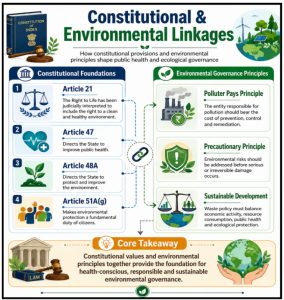 District-Level Enforcement: District Collectors have been emphasised as important actors for coordinating implementation and engaging with households and educational institutions.
- Infrastructure Audit: The Court called for a comprehensive assessment and upgradation of waste-management infrastructure to meet prescribed standards under the Solid Waste Management (SWM) Rules, 2026
- Waste Complexity: Modern waste includes biodegradable, non-biodegradable, hazardous, electronic and construction waste, requiring differentiated treatment.
Key Provision of Solid Waste Management (SWM) Rules 2026
- Waste Generator Responsibility: The Solid Waste Management Rules, 2026 place responsibilities on waste generators for segregation, safe storage and handover of waste.
- Source Segregation: Segregation at source is the foundation for recycling, composting and resource recovery.
- Bulk Waste Generators: Large generators such as gated communities, commercial establishments and bulk waste generators exceeding 100 kg/day are required to process biodegradable waste through mechanisms such as composting or bio-methanation, subject to applicable rules.
- Extended Producer Responsibility: EPR mechanisms place responsibility on producers, brand owners and importers for meeting prescribed collection, recycling and recovery obligations, particularly for plastic packaging and other regulated waste streams.
- Scientific Disposal: Residual and non-recyclable waste should ultimately be directed towards scientific sanitary landfilling, rather than open dumping.
Solid Waste Generation Status in India
- Rising Waste Generation: India generates around 1.70 lakh tonnes/day (TPD) of municipal solid waste, with 92% collection efficiency in 2021–22, as per CPCB.
- Urbanisation Pressure: Rapid urbanisation, population growth and changing consumption patterns are steadily increasing the quantity and complexity of municipal waste.
- Processing Gap: High collection efficiency does not translate into scientific management, with significant gaps in waste processing, recycling, treatment and resource recovery.
- Key Gaps: Persistent challenges include poor source segregation, inadequate processing infrastructure, landfill dependence, weak enforcement and behavioural deficits.
- Environmental Burden: Continued dependence on open dumpsites and landfills contributes to air and water pollution, methane emissions, land degradation and public-health risks.
|
Key Measures for Solid Waste Management
- Circular Economy: Shift from a “take–make–dispose” model towards reduce, reuse, repair, recycle and resource recovery.
- Fiscal Devolution: Strengthen Urban Local Bodies (ULB) own-source revenues, performance-linked grants and rational user charges to create financially sustainable waste systems.
- Informal Sector Integration: Integrate waste pickers through cooperatives, Self-Help Groups and registered organisations, with social security and occupational protection.
- Pune’s SWaCH model now integrates 4,000+ waste pickers, covers about 10 lakh households and recycles/diverts over 82,000 tonnes annually, demonstrating the viability of inclusive urban waste governance.
- Technology & Monitoring: Use GPS/GIS-based collection, digital dashboards and environmental audits to track segregation, collection, processing and landfill use, enabling outcome-based municipal financing.
- Legacy Waste: Adopt biomining, bioremediation and scientific landfill capping to reclaim land and reduce soil, groundwater and air pollution.
Click to Know UPSC Offline Courses
 20 Aug 2026