Subject: GS 3: Agriculture
Context: India’s honey sector is expanding rapidly, but its long-term potential depends on bee health, sustainable apiculture, export diversification, quality upgrading and protection of pollination services that underpin agricultural productivity.
UPSC Coaching Classes
India’s Honey & Apiculture Sector
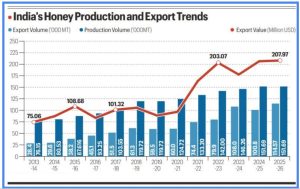
- Honey Production: India’s honey production has nearly doubled from around 76,000 tonnes in 2013-14 to about 1.51 lakh tonnes in 2025-26.
 Global Position: India is the second-largest honey producer globally after China.
-
- India accounts for around 8.4% of global honey exports.
- Export Position: India is among the major global honey exporters and ranked third in export value after China and New Zealand.
- Export Orientation: Around 70% of India’s honey production is exported, highlighting the sector’s strong external-market orientation.
- Export Value: India’s honey exports were worth approximately $208 million in 2025-26.
- Global Bee-Products Market: The global market for bee products was estimated at around $12.7 billion in 2023, creating opportunities for diversification.
- State with Highest Production: Uttar Pradesh is the Indian state with the highest honey production, contributing between 17% and 30% of the country’s total output.
Importance of Honey Bees & Pollination
- Agricultural Productivity: According to the FAO, pollinators contribute to nearly one-third of global crop production and improve yields of 87 out of 115 leading food crops.
- Nutritional Security: Pollination can influence not only crop yields but also the quality and nutritional characteristics of agricultural produce.
- Ecosystem Service: Pollination is a crucial ecosystem service supporting food production, biodiversity and ecosystem functioning.
Government Initiatives & Institutional Support:
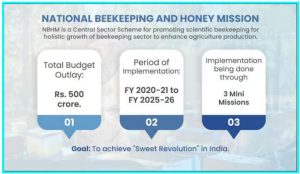
- National Beekeeping and Honey Mission (NBHM): Aims to promote scientific beekeeping, honey production, productivity, quality and market development.
- Scientific Apiculture: Support is provided for improving bee colonies, beekeeping practices, training, processing and infrastructure.
- APEDA: The Agricultural and Processed Food Products Export Development Authority (APEDA) supports agricultural and processed-food exports, including measures related to export quality and market access.
- Testing Infrastructure: Investment in Nuclear Magnetic Resonance (NMR) testing laboratories can strengthen authenticity, quality assurance and compliance with stringent international standards.
- Consumer Awareness: Campaigns such as “Honey for Health” can stimulate domestic consumption while improving awareness about genuine and quality honey.
|
- Indian Agriculture: Bees are particularly important for crops such as mustard, apples, fruits, vegetables and several seed crops, linking apiculture directly with farm productivity.
- Rural Livelihoods: Apiculture provides farmers with an additional source of income through honey, beeswax and other bee products.
Concerns that Need to be Tackled
- Export Concentration: Excessive dependence on a few countries exposes Indian exporters to trade-policy and tariff shocks.
- The United States accounted for nearly 76% of India’s honey exports in 2025-26, creating significant dependence on a single market.
- Quality Deficit: Limited testing and traceability infrastructure can restrict access to premium international markets.
- Low Value Realisation: Heavy reliance on bulk and unbranded exports limits profitability.
- Indian honey reportedly realises around $1,858 per tonne, significantly below the global average and premium products such as New Zealand Manuka honey.
- Fragmented Beekeepers: Small-scale producers often face limited access to technology, finance, processing and organised markets.
- Weak Domestic Demand: Low per-capita consumption leaves significant potential for domestic-market expansion unrealised.
- India’s per-capita honey consumption is only around 37 grams annually, indicating considerable scope for expansion of the domestic market.
- Bee Health: Pesticide exposure, habitat loss, diseases and climate change threaten bee populations and pollination services.
- Compliance Costs: International food-safety and traceability requirements can impose disproportionate costs on small beekeepers and exporters.
Way Forward
- Protect Pollinators: Promote bee-friendly farming, flowering habitats, pesticide management and ecological farming practices.
- Scientific Beekeeping: Expand training in modern hive management, disease control, queen rearing and colony health.
- Quality Infrastructure: Establish more Nuclear Magnetic Resonance (NMR)-capable laboratories, testing centres and traceability systems.
- Value Addition: Shift from bulk exports towards branded, certified, processed and premium honey products.
- Market Diversification: Expand exports across EU, Japan, East Asia and other high-value markets to reduce dependence on a single destination.
- Strengthen Farmer Producer Organisers: Organise beekeepers into FPOs/cooperatives for aggregation, processing, branding and collective bargaining.
- Geographical Indication(GI) Promotion: Develop region-specific floral honey brands with GI recognition and traceable origin.
Click to Know UPSC OnlyIAS Coaching Centres
Conclusion
India’s “Sweet Revolution” must go beyond honey production to pollinator conservation, combining scientific apiculture, bee-friendly farming, quality testing, value addition and export diversification to safeguard food security, farmer incomes and biodiversity.
 20 Aug 2026