Subject: GS 2: Polity & Governance
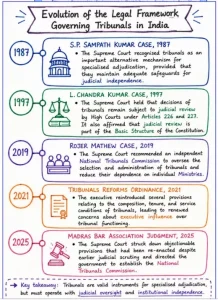
Context: Recently, Parliament passed the Tribunal Reforms Bill, 2026, which seeks to reform the administration of tribunals and establish the National Tribunals Commission (NTC) as a central institutional mechanism for their administration.

IAS coaching

- It repeals the Tribunals Reforms Act, 2021, thereby seeking to bring the statutory framework in line with the Supreme Court’s judicial pronouncements.
- The legislation is significant because tribunals have historically faced concerns regarding executive control, particularly when the Ministry administering a tribunal is also a party whose decisions may come under its scrutiny.
Key Provisions of the Tribunal Reforms Bill, 2026
- National Tribunals Commission: The Bill provides for the establishment of the National Tribunals Commission (NTC) to oversee the administration of tribunals.
- Composition of the NTC: The NTC is headed by a former Supreme Court Judge or Chief Justice of a High Court, appointed in consultation with the Chief Justice of India (CJI), along with judicial and technical members.
Age and Tenure: Tribunal Chairpersons can serve up to 70 years, while Members can serve up to 67 years, subject to a five-year tenure.
- Five-Year Tenure: The Bill restores a five-year tenure for tribunal members, providing greater institutional stability and continuity.
- Uniform Service Conditions: It provides for uniform service conditions for members of tribunals, thereby promoting greater consistency in their functioning.
- National Tribunals Data Grid: The Bill proposes a National Tribunals Data Grid to facilitate systematic collection and management of information relating to tribunal functioning, including cases and pendency.
- Protection of Pending Appointments: The Bill ensures that appointments already pending are not disrupted during the transition to the new framework.
- Search-cum-Selection Committee: For each vacancy, the Search-cum-Selection Committee, headed by the National Tribunals Commission (NTC), recommends one primary candidate and one waiting-list candidate. The Central Government is required to complete the appointment within three months.
Significance of Tribunal: (UPSC CSE Mains 2018)

- Specialised Justice: Tribunals bring specialised expertise into dispute resolution. For instance, environmental disputes before the National Green Tribunal often involve complex questions relating to ecology, pollution, and environmental regulation.
- Speedy Disposal of Cases: Effective tribunals can provide quicker resolution of specialised disputes and help reduce the pendency burden on constitutional courts.
- Administrative Uniformity: A central institutional framework can reduce differences in the administration, service conditions, and functioning of different tribunals.
- Improved Tribunal Governance: The National Tribunals Data Grid can support evidence-based assessment of vacancies, pendency, disposal rates, and institutional performance.
- Greater Institutional Independence: An independent NTC can potentially reduce the dependence of tribunals on the Ministries whose decisions they may be required to scrutinise.
- Strengthening Access to Justice: By providing specialised forums closer to the nature of the dispute, tribunals can make justice more accessible and efficient for citizens, businesses, and public employees.
Challenges that need to be Addressed
- Limited Autonomy of the NTC: The Central Government continues to retain substantial influence over the appointment, finances, and administration of the NTC, raising concerns about its functional independence.
- Excessive Executive Delegation: Section 14 leaves important matters such as qualifications, selection, salaries, allowances, and service conditions of tribunal members to future executive rules.
- This is significant because the Supreme Court in Rojer Mathew emphasised that determining who is qualified to exercise judicial power is an essential legislative function.
- Ministry-Based Screening of Complaints: Under Section 16, a Ministry initially screens complaints against tribunal members before they are forwarded to the NTC for inquiry. This could create a potential conflict of interest where the concerned Ministry is itself involved in disputes before the tribunal.
- Executive Influence over NTC Members: If the government retains significant powers over the appointment and removal of NTC members, the Commission may not be sufficiently insulated from executive influence.
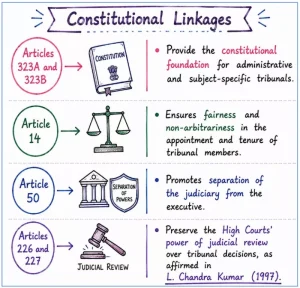
- Risk to Separation of Powers: Tribunals exercise judicial functions, but excessive executive control over their administration can blur the distinction between judicial and executive functions.
- Vacancies and Pendency: Even with institutional reforms, persistent vacancies, inadequate infrastructure, and case pendency can undermine the effectiveness of tribunals.
Way Forward
- Ensure Genuine Autonomy of the NTC: The NTC should enjoy adequate functional, administrative, and financial autonomy so that it can operate independently of the executive.
- Adopt an Independent Selection Process: Appointment of NTC members should follow a transparent, merit-based, and independent mechanism with meaningful judicial participation.
- Limit Executive Rule-Making: Essential matters relating to qualifications, tenure, appointments, and service conditions should be clearly prescribed by Parliament rather than being excessively delegated to the executive.
- Ensure Independent Disciplinary Mechanisms: Complaints against tribunal members should be examined through a transparent and impartial mechanism without allowing the concerned Ministry disproportionate influence.
- Strengthen Infrastructure and Human Resources: Adequate judicial members, technical members, staff, digital infrastructure, and regional benches are necessary to address pendency and improve accessibility.
- Use Data for Performance Monitoring: The National Tribunals Data Grid should be used to monitor vacancies, case pendency, disposal rates, and delays while maintaining appropriate safeguards for data protection.
Click to Know UPSC Coaching Centres in India
Conclusion
The Tribunal Reforms Bill, 2026 can strengthen specialised justice, but its success depends on ensuring the NTC’s independence from executive influence while upholding judicial independence and accountability.