UPSC PYQs

Prelims, Mains & Optional PYQs

UPSC Notes

Comprehensive & Short Notes

Pichavaram Mangrove Forest: TEV, Ecosystem Services & Blue Carbon

3 Sep 2026

Pichavaram Mangrove Forest: TEV, Ecosystem Services & Blue Carbon

Subject: GS 3: Environment 

Context: A recent study has estimated the Total Economic Value (TEV) of the Pichavaram Mangrove Forest in Tamil Nadu at ₹2,485.38 crore, highlighting the significant ecological, economic and social benefits provided by mangrove ecosystems.
UPSC Coaching Classes

About Pichavaram Mangroves

Pichavaram Mangrove Forest

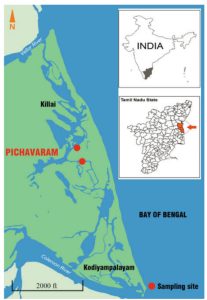
  • Location: Pichavaram Mangrove Forest is located in Tamil Nadu, near Chidambaram, along the Bay of Bengal coast.
  • Conservation & Protection Status of Pichavaram: Pichavaram is both a Reserve Forest and Ramsar Site, but not a National Park or Wildlife Sanctuary.
    • Reserve Forest: Pichavaram Mangrove Forest was declared a Reserve Forest in 1987 under the Tamil Nadu Forest Department.
    • Ramsar Site: Designated as a Wetland of International Importance in 2022 under the Ramsar Convention.
    • Conservation Initiative: Tamil Nadu has proposed a Mangrove Conservation Centre at Pichavaram to promote conservation and public awareness.
  • Ecosystem: It is one of India’s important coastal wetland and mangrove ecosystems, supporting rich biodiversity and local livelihoods.
  • Ecosystem Services: Mangroves provide provisioning, regulating, supporting and cultural services.
    • Ecosystem Services refers to the benefits provided by ecosystems to human beings, including provisioning, regulating, supporting and cultural services.
  • Blue Carbon: The ecosystem acts as an important natural carbon sink, with a substantial proportion of carbon stored in its sediments.
  • Livelihoods: The mangrove ecosystem supports coastal communities through fisheries and other livelihood activities.

About Mangroves

  • Mangroves are salt-tolerant trees and shrubs that grow mainly in intertidal coastal areas, particularly in tropical and subtropical regions.
    • They commonly occur in estuaries, tidal creeks, lagoons, deltas and sheltered coastlines.
  • Mangrove Cover & Distribution in India: ISFR 2023
    • Total Cover: India has 4,991.68 sq. km of mangrove cover, about 0.15% of its geographical area.
    • Major States: West Bengal, Gujarat and Andaman & Nicobar Islands have the highest mangrove cover.
    • Distribution: Mangroves are found in 9 coastal States and 3 Union Territories:
      • States: West Bengal, Gujarat, Andhra Pradesh, Maharashtra, Odisha, Tamil Nadu, Goa, Karnataka and Kerala.
      • Union Territories: Andaman & Nicobar Islands, Puducherry and Daman & Diu.
  • Key Characteristics: 
    • Adaptations: They possess specialised adaptations such as pneumatophores (breathing roots), prop roots and salt-exclusion or salt-excretion mechanisms that enable survival in saline and waterlogged conditions.
    • Nursery Grounds: Mangrove ecosystems provide breeding and nursery habitats for fish, crabs, shrimp and other aquatic species.
    • Coastal Protection: Their dense root systems help reduce wave energy, coastal erosion and storm impacts.
    • Carbon Storage: Mangroves capture and store significant amounts of carbon in both vegetation and waterlogged sediments, making them important blue carbon ecosystems.

Significance of Mangroves

  • Climate Mitigation: Mangroves act as important carbon sinks and contribute to climate-change mitigation.
  • Disaster Risk Reduction: They provide a natural defence against coastal erosion, cyclones, storm surges and flooding.
  • Biodiversity: They support diverse marine, terrestrial and avian species.
  • Livelihood Security: Fisheries and other mangrove-dependent activities provide income and food security to coastal communities.
  • Climate Adaptation: Mangrove conservation is an important nature-based solution for strengthening coastal resilience.
  • Policy Relevance: Economic valuation can support the integration of mangroves into Natural Capital Accounting, Green GDP, blue-carbon finance, carbon-credit programmes and Payment for Ecosystem Services (PES) schemes.
    • Natural Capital is the stock of natural resources and ecosystems that provides benefits and services to society.
    • PES is a mechanism through which those who benefit from ecosystem services provide payments or incentives to those who conserve or maintain them

Click to Know UPSC OnlyIAS Coaching Centres

Check Out UPSC CSE Books

Visit PW Store

online store 1

Pichavaram Mangrove Forest: TEV, Ecosystem Services & Blue Carbon

Need help preparing for UPSC or State PSCs?

Connect with our experts to get free counselling & start preparing

Free Counselling for UPSC Aspirants

Connect with our experts and take the right next step.

Expert Guidance
Personalized Strategy
100% Free

Book Your Free Session

NEED ASSISTANCE?

Request a Callback

Our counsellor will connect with you and help you choose the right course and centre.

  • Expert Guidance
  • Course & Fee Information
  • Quick Callback Support

Request a Callback

Books
UPSC PYQs
UPSC Notes
Current Affairs
Quick Revise Now !
AVAILABLE FOR DOWNLOAD SOON
UDAAN PRELIMS WALLAH
Comprehensive coverage with a concise format
Integration of PYQ within the booklet
Designed as per recent trends of Prelims questions
हिंदी में भी उपलब्ध
Quick Revise Now !
UDAAN PRELIMS WALLAH
Comprehensive coverage with a concise format
Integration of PYQ within the booklet
Designed as per recent trends of Prelims questions
हिंदी में भी उपलब्ध

<div class="new-fform">


    </div>

    Subscribe our Newsletter
    Sign up now for our exclusive newsletter and be the first to know about our latest Initiatives, Quality Content, and much more.
    *Promise! We won't spam you.
    Yes! I want to Subscribe.