UPSC PYQs

Prelims, Mains & Optional PYQs

UPSC Notes

Comprehensive & Short Notes

UNEP’s Limiting Overshoot Report: Managing Global Warming Beyond 1.5°C

3 Sep 2026

UNEP’s Limiting Overshoot Report: Managing Global Warming Beyond 1.5°C

Subject: GS 3: Environment 

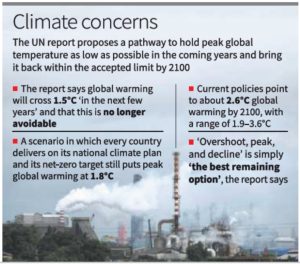
Context: The UNEP’s Limiting Overshoot report warns that global temperatures are likely to temporarily exceed 1.5°C, and proposes an “overshoot, peak and decline” pathway to bring temperatures back below the threshold by 2100

  • Its diplomatic basis was established at COP30, Belém, through the “Global Mutirão” decision.

Best Online Coaching for UPSC

Background of the 1.5°C Goal

  • Origin: The 1.5°C goal emerged from growing scientific evidence that limiting global warming would significantly reduce climate-related risks, particularly for vulnerable countries and ecosystems.
  • Small Island States: During the early 2010s, Alliance of Small Island States (AOSIS) and other vulnerable countries strongly advocated for a 1.5°C limit, arguing that warming of 2°C could threaten their survival through sea-level rise, extreme weather and ecosystem loss.
  • Paris Agreement, 2015: The 1.5°C goal was formally incorporated into the Paris Agreement. Countries agreed to:
    • Hold the increase in global average temperature to well below 2°C above pre-industrial levels.
    • Pursue efforts to limit warming to 1.5°C.
  • Scientific Strengthening: The Intergovernmental Panel on Climate Change (IPCC) Special Report on Global Warming of 1.5°C (2018) highlighted that the risks associated with 1.5°C are substantially lower than those at 2°C, particularly for sea-level rise, extreme heat, coral reefs and biodiversity.
  • Why 1.5°C matters: It is therefore not considered a completely “safe” threshold. Rather, it represents a critical risk-limitation target beyond which climate impacts are expected to become progressively more severe.

Key Highlights of the Report

  • Unavoidable Threshold Breach: Current global policies put the world on track for a 2.6°C temperature rise by 2100. 
    • Even if every nation fulfills its existing Nationally Determined Contributions (NDCs) and net-zero targets, peak warming will still hit 1.8°C.
  • UNEP’s Limiting Overshoot ReportThe “Overshoot, Peak and Decline” Strategy: Designed as a policy roadmap, this model focuses on keeping the peak temperature as low as possible and minimizing the duration spent above 1.5°C before actively pulling temperatures back down using carbon removal interventions.
  • Compounding Costs of Delay: Every 5 additional years of continued high emissions adds approximately 0.1°C to peak warming. Removing that same 0.1°C later requires extracting roughly 220 billion tonnes of carbon dioxide (CO2) from the atmosphere.
  • Mandatory Carbon Removal: Emission cuts alone are no longer sufficient. The framework requires scaling up nature-based carbon removal (such as large-scale reforestation) alongside direct technological removal to complement deep emission reductions.
  • Targeting Methane for Immediate Cooling: Methane contributes approximately 0.5°C to current global warming
    • Cutting 60–70 million tonnes of anthropogenic methane emissions from agriculture and waste management by 2050 provides a cooling benefit equal to pulling 220 billion tonnes of CO2 out of the atmosphere.

About United Nations Environment Programme (UNEP): (UPSC CSE Prelims 2021)

  • Establishment: Founded in 1972 as a direct outcome of the Stockholm Conference on the Human Environment.
  • Headquarters: Nairobi, Kenya (serving as the first global United Nations agency based in the Global South).
  • Core Mandate: Acts as the principal authority on global environmental issues. It sets the global environmental agenda, assists developing nations in implementing environmentally sound policies, and monitors planetary health.
  • Key Flagship Reports:
    • Emissions Gap Report (evaluates the gap between national climate pledges and required emission cuts).
    • Adaptation Gap Report (tracks progress and funding needed for global climate adaptation).
    • Global Environment Outlook (GEO).
  • The Common Carbon Metric, developed under the UNEP Sustainable Buildings and Climate Initiative, is used to measure and compare carbon emissions from building operations, particularly energy use. 

Implications of Crossing the 1.5°C Threshold for India

  • Vulnerability to Climate Extremes: India faces acute risks from melting Himalayan glaciers, intense heatwaves, erratic monsoons, and a projected 14% drop in agricultural yield by 2050 if adaptation measures are insufficient.
  • Methane Diplomacy Pressures: Over 155 countries have signed the Global Methane Pledge to cut emissions by 30% by 2030
    • India remains outside this pledge due to concerns over protecting smallholder farmers, as the majority of domestic methane stems from livestock and paddy cultivation.
  • Escalating Adaptation Needs: As global temperatures cross the target threshold, India will require substantial increases in climate-resilient infrastructure funding and enhanced disaster risk reduction programs.

UPSC Course Fees Online

Key Challenges

  • Irreversible Ecological Tipping Points: Exceeding 1.5°C even temporarily creates severe risks of permanent loss, including coral reef collapse, accelerated glacier retreat, and irreversible sea-level rise.
  • Geopolitical Volatility: Major historical emitters stepping back from international climate treaties (such as the US exiting the Paris Agreement, UNFCCC, and the Green Climate Fund) alongside West Asian energy supply shocks risk driving nations back to short-term coal reliance.
  • Uncertain Scale of Carbon Removals: Relying heavily on future carbon dioxide removal creates a moral hazard. Current carbon removal capacity remains limited and cannot reliably bring temperatures down if peak warming significantly exceeds 2°C.

Way Forward

  • Prioritize Immediate Deep Mitigation: Treat overshoot management strictly as an emergency measure, preventing it from being used as a justification to delay the transition away from fossil fuels.
  • Deploy Agri-Waste Methane Solutions: India can implement low-cost domestic solutions—such as alternate wetting and drying in rice fields, improved livestock nutrition, and biogas generation from agricultural waste—to curb methane without sacrificing food security.
  • Mobilize Global Climate Finance: Ensure developing countries obtain direct access to the Loss and Damage Fund along with dedicated grants for climate adaptation.
  • Multilateral Leadership: Utilize platforms like the G20 and BRICS to enforce technology sharing for carbon removal and maintain international consensus despite geopolitical divisions.

Click to Know UPSC Coaching Centres in India

Conclusion

UNEP’s report provides an undeniable reality check for global climate planning. While an overshoot period is now virtually inevitable, preventing long-term ecological collapse depends on translating civilizational goodwill into immediate methane reductions, rapid renewable energy scaling, and strong climate adaptation frameworks.

Check Out UPSC CSE Books

Visit PW Store

online store 1

UNEP’s Limiting Overshoot Report: Managing Global Warming Beyond 1.5°C

Need help preparing for UPSC or State PSCs?

Connect with our experts to get free counselling & start preparing

Free Counselling for UPSC Aspirants

Connect with our experts and take the right next step.

Expert Guidance
Personalized Strategy
100% Free

Book Your Free Session

NEED ASSISTANCE?

Request a Callback

Our counsellor will connect with you and help you choose the right course and centre.

  • Expert Guidance
  • Course & Fee Information
  • Quick Callback Support

Request a Callback

Books
UPSC PYQs
UPSC Notes
Current Affairs
Quick Revise Now !
AVAILABLE FOR DOWNLOAD SOON
UDAAN PRELIMS WALLAH
Comprehensive coverage with a concise format
Integration of PYQ within the booklet
Designed as per recent trends of Prelims questions
हिंदी में भी उपलब्ध
Quick Revise Now !
UDAAN PRELIMS WALLAH
Comprehensive coverage with a concise format
Integration of PYQ within the booklet
Designed as per recent trends of Prelims questions
हिंदी में भी उपलब्ध

<div class="new-fform">


    </div>

    Subscribe our Newsletter
    Sign up now for our exclusive newsletter and be the first to know about our latest Initiatives, Quality Content, and much more.
    *Promise! We won't spam you.
    Yes! I want to Subscribe.