UPSC PYQs

Prelims, Mains & Optional PYQs

UPSC Notes

Comprehensive & Short Notes

Project Cheetah: Kuno National Park, Cheetah Cubs & Population Recovery

19 Sep 2026

Project Cheetah: Kuno National Park, Cheetah Cubs & Population Recovery

Subject: GS 3: Environment

Context: Recently, an India-born female cheetah, KGP12, has given birth to four cubs at Kuno National Park (KNP), Madhya Pradesh, taking India’s cheetah population to 56 and marking progress towards establishing a self-sustaining population.
UPSC Online Coaching

Key Highlights

  • New Litter: KGP12, an India-born female and daughter of South African cheetah Gamini, has given birth to four cubs in Kuno.
  • Population Milestone: India’s cheetah population has reached 56, comprising 36 India-born and 20 African-origin cheetahs.
  • Current Distribution: 53 cheetahs are in Kuno, while three adults are housed in Gandhi Sagar Wildlife Sanctuary, Madhya Pradesh.
  • Recent Translocation: Nine cheetahs—six females and three males—were brought from Botswana in February 2026, marking the latest intercontinental transfer under Project Cheetah.
  • Habitat Expansion: Veerangana Durgavati Tiger Reserve is being prepared as another potential cheetah habitat.

Its Significance

  • Second-Generation Breeding: Birth of cubs to an India-born cheetah indicates movement beyond the initial translocation phase towards natural population growth in India.
  • Adaptation: Successful reproduction is an important indicator of the species’ adaptation to Indian ecological conditions.
  • Population Recovery: Continued breeding is necessary to establish a viable and self-sustaining population.
  • Ecosystem Restoration: Cheetah reintroduction is associated with conservation of grassland and open-forest ecosystems and their biodiversity.

About Project Cheetah

  • Objective: To establish a viable and self-sustaining cheetah population in India through reintroduction, habitat management and scientific monitoring.
  • Launch: Project Cheetah was launched in September 2022, with the first batch of cheetahs translocated from Namibia to Kuno National Park.
  • Source Countries: Cheetahs have subsequently been translocated from South Africa and Botswana.
  • Landscape Approach: The programme seeks to establish a metapopulation across multiple suitable habitats, rather than concentrating animals at one location.
  • Monitoring: Cheetahs are monitored through radio/GPS collars, field surveillance, veterinary care and ecological assessments.

UPSC Coaching Classes

About Kuno National Park

Project Cheetah

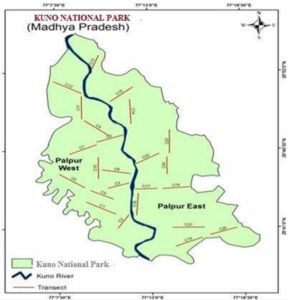
  • Location: Situated in Sheopur district of Madhya Pradesh, Kuno lies within the Kuno River basin and forms part of the Kuno Wildlife Division.
  • Protected Area: It was initially notified as a wildlife sanctuary in 1981 and subsequently upgraded to a National Park in 2018.
  • Landscape: The park comprises dry deciduous forests, grasslands, scrublands and riverine habitats, providing suitable conditions for cheetahs and their prey.
  • Project Cheetah Site: Kuno was selected as the primary site for cheetah reintroduction because of its suitable habitat, prey availability and relatively low human pressure.
  • Prey Base: Important prey species include chital, sambar, nilgai, wild pig and chinkara, supporting a diverse carnivore community.
  • Landscape Connectivity: Its larger landscape provides scope for habitat expansion and population dispersal, which is important for long-term cheetah conservation.

Status of Cheetah

  • Scientific Name: Acinonyx jubatus
  • IUCN Status: Vulnerable
  • India’s Extinction: The cheetah was declared extinct in India in 1952.
  • Habitat: Primarily associated with grasslands, savannas, scrublands and open woodlands.
  • Global Distribution: Wild cheetahs are predominantly found in Africa, while the critically small Asiatic cheetah survives in Iran.
  • Major Threats: Habitat loss, prey depletion, human-wildlife conflict, low genetic diversity and competition with other predators.
  • Distinctive Features: The cheetah is the fastest land animal, characterised by black tear marks, a slender body and non-retractable claws.

Click to Know UPSC Offline Courses

News Source: The Hindu

Check Out UPSC CSE Books

Visit PW Store

online store 1

Project Cheetah: Kuno National Park, Cheetah Cubs & Population Recovery

Need help preparing for UPSC or State PSCs?

Connect with our experts to get free counselling & start preparing

Free Counselling for UPSC Aspirants

Connect with our experts and take the right next step.

Expert Guidance
Personalized Strategy
100% Free

Book Your Free Session

NEED ASSISTANCE?

Request a Callback

Our counsellor will connect with you and help you choose the right course and centre.

  • Expert Guidance
  • Course & Fee Information
  • Quick Callback Support

Request a Callback

Books
UPSC PYQs
UPSC Notes
Current Affairs
Quick Revise Now !
AVAILABLE FOR DOWNLOAD SOON
UDAAN PRELIMS WALLAH
Comprehensive coverage with a concise format
Integration of PYQ within the booklet
Designed as per recent trends of Prelims questions
हिंदी में भी उपलब्ध
Quick Revise Now !
UDAAN PRELIMS WALLAH
Comprehensive coverage with a concise format
Integration of PYQ within the booklet
Designed as per recent trends of Prelims questions
हिंदी में भी उपलब्ध

<div class="new-fform">


    </div>

    Subscribe our Newsletter
    Sign up now for our exclusive newsletter and be the first to know about our latest Initiatives, Quality Content, and much more.
    *Promise! We won't spam you.
    Yes! I want to Subscribe.