UPSC PYQs

Prelims, Mains & Optional PYQs

UPSC Notes

Comprehensive & Short Notes

Stubble Burning in India: Causes, Impacts and Sustainable Solutions

9 Oct 2026

Stubble Burning in India: Causes, Impacts and Sustainable Solutions

Subject: GS 03: Economy

Context: Recurring stubble burning in Punjab, Haryana and parts of Uttar Pradesh highlights the limitations of enforcement-led solutions. The practice persists because of paddy-wheat cropping patterns, narrow harvesting windows, high residue-management costs, weak straw markets and policy contradictions.
UPSC Course Fees Online

About Stubble Burning

Stubble Burning in India

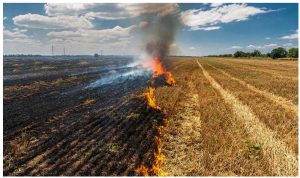
  • Stubble burning refers to the deliberate burning of crop residue left after harvesting, particularly paddy straw, to clear fields for the next crop.
  • Seasonality: It is especially prevalent during October–November in north-western India, when farmers have a limited interval between paddy harvesting and wheat sowing.
  • Historical Development: The practice expanded in Punjab during the late 1970s and early 1980s alongside the spread of combine harvesters, which leave substantial quantities of straw in the fields.

Key Reasons for the Persistence of Stubble Burning in India

  • Compressed Sowing Window: The Punjab Preservation of Subsoil Water Act, 2009, which restricted early paddy transplantation to conserve groundwater, pushed harvesting closer to the wheat-sowing season. 
    • Long-duration varieties such as PUSA-44 (approximately 150–160 days) further reduce the time available for residue management.
  • Economic Incentives and the Paddy–Wheat Cycle: Assured Minimum Support Price (MSP) procurement and subsidised electricity favour water-intensive paddy cultivation over alternative crops. 
  • High Cost of In-Situ Management: In-situ machinery, such as Super Seeders, may cost ₹1,500–₹3,000 per acre to operate, with availability and access challenges for small farmers.
  • Weak Ex-Situ Supply Chains: Although paddy straw can be used in biomass power plants, compressed biogas (CBG) facilities and bioethanol production, collection, baling, transportation and storage remain major bottlenecks. 
    • A short collection window, inadequate local infrastructure and uncertain prices weaken incentives for farmers and aggregators to participate.
  • Unequal Cost–Benefit Equation: Burning is often the quickest and cheapest option for farmers, while its wider environmental and health costs fall on society. 
  • Limitations of Enforcement-Led Approaches: Fines, surveillance and environmental compensation cannot independently resolve machinery shortages, time constraints and weak residue markets. 

Impacts of Stubble Burning

  • Air Pollution: Releases PM2.5, PM10, carbon monoxide and nitrogen oxides, worsening seasonal haze and reducing visibility.
  • Climate Change: Emits greenhouse gases, including carbon dioxide, methane and nitrous oxide.
  • Soil Degradation: Destroys beneficial microorganisms and reduces soil organic matter and nutrients.
  • Health Impacts: Aggravates respiratory and cardiovascular diseases, particularly among vulnerable groups.
  • Economic Losses: Wastes biomass that could be used for mulching, composting, animal feed and bioenergy; pollution also raises healthcare costs and reduces productivity.
  • Ecological Stress: Smoke travels across regions, while intensive paddy cultivation contributes to groundwater stress.

Measures to Curb Stubble Burning in India

  • In-Situ Crop Residue Management: The Central Sector Scheme on Crop Residue Management, implemented since 2018–19, supports machinery such as the Happy Seeder, Super Seeder and Zero-Till Seed-Cum-Fertiliser Drill to manage stubble within fields without burning.
  • Ex-Situ Utilisation and Financial Assistance: Paddy straw is promoted as a resource for biomass power, compressed biogas, bioethanol and industrial fuel. 
    • Government assistance supports machinery purchase and Custom Hiring Centres (CHCs), improving access for small and marginal farmers.
  • Crop Diversification: Promoting alternative crops, short-duration paddy varieties and direct-seeded rice can reduce groundwater stress and, depending on local conditions, ease the narrow interval between paddy harvesting and wheat sowing.
  • Regulatory and Judicial Measures: The Commission for Air Quality Management (CAQM) coordinates anti-burning measures across the NCR and adjoining areas. The CAQM Act, 2021, provides for environmental compensation under Section 15. 
    • The Supreme Court has emphasised stronger enforcement, while disapproving of denying Minimum Support Price (MSP) benefits as a penalty for stubble burning.
  • State-Level Action and Incentives: Punjab and Haryana implement state action plans through subsidised machinery, farmer awareness, village-level interventions, enforcement and incentives for zero-stubble-burning villages. 
    • Effective implementation requires timely machinery access, reliable payments and stronger residue supply chains.
  • Satellite-Based Monitoring: The Consortium for Research on Agroecosystem Monitoring and Modeling from Space (CREAMS) and satellite systems using the Moderate Resolution Imaging Spectroradiometer (MODIS), the Visible Infrared Imaging Radiometer Suite (VIIRS) and geostationary satellite observations help detect and monitor crop-residue fires.

IAS coaching

Global Best Practices

  • Denmark: Utilises agricultural straw for district heating and energy production.
  • Brazil: Promotes no-till farming and crop-residue retention to reduce erosion and conserve soil.
  • European Union: Uses Common Agricultural Policy eco-schemes and agri-environmental measures to incentivise sustainable practices.
  • NASA’s Fire Information for Resource Management System (FIRMS): Provides near-real-time satellite-based active-fire data for monitoring and response.

Way Forward

  • Align Agricultural and Environmental Policies: Integrate groundwater regulation, agricultural electricity subsidies, procurement policies and crop-diversification programmes. 
    • Promote less water-intensive crops through assured procurement, remunerative prices, processing facilities and market access, rather than expecting farmers to abandon paddy without viable alternatives.
  • Make In-Situ Management Affordable: Prioritise small and marginal farmers for machinery subsidies and operational support. 
    • Expand Custom Hiring Centres (CHCs) and machinery banks to ensure timely equipment availability during the short harvesting window, supported by field-level agricultural extension services.
  • Create a Viable Market for Paddy Straw: Consider the Parliamentary Standing Committee’s recommendation for a guaranteed minimum price per quintal for paddy straw supplied to eligible bioenergy and industrial units. 
    • Develop local collection centres, baling services, storage facilities and aggregator networks, alongside assured industrial demand.
  • Strengthen Satellite-Based Monitoring: Combine geostationary satellite observations, polar-orbiting satellite data and ground verification to detect fires occurring outside conventional satellite observation windows. 
    • Assess progress through active-fire detections, burned-area estimates, emissions and adoption of residue-management practices, rather than relying solely on fire counts.
  • Combine Incentives with Proportionate Enforcement: Prioritise affordable alternatives, timely financial assistance, farmer awareness and viable straw markets before penalising non-compliance. 
    • Apply statutory penalties fairly, with due process and clear accountability.

Click to Know UPSC Coaching Centres in India

Conclusion

Stubble burning is a structural agricultural and environmental challenge requiring more than punitive action. Sustainable solutions must combine affordable residue management, viable straw markets, policy coherence and reliable monitoring to make alternatives economically viable and environmentally effective. 

News Source: The Hindu

Check Out UPSC CSE Books

Visit PW Store

online store 1

Stubble Burning in India: Causes, Impacts and Sustainable Solutions

Need help preparing for UPSC or State PSCs?

Connect with our experts to get free counselling & start preparing

Free Counselling for UPSC Aspirants

Connect with our experts and take the right next step.

Expert Guidance
Personalized Strategy
100% Free

Book Your Free Session

NEED ASSISTANCE?

Request a Callback

Our counsellor will connect with you and help you choose the right course and centre.

  • Expert Guidance
  • Course & Fee Information
  • Quick Callback Support

Request a Callback

Books
UPSC PYQs
UPSC Notes
Current Affairs
Quick Revise Now !
AVAILABLE FOR DOWNLOAD SOON
UDAAN PRELIMS WALLAH
Comprehensive coverage with a concise format
Integration of PYQ within the booklet
Designed as per recent trends of Prelims questions
हिंदी में भी उपलब्ध
Quick Revise Now !
UDAAN PRELIMS WALLAH
Comprehensive coverage with a concise format
Integration of PYQ within the booklet
Designed as per recent trends of Prelims questions
हिंदी में भी उपलब्ध

<div class="new-fform">


    </div>

    Subscribe our Newsletter
    Sign up now for our exclusive newsletter and be the first to know about our latest Initiatives, Quality Content, and much more.
    *Promise! We won't spam you.
    Yes! I want to Subscribe.