UPSC PYQs

Prelims, Mains & Optional PYQs

UPSC Notes

Comprehensive & Short Notes

SME Growth Fund 2026: ₹10,000 Crore Fund for MSMEs

10 Oct 2026

SME Growth Fund 2026: ₹10,000 Crore Fund for MSMEs

Subject: GS 03: Economy 

Context: Recently, the Union Cabinet approved the ₹10,000 crore SME Growth Fund (Budget 2026–27) to provide growth-stage equity capital, boost manufacturing, drive innovation, and improve export competitiveness. 
UPSC Course Fees Online

About SME Growth Fund (SGF)

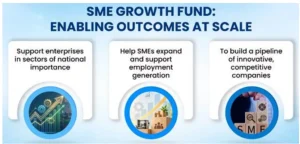
  • The SME Growth Fund (SGF) is a government-backed initiative to provide long-term equity capital and bridge the “missing middle” financing gap for high-potential SMEs.
  • Fund Allocation: The government will commit ₹10,000 crore through an Alternative Investment Fund (AIF) to provide patient growth capital to viable and scalable enterprises.
    • An AIF is a privately pooled investment vehicle in India that collects capital from eligible investors to invest in non-traditional asset classes like growth equity, venture capital, and private equity. 
  • SME Growth Fund 2026Target beneficiaries: High-potential small and medium enterprises with demonstrated business viability and scalability.
  • Priority Areas: Manufacturing, industrial clusters, technological modernisation and export-oriented growth.
  • Expected Outcomes: The fund aims to improve productivity, technology adoption, economies of scale and export competitiveness, supporting Atmanirbhar Bharat and Viksit Bharat @ 2047.

Why Is a Dedicated SME Growth Fund Needed?

  • Growth-Stage Financing Gap: Existing financial support mechanisms often concentrate on early-stage and micro enterprises, leaving viable small and medium businesses with limited access to the equity capital required for expansion.
  • Limitations of Debt Financing: Conventional loans involve repayment obligations and may not adequately support risky, long-term investments in technology, research, capacity expansion and internationalisation.
  • Technology Adoption and Productivity: Patient equity capital can help businesses modernise machinery, automate production, improve quality standards and adopt advanced technologies.
  • Export Competitiveness: Better-capitalised enterprises can meet international standards, integrate into global value chains, diversify export markets and reduce dependence on imported components.
  • Strengthening Supply Chains: The expansion of larger manufacturers can generate more consistent demand for smaller suppliers, enabling them to invest in better equipment, improve skills and increase domestic value addition.

Significance of India’s MSME Ecosystem

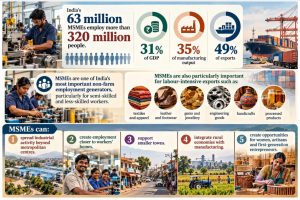
  • Economic Contribution: MSMEs contribute approximately 31.1% of GDP, 35.4% of manufacturing output and 48.58% of exports, supporting economic growth, industrial diversification and export competitiveness.
  • Employment Generation: MSMEs are a major source of non-farm employment, particularly for semi-skilled and less-skilled workers, creating livelihood opportunities in rural areas and smaller towns.
  • Inclusive Growth and Entrepreneurship: They promote women’s entrepreneurship, artisan livelihoods, first-generation entrepreneurs and local enterprise development, enabling wider participation in economic growth.

SME Growth Fund 2026

Major Government Initiatives for MSME Financing and Development: (UPSC CSE Prelims, 2023)

  • Credit Guarantee Scheme for Micro and Small Enterprises: The Ministry of MSME implements Credit Guarantee Scheme (CGS) for Micro and Small Enterprises (MSEs) through Credit Guarantee Fund Trust for Micro and Small Enterprises to provide credit guarantee for loans extended to MSEs. 
    • The ceiling for guarantee coverage under the scheme is Rs 10 crore.
  • Self-Reliant India Fund (SRIF): Established in 2021, it uses a fund-of-funds mechanism to facilitate equity and risk capital for viable MSMEs. The Union Budget 2026–27 proposed a ₹2,000 crore top-up.
  • Emergency Credit Line Guarantee Scheme (ECLGS) 5.0: Approved in May 2026, it provides additional credit and government-guarantee support to eligible businesses affected by external shocks, subject to specified lending limits and repayment conditions.
  • Priority Sector Lending and Public Procurement: Reserve Bank of India (RBI) guidelines facilitate bank credit to MSMEs, including a micro-enterprise sub-target. 
    • The government’s 25% annual procurement target from micro and small enterprises supports market access and demand.
  • Customised Credit Cards for Micro Enterprises: Proposed in the Union Budget 2025–26, these cards offer a limit of ₹5 lakh to eligible Udyam-registered micro enterprises, facilitating working capital and routine business expenditure.
  • SME Growth Fund 2026Trade Receivables Discounting System (TReDS): Enables MSMEs to obtain finance against eligible unpaid invoices, easing working-capital constraints. 
    • The Union Budget 2026–27 announced measures to expand the platform, which the supplementary material reports has unlocked over ₹7 lakh crore for small businesses.
  • Raising and Accelerating MSME Performance (RAMP) and Zero Defect Zero Effect (ZED): RAMP supports institutional capacity, enterprise performance and market access, while ZED Certification promotes better product quality, resource efficiency and environmentally sustainable manufacturing.

IAS coaching

Major Challenges Faced by MSMEs

  • Inadequate Access to Finance: Limited financial records, collateral and creditworthiness restrict access to institutional finance, while dependence on informal credit raises borrowing costs. 
    • A shortage of equity and risk capital also constrains expansion, technology adoption and market entry.
  • Delayed Payments and Working Capital Stress: Late payments by large corporate buyers and Public Sector Undertakings (PSUs) lock up funds needed for wages, raw materials and daily operations. 
    • This creates liquidity shortages, increases borrowing and may force otherwise profitable enterprises to postpone production or reject orders.
  • Regulatory Complexity and Limited Scaling: Compliance with taxation, labour laws, environmental regulations and registration requirements imposes disproportionate costs on smaller firms. 
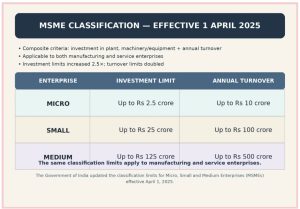
    • Classification thresholds and loss of benefits may discourage expansion, contributing to the limited transition of micro and small enterprises into medium-sized businesses.
  • Credit and Manpower Constraints: According to SIDBI’s report, Understanding the Indian MSME Sector: Progress and Challenges, India’s MSME sector has an estimated addressable credit gap of ₹30 lakh crore (24%), rising to 27% in services and 35% for women-owned MSMEs. 
    • Further, around 25% of surveyed MSMEs reported a shortage of skilled manpower, particularly in defence equipment, readymade garments, hotels, and tiles and sanitaryware. 
  • Technological Obsolescence and Digital Divide: Dependence on outdated machinery and inefficient production processes, combined with limited access to finance and technical expertise, slows the adoption of Artificial Intelligence (AI), automation and digital systems, affecting productivity, quality and competitiveness.
  • Skill Gaps and Workforce Constraints: Shortages of technical, manufacturing, engineering and digital skills, coupled with limited training budgets and difficulties retaining workers, restrict innovation, technology adoption and the production of higher-value goods.
  • Limited Market Access and Export Competitiveness: Weak branding, marketing, logistics and distribution networks constrain market expansion. 
    • Compliance with international quality, Environmental, Social and Governance (ESG) standards and requirements such as the European Union’s Carbon Border Adjustment Mechanism (CBAM) can increase costs for affected exporters.
  • Barriers to Green Transition: High upfront costs of renewable energy, energy-efficient machinery and cleaner technologies, along with limited technical expertise, hinder sustainable production and may restrict access to environmentally sensitive markets and global value chains.

Way Forward

  • Ensure Timely Payments: Strengthen the MSME Samadhaan mechanism for resolving delayed-payment disputes, expand Trade Receivables Discounting System (TReDS) adoption among eligible large buyers and public entities, and improve accountability for payment delays to reduce working capital stress.
  • Improve Credit and Equity Access: Encourage banks and Non-Banking Financial Companies (NBFCs) to use Goods and Services Tax (GST) returns and digital transaction histories for credit assessment. Simplify loan procedures, strengthen last-mile financial inclusion and expand equity financing through mechanisms such as the SME Growth Fund.
  • Promote Technology and Innovation: Facilitate the adoption of Artificial Intelligence (AI), automation, cloud computing and Industry 4.0 technologies through financial and technical support. Expand Common Facility Centres (CFCs), testing laboratories and shared research facilities, alongside industry–academia partnerships for technology transfer.
  • Simplify Regulatory Compliance: Integrate registrations, licences and approvals through digital single-window platforms. Promote self-certification for eligible low-risk enterprises, rationalise compliance costs and decriminalise minor procedural violations where appropriate.
  • Bridge Skill Gaps: Strengthen partnerships among industries, educational institutions and Industrial Training Institutes (ITIs), expand apprenticeships and promote continuous training in digital operations, advanced manufacturing, quality management and sustainable production.
  • Strengthen Market Access and Exports: Improve access to e-commerce platforms, digital marketing, export credit, logistics and quality certification. Develop supplier networks linking MSMEs with large domestic and international manufacturers to facilitate global value chain integration and export diversification.
  • Promote Green and Sustainable Manufacturing: Provide affordable green finance for renewable energy, energy-efficient machinery and cleaner technologies. Support environmental audits, energy assessments and sustainability certification, while developing shared waste-treatment and energy infrastructure in industrial clusters.

Click to Know UPSC Coaching Centres in India

Conclusion

India’s MSME sector drives employment, manufacturing, exports and inclusive growth, while the SME Growth Fund, supported by improved credit access, timely payments, skill development and technology adoption, can address key constraints, enable global competitiveness and advance Atmanirbhar Bharat and Viksit Bharat @ 2047. 

News Source: Indian Express

Check Out UPSC CSE Books

Visit PW Store

online store 1

SME Growth Fund 2026: ₹10,000 Crore Fund for MSMEs

Need help preparing for UPSC or State PSCs?

Connect with our experts to get free counselling & start preparing

Free Counselling for UPSC Aspirants

Connect with our experts and take the right next step.

Expert Guidance
Personalized Strategy
100% Free

Book Your Free Session

NEED ASSISTANCE?

Request a Callback

Our counsellor will connect with you and help you choose the right course and centre.

  • Expert Guidance
  • Course & Fee Information
  • Quick Callback Support

Request a Callback

Books
UPSC PYQs
UPSC Notes
Current Affairs
Quick Revise Now !
AVAILABLE FOR DOWNLOAD SOON
UDAAN PRELIMS WALLAH
Comprehensive coverage with a concise format
Integration of PYQ within the booklet
Designed as per recent trends of Prelims questions
हिंदी में भी उपलब्ध
Quick Revise Now !
UDAAN PRELIMS WALLAH
Comprehensive coverage with a concise format
Integration of PYQ within the booklet
Designed as per recent trends of Prelims questions
हिंदी में भी उपलब्ध

<div class="new-fform">


    </div>

    Subscribe our Newsletter
    Sign up now for our exclusive newsletter and be the first to know about our latest Initiatives, Quality Content, and much more.
    *Promise! We won't spam you.
    Yes! I want to Subscribe.