UPSC PYQs

Prelims, Mains & Optional PYQs

UPSC Notes

Comprehensive & Short Notes

COP17 of the UNCCD: India Calls for Proactive Drought Resilience

26 Aug 2026

COP17 of the UNCCD: India Calls for Proactive Drought Resilience

Subject: GS 3: Environment

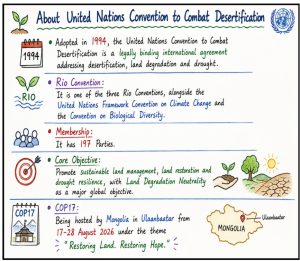
Context: At the ongoing 17th Conference of the Parties (COP17) of the UNCCD, India called for a fundamental shift from reactive drought relief to proactive, technology-enabled drought resilience.
Best Online Coaching for UPSC

Key Developments at COP17 UNCCD

  • Drought Resilience: India advocated moving from ex-post relief to ex-ante anticipatory action, supported by early-warning systems, predictive technologies and proactive land management.
  • COP17Ulaanbaatar Declaration: Local and regional leaders adopted the Ulaanbaatar Declaration, seeking stronger local action on sustainable land management and drought resilience.
  • Rangeland Restoration: Rangelands and pastoralist livelihoods have emerged as major themes, with a USD 1.3 billion package announced to support restoration of critical global rangelands.
  • Innovative Finance: Discussions are focusing on predictable international finance, blended finance, resilience instruments and investment for land restoration and drought resilience.
  • Science and Technology: Greater emphasis is being placed on remote sensing, artificial intelligence, drought data and science-policy interfaces for evidence-based decision-making.
    • Note: Since COP17 is still underway, these should be treated as key developments so far, rather than final negotiated outcomes.

India’s Land Restoration Commitment:

  • Land Degradation Neutrality: India has committed to restoring 26 million hectares of degraded land by 2030.
  • Recent Progress: India reported restoration of approximately 21.76 million hectares of degraded and deforested land, indicating substantial progress towards the 2030 target.
  • Developmental Co-benefits: India’s restoration efforts during 2011–2020 generated around 1.2 billion person-days of employment, demonstrating the link between ecological restoration and rural livelihoods.

Why is Drought a Developmental Challenge?

  • Water Security: Drought causes groundwater depletion, soil-moisture deficits and reduced river flows, intensifying water stress.
  • Food Security: Crop failures and livestock losses can increase food-price volatility and rural distress.
  • Livelihoods: Prolonged drought can trigger income loss, indebtedness and distress migration.
  • Ecological Degradation: Persistent aridity accelerates desertification, soil erosion, biodiversity loss and forest fires.
  • Emerging Risks: Flash droughts can develop rapidly due to sudden heatwaves and soil-moisture depletion, making conventional drought-response systems inadequate.

India’s Drought-Resilience Approach

  • Early Warning: Integrating rainfall monitoring, weather forecasts and satellite-based drought assessment to trigger preparedness before a crisis develops.
  • Technology-Enabled Assessment: Using remote sensing and geospatial technologies to monitor vegetation, soil moisture and land degradation.
  • Drought Management Framework: The Manual for Drought Management provides a framework for drought assessment using rainfall, crop and ground-level indicators, complemented by satellite-based information.
  • Catchment Restoration: India emphasised “Restore the forest, before the flow”, highlighting catchment and riverscape forestry for reducing erosion, improving water retention and enhancing groundwater recharge.
  • Community Resilience: Combining government intervention with watershed management, local water conservation and community participation.
  • Ecosystem-Based Adaptation: Using forests, wetlands, agroforestry and healthy watersheds as Nature-based Solutions for drought resilience.

Global Status:

  • Drying Planet: The United Nations Convention to Combat Desertification has highlighted the accelerating expansion of drylands and global aridity, making drought resilience a major development challenge.
  • Land Degradation: Around 40% of the world’s land is affected by degradation, threatening food security, livelihoods, biodiversity and water security.
  • Human Security: Drought and land degradation increasingly interact with poverty, migration, food insecurity and resource conflicts.
  • Climate Link: Rising temperatures, changing precipitation patterns and extreme heat are increasing the risk of flash droughts and persistent aridity.

Way Forward

  • From Relief to Resilience: Institutionalise anticipatory action frameworks instead of relying predominantly on post-disaster relief.
  • Water-Smart Agriculture: Promote micro-irrigation, rainwater harvesting, drought-tolerant crops and agroforestry.
  • Landscape Restoration: Scale up watershed restoration, rangeland management, afforestation and ecosystem-based adaptation.
  • Technology Integration: Combine artificial intelligence, satellite imagery, weather forecasting and local observations for granular drought prediction.
  • Climate Finance: Mobilise adequate, predictable and sustained international finance for vulnerable countries and communities.
  • Community-Centred Governance: Place local communities, pastoralists, farmers and Indigenous Peoples at the centre of land and drought-management strategies.

Click to Know UPSC Offline Courses

Conclusion

Drought resilience requires a shift from managing crises to managing risks, integrating technology, ecosystem restoration, water security and community participation to build climate-resilient livelihoods and landscapes.

Check Out UPSC CSE Books

Visit PW Store

online store 1

COP17 of the UNCCD: India Calls for Proactive Drought Resilience

Need help preparing for UPSC or State PSCs?

Connect with our experts to get free counselling & start preparing

Free Counselling for UPSC Aspirants

Connect with our experts and take the right next step.

Expert Guidance
Personalized Strategy
100% Free

Book Your Free Session

NEED ASSISTANCE?

Request a Callback

Our counsellor will connect with you and help you choose the right course and centre.

  • Expert Guidance
  • Course & Fee Information
  • Quick Callback Support

Request a Callback

Books
UPSC PYQs
UPSC Notes
Current Affairs
Quick Revise Now !
AVAILABLE FOR DOWNLOAD SOON
UDAAN PRELIMS WALLAH
Comprehensive coverage with a concise format
Integration of PYQ within the booklet
Designed as per recent trends of Prelims questions
हिंदी में भी उपलब्ध
Quick Revise Now !
UDAAN PRELIMS WALLAH
Comprehensive coverage with a concise format
Integration of PYQ within the booklet
Designed as per recent trends of Prelims questions
हिंदी में भी उपलब्ध

<div class="new-fform">


    </div>

    Subscribe our Newsletter
    Sign up now for our exclusive newsletter and be the first to know about our latest Initiatives, Quality Content, and much more.
    *Promise! We won't spam you.
    Yes! I want to Subscribe.