Subject: GS 3: Science & Technology
Context: Recently, Scientists at Duke University have developed an Artificial Intelligence system called Raygun, that can shrink, enlarge, and extensively rewrite proteins.
What is Raygun?
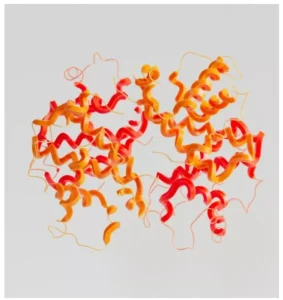
- Raygun is an Al-based protein design system that modifies the length and amino-acid sequence of proteins.
- It uses protein language models trained on millions of protein sequences to learn the relationship between amino-acid sequences, structure and function.
- It can generate proteins of a target length in a single step, rather than repeatedly refining them.
How Does It Work?
- Fixed-resolution representation: Raygun divides proteins of different lengths into the same number of blocks and summarises each block.
UPSC Course Fees Online
About Proteins
- Proteins are biological polymers made up of chains of 20 amino acids, whose sequence determines how the chain folds into a three-dimensional structure and consequently determines its biological function.
- Proteins are composed of 20 amino acids. Each amino acid generally contains an α-carboxyl group, a primary α-amino group, and a variable R group (side chain) that determines its specific properties.
- Proline is an exception because it contains a secondary amino group. The R group differs among amino acids, giving each amino acid its distinct chemical characteristics.
- Nutritional Classification of Amino Acids: Based on the body’s ability to synthesise them, amino acids are classified into three categories:
- Essential Amino Acids: Cannot be synthesised adequately by the human body and must therefore be obtained through the diet.
- Non-essential Amino Acids: Can be synthesised by the body in sufficient quantities.
- Semi-essential Amino Acids: Can generally be synthesised by the body but become essential during periods of growth, illness, or physiological stress.
- Nine Essential Amino Acids: They cannot be synthesised in sufficient quantities by humans and other mammals, making dietary intake necessary.
|
- Probability-based generation: Instead of treating a protein as one fixed sequence, it models a range of plausible variants.
- Two control parameters: Users can determine how much the new protein should differ from the original and its desired length.
- High speed: A designed sequence can be generated in about 0.3 seconds on a single GPU, around 100 times faster than diffusion-based approaches.
Major Findings of the Study
- Wide Size Range: The researchers tested Raygun across a 17-fold protein size range, from haemoglobin with 147 amino acids to mTOR with 2,549 amino acids.
- mTOR (mechanistic Target of Rapamycin) Modification: The study found that mTOR could be shortened by more than 500 amino acids while retaining a largely intact predicted structure.
- mTOR is a protein kinase that regulates cell growth, metabolism, proliferation and protein synthesis. The study found that it could be shortened by more than 500 amino acids while retaining a largely intact predicted structure.
- Fluorescent Proteins: Researchers generated 70,000 candidates from each of two templates, eGFP derived from jellyfish and mCherry derived from coral.
- Experimental Validation: Computational screening reduced the candidates to eight, which were subsequently produced in human cells. Six variants retained fluorescence.
- Miniaturisation: The smallest functional fluorescent variants contained 199 and 206 amino acids, making them shorter than 96% of fluorescent proteins listed in the database used in the study.
- Extensive Rewriting: Some functional variants contained more than 40 coordinated insertions, deletions, and substitutions while retaining their function.
- Importance of Coordinated Editing: Random or poorly coordinated modifications can rapidly destroy protein function, whereas Raygun’s coordinated changes enabled substantial rewriting while retaining activity.
Potential Application
- Gene Therapy: Smaller proteins and redesigned biological components could potentially overcome size constraints in viral delivery systems.
- Drug Development: Protein engineering could enable the development of more compact and functionally optimised therapeutic proteins.
- Synthetic Biology: AI-based protein redesign can accelerate the development of new biological components and molecular tools.
- Basic Research: Compact fluorescent and reporter proteins could reduce the extent to which molecular tags interfere with the proteins being studied.
- Faster Protein Design: Raygun’s ability to generate candidates rapidly could reduce the time and computational resources required for protein engineering and screening.
Click to Explore UPSC Offline Coaching
 12 Aug 2026