UPSC PYQs

Prelims, Mains & Optional PYQs

UPSC Notes

Comprehensive & Short Notes

Glaciers in a Warming Himalaya: Zanskar’s Changing Ice Dynamics

12 Aug 2026

Glaciers in a Warming Himalaya: Zanskar’s Changing Ice Dynamics

Subject: GS 1: Geography

Context: A recent study published in “The Cryosphere” has found that glaciers in the Zanskar region of Ladakh have slowed significantly over the past three decades. 
Glaciers

  • The study examined 12 glaciers between 1992 and 2023 and linked the slowdown primarily to glacier thinning associated with climate change.
  • The finding is important because Himalayan glaciers act as natural freshwater reservoirs and regulate river flows that support ecosystems, agriculture, hydropower, and communities across the Indus Basin.

Key Findings of the Study

  • Declining Glacier Velocity: The study found that glaciers in Zanskar slowed by an average of 2.4 metres per year per decade between 1992 and 2023.
  • Accelerating Thinning: The rate of surface thinning increased from around 0.22 metres per year during 2000–2005 to approximately 0.57 metres per year during 2015–2020.
  • Thinning–Slowdown Mechanism: When glaciers lose more ice than they gain, their thickness decreases. This reduces the driving stress responsible for glacier movement.

UPSC Online Preparation

Climate Drivers

  • Western Disturbances: Zanskar receives much of its winter snowfall from Western Disturbances. Changes in their frequency, intensity, and temperature can reduce winter accumulation and worsen the negative mass balance of glaciers.
  • Rising Temperatures: Increasing temperatures enhance snow and ice melt, causing sustained glacier thinning and retreat.

About Zanskar Glaciers

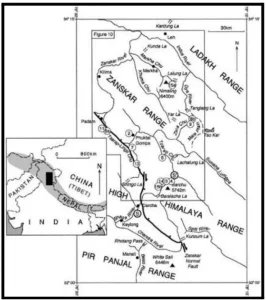
  • The Zanskar-Suru region contains extensive glaciers such as the Drang-Drung Glacier and Pensilungpa Glacier
  • Located in the rain-shadow zone of the Himalaya, the region receives limited summer monsoon precipitation and depends heavily on winter Western Disturbances for snowfall.
  • This makes changes in winter snowfall and temperature particularly important for the region’s glacier mass balance.

  • Black Carbon and Dust: Deposition of black carbon and dust reduces the snow albedo, causing the surface to absorb more solar radiation and accelerating snow and ice melt, particularly at high elevations.
    • Albedo refers to the fraction of incoming solar radiation reflected by a surface.
    • Fresh snow has a high albedo, reflecting most of the Sun’s radiation and therefore absorbing less heat.

Why Do Glaciers Behave Differently?

  • Glacier response is influenced by geometry, debris cover, slope, ice thickness, and terminus conditions.
  • Land-Terminating Glaciers: Their flow is largely governed by ice thickness, surface slope, and basal conditions, making thinning an important factor in declining velocity.
  • Lake-Terminating Glaciers: These glaciers can display different behaviour because interaction with pro-glacial lakes may reduce resistance at the terminus. 
    • Calving and reduced basal friction can cause localised acceleration, even when the broader glacier is losing mass.
      • Calving is the process in which large pieces of ice break off from the terminus of a glacier, usually into a pro-glacial lake or the ocean
  • Thus, glacier slowdown is not uniform and cannot be attributed to warming alone.

Environmental and Disaster Risks

  • Glacial Lake Formation: Retreating glaciers can leave behind depressions that fill with meltwater, creating pro-glacial lakes.
  • Glacial Lake Outburst Floods: Meltwater accumulated behind unstable terminal moraines can suddenly breach the natural dam, triggering Glacial Lake Outburst Floods (GLOFs).
  • Positive Feedback: As glaciers retreat, expanding pro-glacial lakes can enhance ice loss through processes such as calving, potentially accelerating glacier retreat.
  • Downstream Vulnerability: Sudden floods can threaten settlements, roads, bridges, hydropower infrastructure, agriculture, and ecosystems in downstream valleys.

Best Online Coaching for UPSC

India’s Policy and Adaptation Measures:

  • National Mission for Sustaining the Himalayan Ecosystem: The National Mission for Sustaining the Himalayan Ecosystem (NMSHE) under the National Action Plan on Climate Change (NAPCC) promotes scientific monitoring, ecosystem conservation, and climate-resilient development in the Himalayan region.
  • Ice Stupas: The Ice Stupa initiative associated with Sonam Wangchuk uses winter water to create artificial ice structures that melt gradually during spring, providing water for early-season irrigation in water-scarce mountain communities.
  • Artificial Glaciers: Artificial glaciers store winter runoff as ice and release water during the warmer months, helping address seasonal water scarcity.

Implications for the Indus Basin

  • Peak Water: Increased glacier melting can initially raise river discharge, a phenomenon known as peak water. However, once glaciers lose a substantial portion of their stored ice, their contribution to river flows can decline.
  • Water Security: Long-term glacier thinning could reduce the availability of summer meltwater, particularly during periods when rainfall and snowfall are limited.
  • Agriculture and Hydropower: Changes in glacier-fed flows can affect irrigation, hydropower generation, and downstream ecosystems across the Indus Basin.
  • Long-Term Risk: Glacier slowdown does not immediately imply water scarcity because river flows also depend on snowfall, rainfall, groundwater, and water management. However, continued ice loss indicates declining long-term water storage capacity.

Way Forward

  • Strengthen Glacier Monitoring: Combine satellite remote sensing with ground-based measurements of ice thickness, mass balance, temperature, and meltwater discharge.
  • Improve GLOF Preparedness: Regularly map pro-glacial lakes, assess their stability, establish early-warning systems, and strengthen downstream disaster preparedness.
  • Monitor Black Carbon: Reduce black carbon emissions from transport, biomass burning, and other sources to limit their deposition on Himalayan snow and ice.
  • Strengthen High-Altitude Weather Networks: Expand meteorological observations to better understand interactions between Western Disturbances, snowfall, temperature, and glacier mass balance.
  • Promote Climate-Resilient Water Management: Integrate changing glacier dynamics into planning for agriculture, hydropower, drinking water, and ecosystem conservation.
  • Scale Local Adaptation: Promote community-based solutions such as Ice Stupas, artificial glaciers, water harvesting, and efficient irrigation in water-stressed Himalayan settlements.

Click to Know UPSC OnlyIAS Coaching Centres

Conclusion

The slowdown of Zanskar’s glaciers reflects the impact of climate warming, ice loss, and changing snowfall patterns on Himalayan cryospheric dynamics. While meltwater may provide short-term gains, declining glacier storage poses long-term risks to the Indus Basin, requiring stronger monitoring, GLOF preparedness, and climate-resilient water management

Check Out UPSC CSE Books

Visit PW Store

online store 1

Glaciers in a Warming Himalaya: Zanskar’s Changing Ice Dynamics

Need help preparing for UPSC or State PSCs?

Connect with our experts to get free counselling & start preparing

Free Counselling for UPSC Aspirants

Connect with our experts and take the right next step.

Expert Guidance
Personalized Strategy
100% Free

Book Your Free Session

NEED ASSISTANCE?

Request a Callback

Our counsellor will connect with you and help you choose the right course and centre.

  • Expert Guidance
  • Course & Fee Information
  • Quick Callback Support

Request a Callback

Books
UPSC PYQs
UPSC Notes
Current Affairs
Quick Revise Now !
AVAILABLE FOR DOWNLOAD SOON
UDAAN PRELIMS WALLAH
Comprehensive coverage with a concise format
Integration of PYQ within the booklet
Designed as per recent trends of Prelims questions
हिंदी में भी उपलब्ध
Quick Revise Now !
UDAAN PRELIMS WALLAH
Comprehensive coverage with a concise format
Integration of PYQ within the booklet
Designed as per recent trends of Prelims questions
हिंदी में भी उपलब्ध

<div class="new-fform">


    </div>

    Subscribe our Newsletter
    Sign up now for our exclusive newsletter and be the first to know about our latest Initiatives, Quality Content, and much more.
    *Promise! We won't spam you.
    Yes! I want to Subscribe.