UPSC PYQs

Prelims, Mains & Optional PYQs

UPSC Notes

Comprehensive & Short Notes

Indian Ocean Dipole (IOD): Impact on India’s Monsoon and El Niño

4 Jul 2026

Indian Ocean Dipole (IOD): Impact on India’s Monsoon and El Niño

Subject: GS 1: Geography

Context: India’s 2026 Southwest Monsoon recorded a ~40% rainfall deficit in June 2026 due to strengthening El Niño, prompting attention to whether a positive Indian Ocean Dipole (IOD) could revive rainfall in the remaining monsoon season.
Best Online Coaching for UPSC

Indian Ocean Dipole

About Indian Ocean Dipole (IOD)


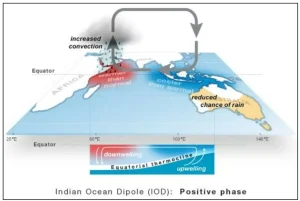
  • It is an ocean-atmosphere coupled climate phenomenon in the tropical Indian Ocean, characterized by differences in Sea Surface Temperature (SST) between:
    • Western Indian Ocean (near East Africa)
    • Eastern Indian Ocean (near Indonesia)
  • It is measured using the Dipole Mode Index (DMI).

Indian Ocean Dipole

Phases of IOD

Phase Features Impact on India
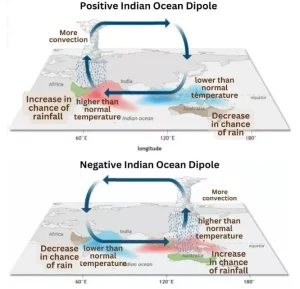
Positive IOD Western Indian Ocean warmer; Eastern Indian Ocean cooler Enhances southwest monsoon; above-normal rainfall
Negative IOD Eastern Indian Ocean warmer; Western Indian Ocean cooler Weakens monsoon; below-normal rainfall
Neutral IOD No significant SST difference Minimal influence on monsoon

Positive Indian Ocean Dipole (IOD) and Its Impact on India’s Monsoon

  • Strengthens Moisture Transport Towards India: During a positive IOD, the western Indian Ocean becomes warmer than the eastern Indian Ocean.
    • The warmer waters increase evaporation, generating moisture-laden winds.
    • These winds are drawn towards the Indian subcontinent, enhancing the supply of moisture essential for monsoon rainfall.
  • Increases Convection Over the Arabian Sea: Warmer sea surface temperatures in the western Indian Ocean promote strong convection (rising warm, moist air).
    • This leads to greater cloud formation and intensified low-pressure systems over the Arabian Sea.
    • The strengthened monsoon circulation helps carry more moisture inland.
  • Enhances Southwest Monsoon Rainfall: Increased moisture availability and stronger atmospheric circulation generally result in above-normal rainfall over many parts of India.
    • A positive IOD often improves rainfall during the latter half of the monsoon season (August–September), benefiting rain-fed agriculture.
    • It supports better reservoir inflows, groundwater recharge, and overall water availability.
  • Partly Offsets the Adverse Effects of El Niño: While El Niño suppresses monsoon rainfall by weakening the Walker Circulation, a positive IOD can counteract this effect by strengthening moisture transport from the Indian Ocean.
    • Although it cannot completely neutralize a strong El Niño, a positive IOD can significantly reduce rainfall deficits and improve monsoon performance.
    • Examples: In 1997 and 2019, a strong positive IOD helped compensate for El Niño-induced monsoon weakness, leading to better-than-expected seasonal rainfall.

Negative Indian Ocean Dipole (IOD) and Its Impact on India’s Monsoon

  • Shifts Moisture Towards Indonesia
    • During a negative IOD, the eastern Indian Ocean near Indonesia and Australia becomes warmer than the western Indian Ocean.
    • The warmer eastern waters enhance evaporation and convection over the eastern Indian Ocean.
    • As a result, moisture-laden winds and rainfall shift towards Indonesia and surrounding regions, reducing the moisture available for India.
  • Weakens Southwest Monsoon Rainfall
    • Reduced moisture transport towards the Indian subcontinent weakens the southwest monsoon circulation.
    • This leads to below-normal rainfall across many parts of India, particularly affecting rain-fed regions.
    • Lower rainfall also reduces reservoir inflows, groundwater recharge, and soil moisture, impacting agriculture and water security.
  • Aggravates Drought During El Niño Years
    • A negative IOD, when occurring alongside El Niño, reinforces the suppression of the Indian monsoon.
    • The combined effect significantly increases the likelihood of monsoon failure, drought conditions, crop losses, and water scarcity.
    • Such years often witness reduced agricultural output, rural distress, and higher food inflation, posing challenges to the economy and disaster management.

Significance of the Indian Ocean Dipole (IOD) for India

  • Agricultural Stability: A positive IOD enhances monsoon rainfall, supporting timely Kharif sowing, improving soil moisture, and increasing agricultural productivity.
  • Water Security: Above-normal rainfall during a positive IOD boosts reservoir storage, groundwater recharge, and irrigation availability, strengthening water security.
  • Economic Growth: A good monsoon driven by a positive IOD supports rural incomes, moderates food inflation, and contributes to overall economic growth.
  • Disaster Risk Reduction: Enhanced rainfall reduces drought risk, improves hydropower generation, and ensures adequate water availability for domestic and industrial needs.

Challenges Associated with the Indian Ocean Dipole (IOD)

  • Limited Ability to Offset El Niño: A positive IOD cannot completely neutralize the adverse impact of a strong El Niño, especially during severe drought years.
  • Uneven Rainfall Distribution: Even under a positive IOD, rainfall may remain spatially uneven, leaving some regions water-stressed.
  • Increased Hydro-meteorological Risks: Enhanced monsoon activity can trigger floods in some areas while drought persists in others, complicating disaster management.
  • Climate Change Uncertainty: Rising ocean temperatures and changing atmospheric circulation patterns are making the behaviour of the IOD and the Indian monsoon increasingly unpredictable.

Click to Know UPSC Coaching Centres in India

Way Forward

  • Strengthen Seasonal Forecasting: Improve monsoon predictions using advanced coupled ocean-atmosphere climate models and real-time ocean observations.
  • Build Climate-Resilient Agriculture: Promote drought-resilient crops, climate-smart farming practices, and contingency planning to reduce monsoon-related risks.
  • Enhance Water Resource Management: Expand rainwater harvesting, efficient irrigation, groundwater recharge, and scientific reservoir operations to improve water security.
  • Improve Early Warning Systems: Strengthen district-level weather advisories, impact-based forecasts, and early warning systems for farmers and disaster managers.
  • Advance Climate Research: Enhance research on the interactions between El Niño, the Indian Ocean Dipole (IOD), the Madden–Julian Oscillation (MJO), and climate change to improve forecasting accuracy and policy planning.

Check Out UPSC CSE Books

Visit PW Store

online store 1

Indian Ocean Dipole (IOD): Impact on India’s Monsoon and El Niño

Need help preparing for UPSC or State PSCs?

Connect with our experts to get free counselling & start preparing

Free Counselling for UPSC Aspirants

Connect with our experts and take the right next step.

Expert Guidance
Personalized Strategy
100% Free

Book Your Free Session

NEED ASSISTANCE?

Request a Callback

Our counsellor will connect with you and help you choose the right course and centre.

  • Expert Guidance
  • Course & Fee Information
  • Quick Callback Support

Request a Callback

Books
UPSC PYQs
UPSC Notes
Current Affairs
Quick Revise Now !
AVAILABLE FOR DOWNLOAD SOON
UDAAN PRELIMS WALLAH
Comprehensive coverage with a concise format
Integration of PYQ within the booklet
Designed as per recent trends of Prelims questions
हिंदी में भी उपलब्ध
Quick Revise Now !
UDAAN PRELIMS WALLAH
Comprehensive coverage with a concise format
Integration of PYQ within the booklet
Designed as per recent trends of Prelims questions
हिंदी में भी उपलब्ध

<div class="new-fform">


    </div>

    Subscribe our Newsletter
    Sign up now for our exclusive newsletter and be the first to know about our latest Initiatives, Quality Content, and much more.
    *Promise! We won't spam you.
    Yes! I want to Subscribe.