Subject: GS 03: Science and Technology
Context: A total solar eclipse was visible across Greenland, Iceland, and Spain, while a partial eclipse was visible across much of Europe.
UPSC Online Coaching
About Solar Eclipse
- Definition: A solar eclipse occurs when the Moon comes between the Sun and Earth, partially or completely blocking sunlight.
- It can occur only during a New Moon, when the Sun, Moon, and Earth are aligned.
- It does not occur every month because the Moon’s orbit is tilted by about 5° relative to Earth’s orbital plane, preventing alignment during every New Moon.
Types of Solar Eclipse

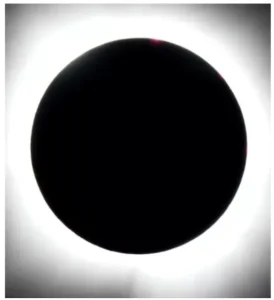
- Total Solar Eclipse: The Moon completely covers the Sun’s disc, revealing the solar corona.
- Annular Eclipse: The Moon appears smaller than the Sun, leaving a bright “ring of fire.”
- Partial Eclipse: The Moon covers only a part of the Sun.
- Hybrid Eclipse: Appears total in some regions and annular in others.
Why are Total Solar Eclipses Rare?
- Limited Umbra: The Moon’s umbra, or darkest central shadow, falls on only a small area of Earth’s surface.
- Narrow Shadow Path: The umbral shadow covers less than 1% of Earth’s surface.
About Path of Totality
- Definition: The narrow strip on Earth within the Moon’s umbra, where the Sun is completely covered during a total solar eclipse.
- Width: Typically around 100–200 km and varies between eclipses.
- Center Line: Totality is highest near the center line and decreases toward the edges.
- Major Regions of Totality in 2026 Eclipse: Northern Russia, Greenland, western Iceland, northern Spain, and parts of northeast Portugal.
|
-
- Therefore, only a small part of Earth can experience totality during a particular eclipse, and the same location experiences a total solar eclipse only rarely.
Why is a Total Solar Eclipse Important for Solar Studies?
- Corona: The corona is the Sun’s outer atmosphere, with the inner corona being the region closest to the Sun.
- Difficulty in Observation: The corona is much fainter than the Sun’s bright disc.
- Coronagraphs can block the disc, but scattered light limits observations of the inner corona.
- Advantage of Eclipse: During totality, the Moon naturally blocks the Sun’s bright disc, reducing glare and revealing the faint inner corona for scientific observation.
- This helps scientists study the Sun’s coronal magnetic structure and solar activity.
- Solar Cycle: The Sun undergoes an approximately 11-year cycle of rising and falling solar activity, marked by changes in sunspots, solar flares, and other phenomena.
- The current solar cycle, Solar Cycle 25, began in 2020 and has already passed its maximum phase, making observations of coronal structures particularly valuable.
Click to Know UPSC Offline Courses