Reserve Bank of India (Interest Rates on Loans and Advances) Directions, 2026
Context: The RBI has proposed a new framework for loan interest rates.
UPSC Online Courses
Key Highlights of Reserve Bank of India (Interest Rates on Loans and Advances) Directions, 2026
- Fixed and Floating-Rate Loans: Lenders may offer loans at fixed or floating interest rates.
- Interest will generally be calculated on a daily reducing balance using the actual/actual day-count convention.
- Fixed interest rate: Remains unchanged throughout the agreed loan period, providing borrowers with predictable interest payments.
- Floating interest rate: Changes periodically according to a specified benchmark, causing the borrower’s interest burden to rise or fall with market conditions.
- External Benchmark for Floating-Rate Loans: Commercial banks must link floating-rate personal loans and MSME loans to an external benchmark.
- Permitted benchmarks include the RBI policy repo rate, Government Treasury Bill yields and benchmarks published by Financial Benchmarks India Pvt Ltd.
- The benchmark, reset frequency and reset date must be clearly specified in the loan agreement.
- Regulation of Spreads: The spread over the benchmark may include credit-risk premium, operating costs, term premium and business-strategy considerations.
- The credit-risk premium can be revised only after a comprehensive review of the borrower’s credit profile.
- Other spread components generally cannot be revised for three years.
- Borrower Protection: For microfinance and small-value loans, lenders must specify a ceiling on the annual percentage rate (APR).
- For short-term agricultural loans to small and marginal farmers, total interest and other charges cannot exceed the principal amount.
- Existing benchmark-linked loans may be migrated to the new framework by April 1, 2029, with borrower consent and no migration charges.
Rationale Behind the Changes
- Greater Transparency: Clearly specified benchmarks, spreads and reset mechanisms can make loan pricing more transparent and easier for borrowers to understand.
- Protection Against Arbitrary Pricing: Restrictions on changes to spreads and requirements for external benchmarking seek to prevent arbitrary increases in borrowing costs.
- Strengthening Monetary Policy Transmission: Linking floating-rate loans to external benchmarks can improve the transmission of changes in RBI policy rates to borrowers and the wider economy.
AI-Designed Viruses
Context: Scientists have used generative AI to design bacteriophages, demonstrating both the potential and biosecurity risks of AI-enabled synthetic biology.
About AI-Designed Viruses
- AI-designed viruses are viral genomes generated using artificial intelligence models trained on large collections of natural genetic sequences.
- A recent study, published in Science, demonstrated the creation of functional bacteriophages using generative AI.
- Bacteriophages (phages) are viruses that infect bacteria rather than humans.
- Key Features
- AI-Based Genome Design: Researchers used a genome language model, which learns recurring patterns in genetic sequences in a manner conceptually similar to large language models.
- The model was trained using genetic sequences from viruses, bacteria, plants and humans.
- Creation of Novel Phages: Researchers generated around 300 AI-designed viral genomes and chemically synthesised their DNA.
- 16 designs successfully produced functional bacteriophages capable of infecting E. coli C.
- Different from Natural Viruses: The AI-designed phages contained de novo mutations, divergent genes and regulatory elements and had varying genome lengths.
- Potential Medical Application: A mixture of AI-designed phages was able to rapidly kill antibiotic-resistant bacteria.
- This indicates potential applications in developing alternative approaches against antimicrobial resistance (AMR).
Is It Safe for Humans?
- No Direct Human Threat: The study reported that the newly created viruses do not infect humans.
- They are bacteriophages designed to target bacteria and are similar to Phi X-174, a naturally occurring bacteriophage.
- Biosecurity Concerns: Although the viruses developed in the study are not considered a human threat, the technology raises broader biosecurity concerns.
- Similar AI capabilities could potentially be misused in the future to design harmful biological agents.
- Need for Responsible AI-Biotechnology Governance: The development highlights the need for appropriate biosafety, biosecurity and responsible AI safeguards.
Hicklin Test
Context: The Supreme Court has clarified that vulgarity or profanity alone does not constitute obscenity, renewing debate over India’s evolving legal standards for obscene content.
About the Hicklin Test
- The Hicklin Test is a 19th-century legal standard used to determine whether material is obscene.
- It assessed whether content could “deprave and corrupt” persons whose minds were susceptible to immoral influences.
- Origin: The test originated in England through R v. Hicklin (1868).
- It focused on isolated passages of a publication and their potential effect on particularly vulnerable persons, rather than assessing the work as a whole.
- Earlier Indian Standard: The Supreme Court adopted the Hicklin approach in Ranjit D. Udeshi v. State of Maharashtra (1964) while upholding restrictions on Lady Chatterley’s Lover.
- Current Standard
- Shift to Contemporary Standards: In Aveek Sarkar v. State of West Bengal (2014), the Supreme Court discarded the Hicklin Test.
- Obscenity is now assessed using contemporary community standards, considering the material from the perspective of an average person.
- Vulgarity is not Obscenity: Recent Supreme Court rulings have emphasised that mere abusive, vulgar or profane language is not automatically obscene.
- Criminal obscenity generally requires the material to cross the legally recognised threshold of lasciviousness or sexual arousal.
Legal Provisions to Tackle Cases Related to Obscenity
- Bharatiya Nyaya Sanhita (BNS): Section 296 of the BNS deals with obscene acts, songs or words in or near public places.
- It corresponds to Section 294 of the erstwhile IPC.
- Information Technology Act, 2000: Section 67 of the IT Act deals with publishing or transmitting obscene material in electronic form.
- Constitutional Framework: Obscenity restrictions operate alongside Article 19(1)(a), which guarantees freedom of speech and expression.
- Restrictions must fall within the constitutionally permitted grounds under Article 19(2), including decency or morality.
UPSC Online Classes
SraVaani
Context: Researchers at IISc, in collaboration with ARTPARK and Google, have released SraVaani, a multilingual speech-recognition model.
About SraVaani
- SraVaani is a multilingual Automatic Speech Recognition (ASR) model designed to provide speech-to-text capabilities across India’s diverse linguistic landscape.
- Objective: To address the technological gap faced by regional and non-scheduled Indian languages that remain underserved by existing speech-AI systems.
- Developed By: IISc’s SPIRE Lab in collaboration with ARTPARK and Google.
- Key Features
-
- Wide Linguistic Coverage: Trained on 65 Indian languages and dialects, including 20 scheduled languages and 45 regional languages and dialects.
- Covers languages such as Garo, Angika, Chakma, Kokborok, Tulu, Bundeli and Bajjika.
- Focus on Underserved Languages: Includes more than 40 languages that are not officially supported by many existing speech-recognition systems.
- Pan-India Coverage: Its linguistic coverage spans different regions, including the Northeast, eastern, western, northern, southern and central parts of India, along with English and Sanskrit.
- According to the 2011 Census, it could potentially benefit around 25 crore people whose languages are inadequately supported by existing systems.
- Improved Recognition Performance: SraVaani demonstrates strong performance in several regional languages.
- For Garo, it achieved a 9.5% word error rate, compared with 69.4% for the next-best evaluated system.
- Free Availability: The model is freely and publicly available on Hugging Face under an Massachusetts Institute of Technology License (MIT licence).
- MIT License allows users to use, copy, modify, merge, publish, distribute, and sell the software.
India–Kenya Relations
Context: Lok Sabha Speaker Om Birla interacted with Kenya’s Speaker Moses M. Wetang’ula, highlighting growing parliamentary cooperation and Kenya supporting India’s permanent membership of the UN Security Council.
About India–Kenya Relations

- India and Kenya share a multifaceted partnership based on historical links, Indian Ocean connectivity, democratic values and Global South cooperation.
- Economic Ties: India is among Kenya’s major trading partners, with bilateral trade around $4.31 billion; Indian exports include pharmaceuticals and petroleum products.
- Diaspora: Nearly 100,000 Persons of Indian Origin live in Kenya, with Kenya recognising the community as its 44th indigenous tribe.
- Parliamentary & Multilateral Cooperation: Parliamentary exchanges and capacity-building programmes strengthen institutional ties, while Kenya supports India’s permanent UNSC membership.
Click to Know UPSC Coaching Centres in India
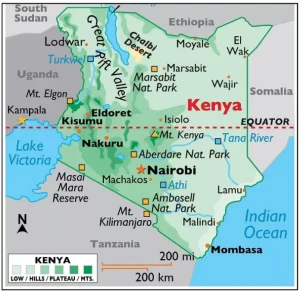
About Kenya
- Kenya is an East African country and a major regional economic and diplomatic hub, with Nairobi as its capital and largest urban centre.
- Location: Located along the equator, Kenya borders the Indian Ocean, Tanzania, Uganda, South Sudan, Ethiopia and Somalia.
- Key Features
-
- Climate: Kenya has diverse climatic zones, ranging from hot and humid coastal conditions to cooler highlands and arid/semi-arid northern and eastern regions.
- Vegetation & Wildlife: Its landscape includes savannahs, tropical forests and coastal mangroves, supporting rich biodiversity and wildlife reserves such as Maasai Mara.
- Mountains, Lakes & Rivers: The Great Rift Valley crosses Kenya, while Mount Kenya is Africa’s second-highest peak.
- Major water bodies include Lake Victoria and Lake Nakuru, while the Tana River is Kenya’s longest river.
- Lake Turkana (Jade Sea) in northern Kenya is the world’s largest permanent desert lake and the world’s largest alkaline lake.