Subject: GS 1: Geography
Context: The Union Ministry of Agriculture & Farmers’ Welfare has flagged 315 districts as meteorologically vulnerable due to an active El Niño cycle.
- This phenomenon has delayed the monsoon, causing precipitation levels to plummet 43% below long-period averages, directly threatening upcoming Kharif crop cycles.
UPSC Online Preparation
Key Changes & Strategic Categorizations

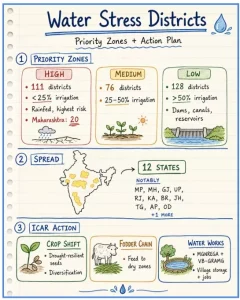
The government has mapped out districts based on their ability to withstand water stress, looking directly at their irrigation networks:
- High-Priority Zone (111 Districts): Regions with less than 25% irrigation infrastructure. These areas rely almost entirely on rainfall and face the biggest risk.
- Maharashtra contains 20 of these critical districts.
- Medium-Priority Zone (76 Districts): Regions maintaining an irrigation net between 25% and 50%.
- Low-Priority Zone (128 Districts): Regions with greater than 50% irrigation access supplied via dams, canals, and perennial reservoirs.
- Geographical Spread: The vulnerable sectors stretch across 12 States, notably Madhya Pradesh, Maharashtra, Gujarat, Uttar Pradesh, Rajasthan, Karnataka, Bihar, Jharkhand, Telangana, Andhra Pradesh, and Odisha.
Action Plan and Interventions
To counter the dry spell, the Indian Council of Agricultural Research (ICAR) has deployed District Agriculture Contingency Plans:
- Crop Re-engineering: Pushing for alternative, drought-resilient seeds alongside fast crop diversification to shield farmers from total field failure.
- Fodder Safety Pipelines: Pre-arranging supply chains to transport livestock feed from climate-surplus areas to dry zones to prevent starvation among cattle.
- Water Asset Integration: Merging water conservation tasks under MGNREGA with upcoming rural programs like VB-GRAMG to build up village water storage capacity while providing rural jobs.
About El Niño
- Definition: El Niño represents the warm phase of the El Niño–Southern Oscillation (ENSO).
- El Niño is a loose translation of “little boy” or even “Christ child” in Spanish.
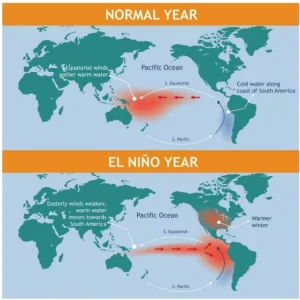
Key Characteristics: It is marked by abnormally warm sea surface temperatures in the central and eastern equatorial Pacific.
-
- There is suppression of nutrient-rich cold water upwelling off the coasts of Peru and Ecuador.
- Trade winds weaken during El Niño conditions.
- El Niño is often associated with a weaker Indian monsoon.
- Atmospheric Mechanism During El Niño: During El Niño, atmospheric pressure over the tropical Pacific becomes lower than normal.
- Rising air over the eastern Pacific leads to increased rainfall and storm activity.
- The western Pacific experiences sinking air, higher pressure, and more stable weather conditions.
- Impact on Global Climate: These pressures and rainfall changes propagate worldwide.
- They influence weather patterns far beyond the Pacific, including South Asia.
About El Niño–Southern Oscillation (ENSO)
- ENSO is a naturally occurring climate phenomenon involving periodic fluctuations in sea surface temperatures and atmospheric pressure over the equatorial Pacific Ocean.
- Phases of ENSO: It presents 3 phases: El Niño, La Niña and a neutral phase.
- La Niña (Cool phase): Abnormally cool sea surface temperatures in the central/eastern equatorial Pacific; strengthens trade winds; often linked to stronger Indian monsoon.
- Neutral (Normal phase): Near-average sea surface temperatures.
Key Differences Between El Niño and La Niña: (UPSC CSE Prelims 2011)
- El Niño is characterized by unusually warm sea surface temperatures in the central and eastern equatorial Pacific Ocean, while La Niña is characterized by unusually cold sea surface temperatures in the same region.
- El Niño generally weakens the South-West Monsoon and is associated with below-normal rainfall in India, whereas La Niña generally strengthens the monsoon and is associated with normal to above-normal rainfall.
- Both El Niño and La Niña are opposite phases of the El Niño–Southern Oscillation (ENSO) and significantly influence global weather and climate patterns.
|
Best Online Coaching for UPSC
Indicators of a Potential El Niño
- Sea Surface Temperature (SST) Anomalies: NOAA’s (National Oceanic and Atmospheric Administration) sea surface temperature anomaly data shows early signs of warming in the equatorial Pacific, contributing to the weakening of existing La Niña conditions.
- Subsurface Ocean Heat Content: Subsurface temperature anomalies show a large warm pool in the western Pacific.
- The warm pool is located at depths of about 100–250 metres.
- These warm anomalies are expanding below the ocean surface.
- This subsurface warming is weakening La Niña from the western Pacific side.
- Forecasts by Severe Weather Europe: Latest forecast data indicates El Niño could return in 2026, strengthening during the second half of the year.
- ECMWF (European Centre for Medium-Range Weather Forecasts) Seasonal Forecast: The ECMWF seasonal forecast shows ENSO conditions entering the El Niño range by summer 2026.
Possible Climate Impacts
- Temperature Close to Threshold: A renewed El Niño could push global temperatures closer to or above the 1.5°C threshold.
- Scientists warn of heightened risks of more frequent and intense heatwaves, droughts, wildfires, and extreme weather events.
- Impact on India: Several past monsoon droughts in India have been linked to El Niño conditions in the equatorial Pacific.
- During El Niño events, altered pressure patterns often suppress monsoon rainfall over India.
Significance of the New Changes
- Proactive Governance: Shifts policy from reactive disaster relief to preventative agricultural planning, preserving farming livelihoods before the dry spell hits peak intensity.
- Scientific Risk Gridding: Utilizing data-backed irrigation percentages helps the administration allocate resources directly to water-starved areas instead of spreading aid too thin.
- Preserving Food Supply Chains: Taking early steps shields critical Kharif crops (like rice, pulses, and oilseeds), helping keep national food inflation in check.
Associated Challenges
- Deep Rainfed Vulnerability: Because nearly half of India’s farmlands lack canal or pump access, any extended El Niño delay causes immediate economic stress across the rural sector.
- Groundwater Over-extraction: Forcing medium and low-priority zones to pump more water during surface-dry spells risks depleting shallow aquifers even further.
- Logistical Friction: Moving bulky livestock feed across multiple state lines requires high-level inter-state transport coordination to avoid local supply bottlenecks.
Click to Know UPSC OnlyIAS Coaching Centres
Way Forward
- Expanding Micro-irrigation: Shifting focus toward drip and sprinkler systems through programs like Pradhan Mantri Krishi Sinchayee Yojana (PMKSY) to maximize every drop of stored water.
- Climate-Smart Seed Adoption: Subsidizing short-duration, heat-tolerant seed varieties to ensure fields mature even if the monsoonal wet window shortens.
- Reforming Local Water Storage: Moving from temporary earth excavations to permanent, desilted community tanks and check-dams to capture unpredictable downpours.