UPSC PYQs

Prelims, Mains & Optional PYQs

UPSC Notes

Comprehensive & Short Notes

News in Shorts 04 August 2026: Satish Gujral, Glaw Lake, Republic of Naoero & more

4 Aug 2026

News in Shorts 04 August 2026: Satish Gujral, Glaw Lake, Republic of Naoero & more

ONGC to Develop Strategic Petroleum Reserve at Mangaluru

Context: The Union Government informed Parliament that ONGC will reserve 50% of its proposed 1.75 MMT crude oil storage facility at Mangaluru as a Strategic Petroleum Reserve (SPR).

UPSC Online Courses

Key Announcements

ONGC

  • Strategic Reserve at Mangaluru: ONGC is developing a 1.75 MMT crude oil storage facility at Mangaluru, with 50% earmarked as strategic storage and the remaining 50% for commercial operations.
  • Current Storage Capacity: India’s existing crude oil and petroleum product storage can meet 74 days of net crude import requirements.
  • Expansion of Strategic Reserves: The Government plans to add 6.5 MMT of additional storage capacity, including:
    • 4 MMT at Chandikhol (Odisha) and Padur (Karnataka).
  • Chandikhol Project: The estimated project cost is about ₹9,000 crore, and the draft Request for Proposal (RFP) and Concession Agreement are being finalised.

About Strategic Petroleum Reserve (SPR)

  • Strategic Petroleum Reserve (SPR) refers to government-owned emergency crude oil stockpiles maintained to ensure energy security during supply disruptions or geopolitical crises.
  • IEA Mandate: The International Energy Agency recommends a 90-day reserve of net oil imports to maintain oil supply security during a crisis.
  • Management: India’s SPR facilities are developed and managed by the Indian Strategic Petroleum Reserves Limited (ISPRL), a wholly owned subsidiary of the Oil Industry Development Board (OIDB) under the Ministry of Petroleum and Natural Gas.
  • Existing SPR Locations: India currently has operational strategic petroleum reserves at:
    • Visakhapatnam (Andhra Pradesh)
    • Mangaluru (Karnataka)
    • Padur (Karnataka)
  • Proposed SPR Facilities: Chandikhol in Odisha, Bina in Madhya Pradesh, Bikaner in Rajasthan, and Mangaluru and Padur in Karnataka.


Satish Gujral

Context: Recently, the Department of Posts released a commemorative postage stamp to mark the centenary of renowned artist, architect, sculptor, muralist and writer Satish Gujral.

About Satish Gujral (1925–2020)

Satish Gujral

  • He was a distinguished Indian painter, sculptor, muralist, architect and writer who played a significant role in shaping post-Independence Indian modernism.
    • He received the Padma Vibhushan in 1999.
  • Early Life: Born in Jhelum in undivided Punjab, Gujral suffered a swimming accident at eight that left him bedridden for several years and impaired his hearing, leading him towards drawing and literature.
    • He studied at the Mayo School of Arts, Lahore, and later at the Sir J.J. School of Art, Bombay.
  • Notable Works and Themes:
    • Partition Series: His Partition Series portrayed the trauma and suffering of refugees during the 1947 Partition.
    • Political Portraits: Beginning in the 1950s, Gujral created portraits of India’s political leaders such as Jawaharlal Nehru, Indira Gandhi, Maulana Azad, Krishna Menon, etc.
    • Muralism: After training in Mexico under muralists Diego Rivera and David Alfaro Siqueiros, he introduced large-scale mural techniques to Indian public art.
    • Burnt Wood Sculptures: He developed innovative sculptures using burnt and charred wood, along with materials such as steel, copper, bronze and glass, creating a distinctive artistic vocabulary.
    • Architecture: Despite lacking formal architectural training, he designed notable structures, including the Embassy of Belgium in New Delhi, recognised for its distinctive exposed-brick and organic architectural design.
  • Legacy: Satish Gujral is remembered for his exceptional versatility across painting, sculpture, muralism, architecture and writing, with his works contributing significantly to India’s modern artistic and cultural heritage.

About Postage Stamp

  • A postage stamp is a small adhesive paper issued by a government or postal authority to indicate prepayment of postal charges and has also become an important medium of cultural representation.
  • Origin: The world’s first postage stamp, the Penny Black, was issued in Britain in 1840, while India’s first adhesive stamp, the Scinde Dawk, was issued in 1852 in Sind.
  • Types of Stamps in India Post
    • Definitive Stamps: Regular stamps issued for everyday postal use in different denominations.
    • Commemorative Stamps: Special issues released to honour notable personalities, events and historical milestones.
      • Commemorative stamps in India are decided by the Department of Posts under the Ministry of Communications, with recommendations provided by the Philatelic Advisory Committee (PAC).
    • Thematic/Special Issues: Stamps focusing on themes such as nature, heritage, architecture and science.
  • Uses: Postage stamps facilitate postal prepayment, preserve and promote cultural heritage, commemorate important personalities and events, and support philately as a hobby and collectible activity


Glaw Lake

Context: Glaw Lake has been designated India’s 101st Ramsar Site, becoming Arunachal Pradesh’s first internationally recognised wetland under the Ramsar Convention.
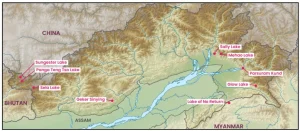
About Glaw Lake

Glaw Lake

  • Glaw Lake, also known as Glow Lake, is a pristine high-altitude natural freshwater lake situated in the Eastern Himalayas.
  • Location: The lake is located in Lohit district of Arunachal Pradesh, near Wakro, within the Kamlang Tiger Reserve and Wildlife Sanctuary, with Namdapha National Park lying to its south.
  • Key Features
    • High-Altitude Freshwater Ecosystem: Spread over nearly 8 sq km at an elevation of approximately 1,168 metres, the lake is an important source of the perennial Kamlang River.
    • Hydrological Significance: The lake is fed by perennial mountain streams originating from the Eastern Himalayan region and contributes to the local river system.
    • Floral Diversity: Its surrounding catchment supports rich vegetation, with over 150 tree species and 49 orchid species recorded within the site and its catchment.
    • Biodiversity Hotspot: Located within the Eastern Himalayan biodiversity hotspot, the landscape supports diverse wildlife and acts as a habitat and forest corridor for species such as the Hoolock Gibbon, Capped Langur, Red Panda and Mishmi Takin.

About Ramsar Sites

  • Ramsar Sites are wetlands of international importance designated under the Ramsar Convention on Wetlands, adopted in 1971 at Ramsar, Iran, to promote their conservation and wise use.
    • India joined the Ramsar Convention on February 1, 1982
  • India’s Position: With the designation of Glaw Lake, India has 101 Ramsar Sites covering 1,387,741 hectares as of August 2026.
    • Jai Prakash Narayan Bird Sanctuary (UP) was India’s 100th Ramsar Site.
  • Global Position: India ranks 3rd globally (after the United Kingdom and Mexico) and 1st in Asia for having the highest number(101) of Ramsar sites.
  • Largest Ramsar Site: Sundarban Wetland in West Bengal is India’s largest Ramsar site, covering approximately 4,230 sq km.
    • World’s largest individual Ramsar site is the Llanos de Moxos wetland in Bolivia, covering an immense area of over 6.9 million hectares
  • Smallest Ramsar Sites: Renuka Wetland (Himachal Pradesh) and Vembannur Wetland Complex (Tamil Nadu) are among the smallest, each covering about 0.2 sq km (20 hectares).
  • State with most Wetlands in India: Tamil Nadu has the highest number of Ramsar sites (20)
  • Montreux Record: Keoladeo National Park (Rajasthan) and Loktak Lake (Manipur) are India’s two wetlands listed under the Montreux Record.
    • The Montreux Record is a register of Ramsar sites where ecological character has changed, is changing, or is likely to change due to technological developments, pollution, or other human interference.

UPSC Online Classes

Republic of Naoero

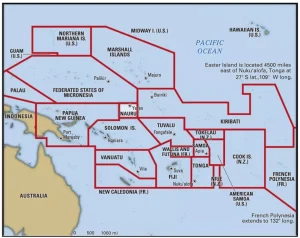
Context: Nauru has revised its official name to the Republic of Naoero.
Rationale of Renaming

Republic of Naoero

  • Decolonisation and Identity: The name Naoero is considered the indigenous form, while Nauru entered official records during German colonial rule; the revision seeks to reaffirm national identity and heritage.
  • Language Preservation: The change also aims to support dorerin Naoero, the country’s indigenous language classified by UNESCO as severely endangered, by strengthening its cultural and linguistic identity.

About the Republic of Naoero

  • The Republic of Naoero (formerly Nauru) is the world’s smallest independent republic, covering about 21 sq km
    • It has no official capital, while government offices and Parliament are located in Yaren District, the de facto capital.
  • Location and Neighbours: Nauru is an island nation in southeastern Micronesia in the southwestern Pacific Ocean, located about 42 km south of the Equator; its nearest neighbour is Banaba Island of Kiribati, around 300 km east.
  • Key Features
    • Geography: It is an oval-shaped raised coral island with a narrow fertile coastal belt surrounding a central phosphate plateau called Topside with Command Ridge as its highest point.
    • Climate and Hydrology: It has a hot, humid tropical marine climate with seasonal rainfall, no rivers or substantial lakes, and Buada Lagoon as its main inland water body.
    • Economy and Resources: Intensive phosphate mining has severely degraded its interior, leaving limited agricultural capacity and high dependence on imported food, fuel and manufactured goods.
  • Key Threats
    • Climate Vulnerability: Rising sea levels, coastal erosion and intensifying storms pose major threats to this low-lying island nation.
    • Resource and Economic Fragility: Environmental degradation, freshwater scarcity and depleted phosphate reserves have increased dependence on foreign aid, fishing licences and external economic support.
  • Strategic Significance
    • Maritime Zone: Despite its tiny landmass, Nauru possesses a large Exclusive Economic Zone (EEZ) supporting valuable tuna fisheries.
    • Deep-Sea Mining: Nauru is involved in efforts promoting deep-sea mining exploration in the Clarion-Clipperton Zone, which contains polymetallic nodules rich in minerals such as cobalt, nickel and manganese.

Click to Know UPSC Coaching Centres in India

Check Out UPSC CSE Books

Visit PW Store

online store 1

News in Shorts 04 August 2026: Satish Gujral, Glaw Lake, Republic of Naoero & more

Need help preparing for UPSC or State PSCs?

Connect with our experts to get free counselling & start preparing

Free Counselling for UPSC Aspirants

Connect with our experts and take the right next step.

Expert Guidance
Personalized Strategy
100% Free

Book Your Free Session

NEED ASSISTANCE?

Request a Callback

Our counsellor will connect with you and help you choose the right course and centre.

  • Expert Guidance
  • Course & Fee Information
  • Quick Callback Support

Request a Callback

Books
UPSC PYQs
UPSC Notes
Current Affairs
Quick Revise Now !
AVAILABLE FOR DOWNLOAD SOON
UDAAN PRELIMS WALLAH
Comprehensive coverage with a concise format
Integration of PYQ within the booklet
Designed as per recent trends of Prelims questions
हिंदी में भी उपलब्ध
Quick Revise Now !
UDAAN PRELIMS WALLAH
Comprehensive coverage with a concise format
Integration of PYQ within the booklet
Designed as per recent trends of Prelims questions
हिंदी में भी उपलब्ध

<div class="new-fform">


    </div>

    Subscribe our Newsletter
    Sign up now for our exclusive newsletter and be the first to know about our latest Initiatives, Quality Content, and much more.
    *Promise! We won't spam you.
    Yes! I want to Subscribe.