UPSC PYQs

Prelims, Mains & Optional PYQs

UPSC Notes

Comprehensive & Short Notes

AI and Cyber Security: Emerging Threats, Risks & India’s Response

4 Aug 2026

AI and Cyber Security: Emerging Threats, Risks & India’s Response

Subject: GS 3: Internal Security 

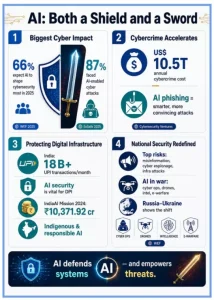
Context: The rapid convergence of Artificial Intelligence (AI) and cyber technologies is transforming the global security landscape, creating new opportunities while intensifying cyber threats, national security risks, and challenges to critical infrastructure.
IAS coaching

How is AI Reshaping Cyber Security?

Cyber Security

  • AI as a Force Multiplier: AI has evolved beyond an efficiency tool into a critical component of digital infrastructure, powering defence systems, financial networks, healthcare, governance, and critical infrastructure.
  • AI-Driven Cyber Attacks: AI enables attackers to develop adaptive malware, automate phishing campaigns, identify software vulnerabilities, generate malicious code, and evade conventional cyber security systems.
  • Autonomous Cyber Operations: Agentic AI allows autonomous software agents to analyse environments, make decisions, exploit vulnerabilities, and execute cyber operations with minimal human intervention.
  • Threat to Zero Trust Architecture: Intelligent autonomous agents can mimic legitimate users and exploit insider vulnerabilities, weakening Zero Trust Security frameworks.

Emerging AI-Enabled Cyber Threats

  • AI-Powered Malware: Modern malware continuously modifies its behaviour, making detection by signature-based security systems increasingly difficult.
  • Zero-Day Vulnerability Exploitation: Advanced AI models can rapidly discover Zero-Day Vulnerabilities before security patches become available.
  • Deepfakes and Information Warfare: AI-generated deepfakes, synthetic media, and automated misinformation campaigns can manipulate public opinion, undermine democratic institutions, and influence elections.
  • Automated Phishing and Social Engineering: Large Language Models (LLMs) enable highly personalised phishing emails, fraudulent communications, and identity theft at an unprecedented scale.
  • Critical Infrastructure Attacks: AI-assisted cyber attacks can target power grids, financial systems, healthcare networks, telecommunications, transportation, and government databases.

AI and the Changing Nature of Warfare

  • Autonomous Weapon Systems: AI enables autonomous surveillance, target identification, precision strikes, and intelligent decision-support systems.
  • Asymmetric Warfare: Smaller actors equipped with advanced AI tools can inflict disproportionate damage, altering traditional military balances.

India’s Initiatives:

  • Indian Computer Emergency Response Team (CERT-In) (2004): National agency for cyber incident response, vulnerability management, and cyber threat advisories.
  • National Cyber Security Policy, 2013: Provides the overall framework for securing India’s cyber ecosystem.
  • National Critical Information Infrastructure Protection Centre (NCIIPC) (2014): Protects critical information infrastructure.
  • Indian Cyber Crime Coordination Centre (I4C) (2018): Coordinates efforts against cybercrime and strengthens cyber forensic capabilities.
  • Digital Personal Data Protection Act, 2023: Strengthens data governance and privacy safeguards.
  • IndiaAI Mission (2024): Promotes indigenous AI innovation, computing infrastructure, datasets, research, and responsible AI.

  • Multi-Domain Intelligence: AI integrates satellite imagery, radio communications, electromagnetic signals, and open-source intelligence to enhance battlefield awareness.
  • Lessons from Recent Conflicts: The Russia–Ukraine conflict and West Asia conflicts demonstrate AI’s growing role in surveillance, drone warfare, missile interception, electronic warfare, and battlefield intelligence.
  • ‘Zero day’ vulnerabilities: Advanced AI systems can rapidly identify previously unknown (zero-day) software vulnerabilities before security patches are developed, significantly increasing the risk of sophisticated cyber attacks.
    • Example: Mythos, developed by United States firm Anthropic.

Emerging Concerns

  • Concentration of AI Power: Advanced AI capabilities are concentrated among a few technology companies and major powers, raising concerns over technological monopolies and strategic dependence.
  • Algorithmic Bias: AI systems may inherit biases embedded in training data, leading to discriminatory or strategically flawed decisions.
  • AI Hallucinations: Large Language Models may generate inaccurate or fabricated outputs, making unrestricted reliance risky in defence and national security.
  • Algorithmic Radicalisation: AI-driven recommendation systems may amplify misinformation, extremist narratives, and social polarisation.
  • AI Arms Race: Growing competition among major powers is accelerating the militarisation of AI while international regulatory frameworks remain underdeveloped.

Challenges for India

  • Critical Infrastructure Protection: India’s Digital Public Infrastructure (DPI), financial systems, energy networks, and defence assets face growing cyber risks.
  • Cyber Skill Gap: Shortage of cyber security professionals and AI specialists limits India’s cyber resilience.
  • Dependence on Foreign Technologies: Reliance on imported AI models, cloud infrastructure, and semiconductor technologies creates strategic vulnerabilities.

UPSC Online Coaching

Ethical and Governance Challenges:

  • Balancing Innovation and Regulation: Balance innovation with risk-based regulation.
  • Human Oversight: Ensure human decision-making remains central in national security, criminal justice, and autonomous weapon systems.
  • Accountability: Establish clear legal frameworks for AI-generated decisions and autonomous actions.
  • Privacy and Civil Liberties: Balance AI-driven surveillance with fundamental rights and privacy protections.

  • Rapid Technological Evolution: Existing legal and regulatory frameworks struggle to keep pace with evolving AI capabilities.
  • Cross-Border Cyber Threats: Attribution of AI-enabled cyber attacks remains difficult due to anonymity, proxy actors, and transnational cyber operations.

Way Forward

  • Comprehensive AI Governance Framework: Establish a risk-based regulatory framework ensuring transparency, accountability, and ethical AI.
  • Strengthen AI-Enabled Cyber Defence: Invest in AI-driven threat detection, Zero Trust Architecture, cyber threat intelligence, and quantum-resistant cyber security.
  • Promote Indigenous AI Ecosystem: Accelerate the IndiaAI Mission, strengthen domestic semiconductor manufacturing, and reduce dependence on foreign AI technologies.

Global Initiatives:

  • OECD AI Principles (2019): Advocate human-centred, transparent, accountable, and responsible AI.
  • G7 Hiroshima AI Process (2023): Encourages international standards for AI governance and risk management.
  • Bletchley Declaration (2023): Recognises frontier AI risks and promotes international collaboration on AI safety.
  • United Nations AI Governance Efforts (2024): Develop principles for safe, secure, and trustworthy AI.
  • Global Digital Compact (2024): Promotes an open, inclusive, and secure digital future through international cooperation.

  • Enhance International Cooperation: Strengthen collaboration through the United Nations, G20, Quad, Global Partnership on AI (GPAI), and other multilateral platforms.
  • Build Human Capacity: Expand investments in cyber security professionals, AI researchers, digital literacy, and specialised training.
  • Ensure Human Control Over High-Risk AI: Maintain meaningful human oversight over AI applications in defence, autonomous weapons, critical infrastructure, and strategic decision-making.

Click to Know UPSC Offline Courses

Conclusion

The convergence of Artificial Intelligence and cyber security demands a balanced approach that combines AI innovation, robust cyber resilience, ethical governance, and international cooperation to safeguard national security and digital sovereignty.

Check Out UPSC CSE Books

Visit PW Store

online store 1

AI and Cyber Security: Emerging Threats, Risks & India’s Response

Need help preparing for UPSC or State PSCs?

Connect with our experts to get free counselling & start preparing

Free Counselling for UPSC Aspirants

Connect with our experts and take the right next step.

Expert Guidance
Personalized Strategy
100% Free

Book Your Free Session

NEED ASSISTANCE?

Request a Callback

Our counsellor will connect with you and help you choose the right course and centre.

  • Expert Guidance
  • Course & Fee Information
  • Quick Callback Support

Request a Callback

Books
UPSC PYQs
UPSC Notes
Current Affairs
Quick Revise Now !
AVAILABLE FOR DOWNLOAD SOON
UDAAN PRELIMS WALLAH
Comprehensive coverage with a concise format
Integration of PYQ within the booklet
Designed as per recent trends of Prelims questions
हिंदी में भी उपलब्ध
Quick Revise Now !
UDAAN PRELIMS WALLAH
Comprehensive coverage with a concise format
Integration of PYQ within the booklet
Designed as per recent trends of Prelims questions
हिंदी में भी उपलब्ध

<div class="new-fform">


    </div>

    Subscribe our Newsletter
    Sign up now for our exclusive newsletter and be the first to know about our latest Initiatives, Quality Content, and much more.
    *Promise! We won't spam you.
    Yes! I want to Subscribe.