Race for the Next UN Secretary-General (UNSG) Begins
Context: The UN Security Council (UNSC) has conducted its first straw poll to select the next UN Secretary-General (2027–2031 term), with the new Secretary-General set to assume office on January 1, 2027.
UPSC Online Courses
About the UN Security Council (UNSC)

- The UNSC is one of the six principal organs of the United Nations and bears primary responsibility for maintaining international peace and security.
- Composition of the UN Security Council (UNSC): The UNSC comprises 15 members:
- 5 Permanent Members (P5): China, France, Russia, the United Kingdom, and the United States (each holds veto power).
- 10 Non-Permanent Members: Elected by the UN General Assembly for two-year terms.
- Headquarters: New York City, United States.
- Presidency: The Presidency of the UN Security Council rotates monthly among all 15 members.
- The rotation follows the English alphabetical order of the official names of the member states.
- Veto Power: Only the P5 possess the veto.
- A single veto can block a substantive resolution.
- Key Functions: Adopt binding resolutions.
- Impose sanctions, Authorise peacekeeping operations and, where necessary, the use of force.
- Recommend the appointment of the UN Secretary-General to the General Assembly.
- Recommend admission of new UN members to the General Assembly.
About the UN Secretary-General (UNSG)
- The UN Secretary-General is the Chief Administrative Officer of the United Nations under Article 97 of the UN Charter.
- Term: Five years, with the possibility of reappointment (no formal term limit under the UN Charter).
- Current Secretary-General: António Guterres (since 1 January 2017; currently serving his second term, ending 31 December 2026).
Appointment Process of the UN Secretary-General
- Role of the UN Security Council: Under Article 97 of the UN Charter, the Secretary-General is appointed by the UN General Assembly upon the recommendation of the UN Security Council (UNSC).
- The UNSC recommends only one candidate, who is then formally endorsed by the General Assembly.
- Straw Poll Process: The UNSC conducts a series of informal secret “straw polls” to gauge support for candidates. Each member marks:
- “Encourage”: supports the candidate.
- “Discourage”: opposes the candidate.
- Blank: neutral/no opinion.
- Initially, votes are anonymous, but in later rounds P5 ballots are colour-coded to identify any potential veto.
- Winning Requirement: A candidate must secure:
- At least 9 “Encourage” votes in the 15-member UNSC, and
- No “Discourage” vote from any of the P5, as it effectively amounts to a veto.
Lunar Collision
Context: On 5th August 2026, a piece of SpaceX Falcon 9 hardware is set to hit the moon, near Einstein Crater.
Key Points
- The object (known as 2025-010D) heading toward the moon is the upper stage of a SpaceX Falcon 9 rocket.
- The Rocket was launched in January 2025 to send two satellites towards the Moon.
- Researchers estimate that it will hit the moon at a speed of roughly 8,750 kilometers per hour (5,400 mph).
- The unusual collision could give scientists a rare look at what happens when a human-made object slams into the lunar surface.
About Falcon 9
- Falcon 9 is a reusable, two-stage rocket designed and manufactured by SpaceX for the reliable and safe transport of people and payloads into Earth orbit and beyond.
- It is the world’s first orbital class reusable rocket.
- Propellants: Rocket-Grade Kerosene (RP-1) as fuel and Liquid Oxygen (LOX) as oxidizer across both stages.
- Propulsion Systems:
- First Stage: Powered by 9 SpaceX Merlin 1D engines.
- Second Stage: Powered by 1 Vacuum Merlin engine designed to operate in space vacuum.
- Reusable First Stage: The first-stage booster returns to Earth through controlled vertical landing on land or autonomous drone ships, significantly reducing launch costs.
- Main Uses: Launches commercial and scientific satellites, transports astronauts and cargo to the International Space Station (ISS), deploys Starlink satellites, and supports lunar and deep-space exploration missions.
| The last time a similar event was observed was NASA’s 2009 LCROSS mission, which deliberately crashed a rocket stage near the moon’s south pole and confirmed water ice in the debris it kicked up. |
Extension of Khelo India Scheme
Context: The Union Cabinet approved the expanded Khelo India Scheme (2026–31) with an outlay of ₹29,054 crore to strengthen grassroots sports and Olympic preparation.
About Khelo India Scheme

- Khelo India is the Government of India’s flagship programme for promoting grassroots sports, talent identification, infrastructure development, and excellence in competitive sports across the country.
- Origin: The scheme was launched in 2018, replacing the earlier Rajiv Gandhi Khel Abhiyan and other sports development initiatives under a unified framework.
- Nodal Ministry: The scheme is implemented by the Ministry of Youth Affairs and Sports.
- Extended Phase (2026–31): The revamped phase has been approved with an outlay of ₹29,054 crore, while the combined allocation for Khelo India and Assistance to National Sports Federations (ANSFs) stands at ₹36,441 crore for 2026–31.
- Key Features
- Expanded Athlete Support: The scheme introduces Emerging Khelo India Athletes (E-KIAs), expanding the supported athlete base from about 2,900 to nearly 28,000.
- Education–Sports Integration: Khelo India Feeder Schools (KIFS) and Khelo India Utkrishta Vidyalayas (KIUV) will integrate sports with formal education in line with the National Education Policy (NEP).
- Digital Sports Ecosystem: Athlete performance will be digitally tracked to enable transparent talent identification, monitoring, and communication from grassroots to elite levels.
- Infrastructure and Partnerships: The scheme will expand Khelo India Centres, Centres of Excellence, and accredited academies, while strengthening public-private partnerships to improve sports infrastructure and coaching.
- Strategic Targets
- Preparing for Global Events: The scheme aims to build a strong athlete pipeline for the 2030 Commonwealth Games in Ahmedabad and India’s proposed 2036 Olympic Games.
- Global Sporting Ambitions: India aims to become a top-10 sporting nation by 2036 and a top-5 sporting nation by 2047 through sustained investment in grassroots sports.
- Strengthening the Sports Ecosystem: The programme seeks to improve coaching standards, promote a sports culture through Fit India, and strengthen anti-doping measures to enhance India’s international sporting performance.
National Handloom Day
Context: President Droupadi Murmu will present the Handloom Awards 2025 during the National Handloom Day celebrations on 7 August to honour excellence in India’s handloom sector.
About National Handloom Day
- National Handloom Day is observed annually on 7 August to celebrate India’s rich handloom heritage, recognise the contribution of weavers, and promote sustainable, indigenous handloom products.
- Origin: The observance commemorates the Swadeshi Movement, launched on 7 August 1905 at Calcutta Town Hall, which encouraged the use of indigenous goods and the boycott of foreign products.
- Launch: The Government of India instituted National Handloom Day in 2015, and the first celebration was held on 7 August 2015.
- Organised By: The annual celebrations are organised by the Ministry of Textiles, involving exhibitions, awareness campaigns, and programmes to promote traditional weaving and support handloom artisans.
- Significance: The day recognises the economic, cultural, and social contribution of handloom weavers, promotes “Vocal for Local”, and encourages the preservation of India’s diverse weaving traditions.
UPSC Online Classes
National Handloom Awards and Sant Kabir Handloom Award
- The National Handloom Awards are among India’s highest honours in the handloom sector, recognising outstanding contributions to craftsmanship, innovation, design, entrepreneurship, and market development.
- Presented By: The awards are presented by the President of India under the Handloom Marketing Assistance (HMA) component of the National Handloom Development Programme (NHDP) administered by the Ministry of Textiles.
- Sant Kabir Handloom Award: The Sant Kabir Handloom Award is the highest national honour for handloom weavers, recognising lifetime excellence in traditional weaving, innovation, mentoring, and community development.
- Awardees receive a mounted gold coin, Tamrapatra (copper plaque), shawl, and certificate.
- Handloom Awards 2025: A total of 22 awardees have been selected, comprising 3 recipients of the Sant Kabir Handloom Award and 19 recipients of the National Handloom Award, for their exceptional contribution to preserving India’s handloom heritage while promoting innovation and global competitiveness.
Sant Kabir Handloom Award 2025 Awardees
- Ram Meher (Odisha): Honoured for preserving and promoting the traditional Bichitrapuri Khadi Saree weaving craft from Bargarh district.
- Runima Chetiya Choudhury (Assam): Recognised for excellence in weaving the iconic Muga Silk Saree, a hallmark of Assam’s indigenous silk heritage.
- Shah Muhammad Ansari (Uttar Pradesh): Awarded for revitalising the languishing Zarbaft Shewatambari Awadh Jamdhani Saree weaving tradition from Varanasi.
Clouded Leopard
Context: The Centre has launched the Clouded Leopard Conservation Action Plan (CAP) to strengthen habitat protection and scientific conservation across Northeast India.
About Clouded Leopard
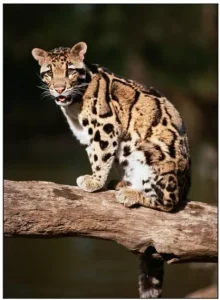
- The Clouded Leopard (Neofelis nebulosa) is a medium-sized wild cat regarded as an evolutionary link between small and large felines and is the State Animal of Meghalaya.
- Habitat: It inhabits tropical rainforests, subtropical forests, moist evergreen forests, mangrove forests, and montane forests, extending to elevations of about 9,000 feet.
- Distribution: The species occurs across the Eastern Himalayas, Northeast India, Bhutan, Nepal, Bangladesh, mainland Southeast Asia, and southern China, while it is considered regionally extinct in Taiwan and Singapore.
- In India, it is primarily found in Arunachal Pradesh, Assam, Meghalaya, and Mizoram, particularly in the forests of Northeast India.
- Key Features
- Distinctive Appearance: The species possesses cloud-shaped dark blotches on its coat and has the longest canine teeth relative to skull size among all living cat species.
- Exceptional Arboreal Ability: It can climb down vertical tree trunks headfirst, aided by highly flexible ankle joints, broad paws, and a long balancing tail.
- Ecological Importance: The clouded leopard serves as an indicator species of healthy forest ecosystems, reflecting the ecological integrity of dense forests.
- Threats: The principal threats include habitat loss and fragmentation, poaching for illegal wildlife trade, human–wildlife conflict, and accidental capture in wire snares.
- Conservation Status
- IUCN Red List: Vulnerable
- Wildlife (Protection) Act, 1972: Schedule I
- CITES: Appendix I
Click to Know UPSC Coaching Centres in India
Clouded Leopard Conservation Action Plan (CAP)
- The Clouded Leopard Conservation Action Plan (CAP) adopts a landscape-based approach to secure the long-term conservation of the species across Northeast India.
- Nodal Body: The plan was prepared under the Government of India–Global Environment Facility (GEF)–United Nations Development Programme (UNDP) initiative and released during the 91st meeting of the Standing Committee of the National Board for Wildlife (SCNBWL).
- Key Initiatives
-
- Habitat Conservation: The plan identifies 14 priority conservation landscapes and promotes habitat restoration and wildlife corridor conservation to improve forest connectivity.
- Scientific Monitoring: It recommends camera trapping, occupancy surveys, genetic analysis, and environmental Deoxyribonucleic Acid (eDNA) monitoring to strengthen scientific assessment of the species.
- Community Participation and Protection: The plan promotes community-led conservation, anti-poaching measures, monitoring through the Monitoring System for Tigers – Intensive Protection and Ecological Status (M-STrIPES) application, transboundary cooperation, and climate-resilient conservation planning
 5 Aug 2026