Subject: GS 3: Environment
Context: Europe is witnessing increasingly severe wildfires, with recent fires across Greece, Spain, France, Portugal, Italy, Cyprus, and Croatia causing mass evacuations and extensive forest loss.
UPSC Course Fees Online
Why are Europe’s Wildfires Becoming More Severe?
- Climate Change: Rising global temperatures, prolonged heatwaves, and recurrent droughts have created hotter and drier conditions, significantly increasing the frequency, intensity, and duration of wildfires across Europe.
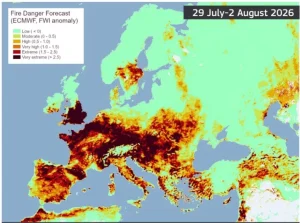 Climate Whiplash: Rapid transitions from excessive rainfall to extreme heat and drought promote dense vegetation growth, which later dries into highly combustible fuel loads, accelerating wildfire spread.
- Land-use Changes: Rural depopulation, declining livestock grazing, and the abandonment of agricultural lands have resulted in the accumulation of dense shrubs and dry undergrowth, creating continuous fuel that enables fires to spread farther and faster.
- Fire Suppression Paradox: Decades of successfully suppressing smaller fires have prevented the natural removal of combustible vegetation, allowing fuel loads to accumulate and making subsequent wildfires far more destructive.
- Sixth-Generation Wildfires: Modern wildfires increasingly develop into high-intensity fires capable of generating their own weather systems, making them highly unpredictable and extremely difficult to contain.
About Climate Whiplash
- It refers to rapid shifts between contrasting weather extremes within a short period.
- Wildfire Mechanism: An unusually wet season promotes rapid vegetation growth, which is subsequently dried by heatwaves and drought, creating extensive layers of highly combustible fuel.
- Climate Link: Global warming is intensifying both extreme rainfall and prolonged dry spells, making climate whiplash events more frequent and increasing wildfire risk.
About Fire Clouds (Pyrocumulonimbus or PyroCb):
- PyroCb are fire-generated thunderstorms that develop above extremely intense wildfires.
- Formation: Intense wildfire heat lifts hot air, smoke, ash, and moisture high into the atmosphere. As the air cools, moisture condenses around smoke particles, forming towering PyroCb clouds.
- Characteristics: These clouds can rise 10–15 km into the atmosphere, generate lightning that ignites new fires, produce erratic winds that rapidly alter fire behaviour, and create self-sustaining fire weather, making wildfires increasingly difficult to control.
What are Sixth-Generation Wildfires?
- These are extremely high-intensity fires capable of generating Pyrocumulonimbus clouds and their own localized weather systems.
- Characteristics: They spread rapidly due to extreme heat, strong winds, and large fuel loads, while releasing massive amounts of carbon dioxide, accelerating climate change.
- Impact: These fires cause widespread ecosystem destruction, biodiversity loss, and pose severe risks to human settlements, critical infrastructure, and firefighters.
|
Wildfires in India
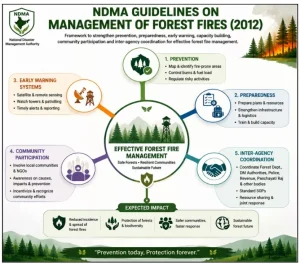
- Growing Forest Fire Risk: Forest fires are a recurring feature of India’s dry season, with the Forest Survey of India (FSI) detecting over 2 lakh forest fire alerts annually through its satellite-based Forest Fire Alert System.
- According to the India State of Forest Report (ISFR) 2023, around 36% of India’s forest cover is prone to frequent forest fires, while nearly 4% is classified as extremely fire-prone.
- Major Fire-Prone Regions: The highest fire susceptibility is observed in the North-Eastern states, parts of Odisha, Chhattisgarh, Madhya Pradesh, and the Himalayan states of Uttarakhand and Himachal Pradesh, owing to their climatic conditions, forest composition, and prolonged dry periods.
- Predominantly Human-Induced: Unlike Europe, where lightning, climate whiplash, and Pyrocumulonimbus (PyroCb) events are increasingly influencing wildfire behaviour, over 90–95% of forest fires in India are estimated to be caused by human activities, including agricultural residue burning, collection of non-timber forest produce, shifting cultivation, grazing, and accidental ignition.
Way Forward
- Active Landscape Management: Governments should promote controlled burning, managed livestock grazing, removal of excess dry undergrowth, and the creation of firebreaks to reduce combustible fuel loads.
Global Initiatives:
- Sendai Framework for Disaster Risk Reduction (2015–2030): Promotes disaster risk reduction through risk-informed governance, preparedness, resilience, and the Build Back Better approach.
- European Forest Fire Information System (EFFIS): Established under the Copernicus Emergency Management Service, EFFIS provides real-time wildfire monitoring, early warning, fire danger assessment, and post-fire damage analysis across Europe.
- United Nations Decade on Ecosystem Restoration (2021–2030): Supports the restoration of degraded ecosystems to enhance climate resilience, conserve biodiversity, and reduce the risk of environmental disasters, including wildfires.
- OECD Report on Wildfire Risk (2023): Highlights that land abandonment, fuel accumulation, and climate change are key drivers of increasingly frequent and intense wildfires, and advocates integrated landscape management and climate adaptation strategies.
|
Click to Know UPSC Coaching Centres in India
- Climate Adaptation: Wildfire risk management should be integrated into climate adaptation, forest management, and land-use planning to address the growing impact of climate change.
- Early Warning and Preparedness: Investments in satellite monitoring, AI-based fire prediction, risk communication, and timely evacuation systems should be strengthened to minimise the loss of life and property.
- Revitalising Rural Landscapes: Sustainable agriculture, agroforestry, and incentives for rural communities should be promoted to prevent land abandonment and maintain resilient landscapes.
- Building Fire-Resilient Ecosystems: Forest restoration should prioritise native, biodiverse, and fire-resilient species instead of highly flammable monoculture plantations.
- International Cooperation: Countries should strengthen cooperation on climate action, forest conservation, technology sharing, and disaster risk reduction to tackle increasingly transboundary wildfire risks.
 5 Aug 2026