UPSC PYQs

Prelims, Mains & Optional PYQs

UPSC Notes

Comprehensive & Short Notes

Draft CAFE-III Norms 2027–2032: Fuel Efficiency, CO₂ Targets and Key Features

17 Jul 2026

Draft CAFE-III Norms 2027–2032: Fuel Efficiency, CO₂ Targets and Key Features

Subject: GS 3: Environment

Context: Recently, the Ministry of Power has released the Draft Corporate Average Fuel Economy (CAFE-III) Norms for 2027–2032, proposing stricter fuel efficiency and carbon emission standards for passenger vehicles. 
UPSC Online Coaching

Key Highlights of the Draft Corporate Average Fuel Economy (CAFE-III) Norms

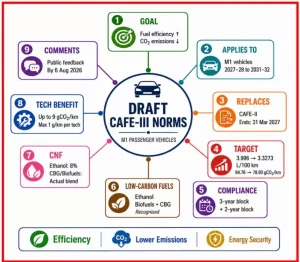
  • The Draft CAFE-III Norms aim to progressively improve fuel efficiency, reduce carbon dioxide (CO₂) emissions, and support India’s climate and energy conservation goals.
  • Applicability: The norms will apply to M1 category passenger vehicles (vehicles with up to eight passenger seats besides the driver) manufactured or imported for sale in India during 2027–28 to 2031–32.
  • CAFE-III NormsReplacement of CAFE-II: The proposed norms will replace the existing CAFE-II norms, which are scheduled to expire on 31 March 2027.
  • Progressive Tightening of Targets: The draft proposes reducing the corporate average fuel consumption target from 3.996 litres/100 km (94.76 gCO₂/km) in 2027–28 to 3.3273 litres/100 km (78.90 gCO₂/km) by 2031–32.
  • Compliance Assessment: Compliance will be evaluated in two phases—an initial three-year block, followed by a two-year block, providing manufacturers with a predictable regulatory framework.
  • Recognition of Low-Carbon Fuels: For the first time, the norms propose recognising the carbon neutrality of ethanol, biofuels and Compressed Biogas (CBG) by allowing specified reductions in declared tailpipe CO₂ emissions during compliance assessment.
  • Carbon Neutrality Factor (CNF):
    • An 8% Carbon Neutrality Factor (CNF) has been proposed for the current level of ethanol blending.
    • For CBG and other biofuels, the reduction will depend on the prevailing actual blending level.
  • Technology Incentives: Vehicle manufacturers will be eligible to claim up to 9 gCO₂/km as compliance benefits for approved fuel-saving technologies, subject to a maximum benefit of 1 gCO₂/km per technology.

About Corporate Average Fuel Economy (CAFE) Norms

  • Corporate Average Fuel Economy (CAFE) norms prescribe the average fuel consumption and carbon dioxide (CO₂) emission limits that a vehicle manufacturer must achieve across its fleet of passenger vehicles sold in a financial year.
  • Objective: To improve fuel efficiency, reduce dependence on fossil fuels, lower greenhouse gas emissions, enhance energy security, and help India meet its climate commitments.
  • Implementation: The norms are implemented under the Energy Conservation Act, 2001 by the Bureau of Energy Efficiency (BEE) in consultation with the Ministry of Power.
  • Compliance Principle: Compliance is assessed on the corporate fleet average of each manufacturer rather than on individual vehicle models, allowing flexibility in product design while ensuring overall emission reductions.
  • Coverage: The norms currently apply to M1 category passenger vehicles, including cars with up to eight passenger seats in addition to the driver’s seat.
  • CAFE norms in India began with CAFE-I (2017-2022) and CAFE-II (2022-2027); CAFE-III will be the third phase, indicating a progressively tightening regulatory trajectory consistent with India’s climate commitments 

Comparison of CAFE Norms in India

Parameter CAFE-I CAFE-II Draft CAFE-III
Implementation Period 2017–18 to 2021–22 2022–23 to 2026–27 2027–28 to 2031–32 (Proposed)
Primary Objective Introduce fleet-level fuel efficiency standards Tighten fuel efficiency and CO₂ emission norms Accelerate decarbonisation through stricter fuel efficiency standards and recognition of low-carbon fuels
Fuel Consumption / CO₂ Target Introduced first fleet-average limits More stringent than CAFE-I Tightened from 3.996 L/100 km (94.76 gCO₂/km) in 2027–28 to 3.3273 L/100 km (78.90 gCO₂/km) by 2031–32
Recognition of Alternative Fuels Not provided Limited recognition Recognises ethanol, biofuels and Compressed Biogas (CBG) through Carbon Neutrality Factor (CNF)

Click to Know UPSC Offline Courses

Distinguishing CAFE from Other Related Regulations

Aspect CAFE Norms Bharat Stage VI (BS-VI) Norms FAME Scheme
Objective Improve fuel efficiency and reduce CO₂ emissions Reduce tailpipe air pollutants Promote adoption of electric vehicles (EVs)
Focus Fuel consumption and carbon emissions Vehicle emission standards (PM, NOx, HC, CO) Demand incentives and EV charging infrastructure
Nature Regulatory fuel-efficiency standards for manufacturers Emission control regulations for vehicles and fuels Government incentive scheme
Applicability Passenger vehicle manufacturers (fleet-average norms) All applicable vehicle categories EV buyers, manufacturers, and charging ecosystem
Key Outcome Lower CO₂ emissions and improved fuel economy Better air quality through reduced pollutants Faster EV penetration and reduced fossil fuel dependence

Check Out UPSC CSE Books

Visit PW Store


online store 1

Draft CAFE-III Norms 2027–2032: Fuel Efficiency, CO₂ Targets and Key Features

Explore UPSC Foundation Batches

Need help preparing for UPSC or State PSCs?

Connect with our experts to get free counselling & start preparing

Free Counselling for UPSC Aspirants

Connect with our experts and take the right next step.

Expert Guidance
Personalized Strategy
100% Free

Book Your Free Session

NEED ASSISTANCE?

Request a Callback

Our counsellor will connect with you and help you choose the right course and centre.

  • Expert Guidance
  • Course & Fee Information
  • Quick Callback Support

Request a Callback

Books
UPSC PYQs
UPSC Notes
Current Affairs
Quick Revise Now !
AVAILABLE FOR DOWNLOAD SOON
UDAAN PRELIMS WALLAH
Comprehensive coverage with a concise format
Integration of PYQ within the booklet
Designed as per recent trends of Prelims questions
हिंदी में भी उपलब्ध
Quick Revise Now !
UDAAN PRELIMS WALLAH
Comprehensive coverage with a concise format
Integration of PYQ within the booklet
Designed as per recent trends of Prelims questions
हिंदी में भी उपलब्ध

<div class="new-fform">


    </div>

    Subscribe our Newsletter
    Sign up now for our exclusive newsletter and be the first to know about our latest Initiatives, Quality Content, and much more.
    *Promise! We won't spam you.
    Yes! I want to Subscribe.