Food Adulteration
Context: Recently, the state of Gujarat has prohibited the production and sale of analogue paneer, cheese and butter.
Reasons for Banning Analogue Paneer
- The ban was imposed due to food safety concerns, repeated violations of quality standards, and misleading sale of non-dairy paneer as dairy paneer.
- It aims to protect public health, prevent food adulteration, and safeguard the interests of consumers and genuine dairy producers.
UPSC Online Classes
About Analogue Paneer
- Analogue paneer referred to as ‘synthetic paneer’ is a non-dairy substitute made using vegetable oils, starches, emulsifiers and other additives instead of milk fat.
- It is cheaper to produce than conventional paneer and generally contains lower protein levels.
About Food Adulteration
- Food adulteration is the act of intentionally degrading the quality of food offered for sale, either by the admixture or substitution of inferior/toxic substances or by the removal of a valuable ingredient.
- Under Food Safety and Standards Act, 2006 (FSSAI Act), a food item is classified as adulterated if it contains unapproved additives, fails to meet prescribed quality standards, or presents a health hazard to consumers.
Statutory and Institutional Framework in India for food adulteration
- Food Safety and Standards Act, 2006: The statutory and institutional framework in India for food adulteration is primarily governed by the Food Safety and Standards Act, 2006.
- It establishes the Food Safety and Standards Authority of India (FSSAI) as the independent statutory authority responsible for laying down science-based standards for food articles and regulating their manufacture, storage, distribution, sale, and import.
- Prevention of Food Adulteration Act, 1954: It was the first comprehensive central legislation in India aimed at tackling food adulteration.
Rabindranath Tagore
Context: The nation paid tribute to Gurudev Rabindranath Tagore on his death anniversary. He died on August 7, 1941 in Calcutta.
About Rabindranath Tagore
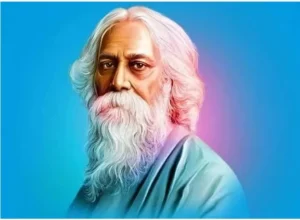
- Rabindranath Tagore (1861–1941) was known as the Bard of Bengal.
- He was a celebrated Bengali poet, artist, and philosopher who led the Bengal Renaissance.
- Universal Humanism was the core idea that shaped his views on education, literature, society, and politics.
- It is the belief that humanity comes before any country, religion, or border.
His contributions
1. Literary and Cultural Contributions
- Nobel Laureate: He became the first non-European to win the Nobel Prize in Literature in 1913 for his poetry collection Gitanjali (Song Offerings).
- National Anthems: He composed the national anthems for two nations:
- Jana Gana Mana in 1911 (adopted as India’s national anthem in 1950 )
- Amar Shonar Bangla in 1905 (adopted as Bangladesh’s national anthem in 1971).
- Key Literary Works
- Novels: Gora (exploring identity and caste), Ghare-Baire / The Home and the World (navigating the clash between nationalist zeal and ethics), and Chokher Bali.
- Poetry & Plays: Masterpieces including Raktakarabi, Visarjan, Muktadhara, Sonar Tari, and Balaka.
- Short Fiction: Galpaguchchha, a renowned collection capturing rural Bengal and its social realities.
2. Educational Philosophy
- Visva-Bharati University (Santiniketan): It was founded in 1921 as an open-air university to combine the best of Indian and world knowledge.
- It was inscribed as a UNESCO World Heritage Site in 2023.
3. Role in the Freedom Movement & Political Ideology
- Anti-Partition Movement (1905): He actively opposed the Partition of Bengal by promoting national unity through patriotic songs such as Banglar Mat i Banglar Jol.
- He introduced the Rakhi Bandhan festival to foster Hindu-Muslim unity.
- Renunciation of Knighthood (1919): He returned the Knighthood conferred by the British in 1915 as a mark of protest against the Jallianwala Bagh Massacre.
The title “Gurudev” was given to Rabindranath Tagore by Mahatma Gandhi as a mark of deep respect.
Hexavalent Vaccine
Context: A recent study led by the Union Health Ministry found that introducing the hexavalent (six-in-one) vaccine into India’s Universal Immunisation Programme could enhance the efficiency of the country’s childhood immunisation programme.
About Hexavalent Vaccine
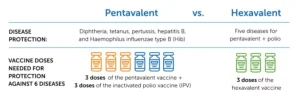
- It is a combination vaccine that provides protection against six diseases in infants through a single injection.
- Six diseases: It works on following six diseases:
- Diphtheria: Caused by Corynebacterium diphtheriae, it creates a thick membrane in the throat that blocks breathing.
- Tetanus: Caused by soil bacteria Clostridium tetani, in open wounds, it produces toxins that cause severe muscle spasms and “lockjaw.”
- Pertussis: Caused by Bordetella pertussis, it is a contagious lung infection causing violent coughing fits with a “whoop” sound.
- Hepatitis B: It is a viral infection spread through blood or bodily fluids that causes chronic liver damage and cancer.
- Haemophilus influenzae type b (Hib): Caused by Haemophilus influenzae type b bacterium that causes dangerous invasive infections in infants, especially bacterial meningitis and pneumonia.
- Polio: A viral infection caused by Poliovirus attacks the nervous system and can cause permanent limb paralysis.
- Significance:
- It reduces the number of injections and healthcare visits,
- Improves immunization coverage and timely vaccination,
- Lowers infant morbidity,
- Mortality from vaccine-preventable diseases and
- Strengthens routine immunization programmes by making vaccination safer, more convenient, and cost-effective.
About Universal Immunisation Programme
- It is one of the world’s largest public health initiatives.
- Origin: It was introduced in 1978 as the Expanded Programme on Immunization (EPI) and upgraded as the Universal Immunisation Programme (UIP) in 1985.
- Nodal Ministry: Ministry of Health and Family Welfare
- Funded: Fully funded by the Government of India under the National Health Mission (NHM).
- Objective: To reduce child mortality and morbidity by ensuring routine immunisation against vaccine-preventable diseases.
- Diseases Covered: Under UIP, immunization is providing free of cost against 12 vaccine preventable diseases:
- Nationally against 9 diseases: Diphtheria, Pertussis, Tetanus, Polio, Measles, Rubella, severe form of Childhood Tuberculosis, Hepatitis B and Meningitis & Pneumonia caused by Hemophilus Influenza type B.
- Sub-nationally against 3 diseases: Rotavirus diarrhoea, Pneumococcal Pneumonia and Japanese Encephalitis; of which Rotavirus vaccine and Pneumococcal Conjugate vaccine are in process of expansion while JE vaccine is provided only in endemic districts.
UPSC Online Coaching
Agni- 4 Missile
Context: Recently Agni-4 missile was tested from the Integrated Test Range, Chandipur in Odisha.
About Agni-4 missile

- It is an indigenously developed, nuclear-capable, surface-to-surface ballistic missile of India.
Key Features
- Developed by: Defence Research and Development Organisation (DRDO)
- Type and Range: Medium-Range Ballistic Missile
- It is capable of striking targets at a range of approximately 3,000–5,500 km.
- Propulsion: It is powered by a two-stage solid-fuel rocket motor, where both stages use solid propellant.
- Payload: Up to 1,000 kg (conventional or nuclear warhead)
- Launcher Platform: It is launched from a road-mobile launcher, allowing it to be transported and fired from different locations.
- Technology: The missile is equipped with state-of-the-art avionics, a fifth-generation onboard computer and a distributed architecture.
- It uses a Ring Laser Gyro-based Inertial Navigation System supported by a Micro Navigation System, enabling it to reach its target with great accuracy.
Indigenous African Swine Fever (ASF) Vaccine
Context: Indian Council of Agricultural Research (ICAR) has developed Indigenous African Swine Fever Vaccine.
- The indigenous vaccine is expected to reduce pig deaths, prevent economic losses, and improve the livelihoods of pig farmers by protecting against a major livestock disease.
India’s First Indigenous ASF Vaccine
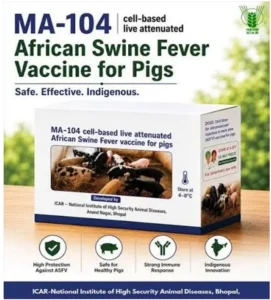
- About: India’s first indigenous, live attenuated vaccine for African Swine Fever (ASF) in pigs.
- Developed By: ICAR–National Institute of High Security Animal Diseases (ICAR-NIHSAD), Bhopal
- Technology Used
-
- Based on a novel attenuated ASFV Genotype II virus
- Features unique gene deletions to reduce virulence while retaining immunogenicity
- Produced using the MA-104 cell line (a mammalian cell line commonly used for viral vaccine production)
About African Swine Fever (ASF)
- It is a highly contagious and deadly viral disease of domestic and wild pigs. It was first documented in Kenya in 1921.
- Causative Agent: African Swine Fever Virus
- It is a large DNA virus belonging to the Asfarviridae family.
- Hosts: Domestic pigs and wild boars
- Transmission:
- Direct contact with infected pigs.
- Contaminated feed, equipment and clothing.
- It causes no danger to human health, but it has devastating effects on pig populations and the farming economy.
- Status in India: It was first detected in India in 2020 since then it has spread to several States and Union Territories.
- There is no effective treatment or approved vaccine of ASF in India, therefore it has been controlled through early detection, culling of infected pigs, and strict biosecurity measures.
About Indian Council of Agricultural Research (ICAR)
- It is an apex agricultural research organization in India.
- Established: 1929 (originally as the Imperial Council of Agricultural Research); renamed ICAR in 1946.
- Ministry: Autonomous organization under the Department of Agricultural Research and Education (DARE), Ministry of Agriculture & Farmers Welfare.
- Headquarters: New Delhi
- Role: Apex body for coordinating, guiding, and managing agricultural research, education, and extension in India.
Fugitive Criminals
Context: India has brought back 274 fugitive criminals from 36 countries between 2019 and 2026.
About Fugitive Criminals
- A fugitive criminal is a person who is accused or convicted of a crime and escapes from one country to another to avoid arrest, prosecution, or punishment.
- Under the Fugitive Economic Offenders Act, 2018, a Fugitive Economic Offender (FEO) is a person who:
-
- Has committed a scheduled economic offence involving at least ₹100 crore.
- Has left India to avoid criminal prosecution, or
- Refuses to return to face legal proceedings.
Click to Know UPSC Coaching Centres in India
Government Initiatives to Extradite Fugitives Criminals
- Fugitive Economic Offenders Act, 2018: It laid the foundation for stronger action against economic offenders.
- Unlawful Activities (Prevention) Amendment Act, 2019: It expanded the scope of action against individual terrorists, handlers, funding networks and support systems operating from abroad.
- Sections 355 and 356 of the Bharatiya Nagarik Suraksha Sanhita (BNSS): It introduced provisions for trial in absentia, allowing judicial proceedings to continue even if an accused fugitive remains outside the country.
- BHARATPOL: It is a secure digital portal developed by the Central Bureau of Investigation (CBI) to facilitate real-time international police cooperation through INTERPOL.
- It connects Indian law enforcement agencies with INTERPOL’s global network, enabling faster investigations and the tracing of fugitives.
- It was launched on 7 January 2025.
- Operation Trishul: It was launched in 2023 by the CBI.
- It is carried out in close coordination with the Ministry of Home Affairs (MHA), Ministry of External Affairs (MEA), INTERPOL, and foreign law enforcement agencies.
- It was launched to trace, locate, and bring back fugitive criminals and economic offenders who have fled India to evade justice.
 7 Aug 2026