UPSC PYQs

Prelims, Mains & Optional PYQs

UPSC Notes

Comprehensive & Short Notes

GOBARdhan Scheme: National Circular Bioenergy Scheme, CBG & Benefits

7 Aug 2026

GOBARdhan Scheme: National Circular Bioenergy Scheme, CBG & Benefits

Subject: GS 3: Environment

Context: Recently, the Union Cabinet has approved the National Circular Bioenergy Scheme (GOBARdhan) with an outlay of ₹23,731 crore (up to 2035–36).

UPSC Online Courses

About GOBARdhan (Galvanising Organic Bio-Agro Resources Dhan) Scheme

  • It is the Government of India’s flagship programme for converting organic waste into Compressed Biogas (CBG), bio-slurry, and other value-added products, thereby promoting the principles of a Circular Economy and Waste-to-Wealth.

  • Compressed Biogas (CBG) is purified biogas (containing over 90% methane) produced from agricultural residue, cattle dung, municipal solid waste, sewage, and other organic biomass
  • It possesses properties similar to Compressed Natural Gas (CNG) and can be used as a clean fuel for transport, industry, and cooking.

  • Launch: The initiative was launched in 2018 under the Swachh Bharat Mission (Grameen) and has now been expanded into the National Circular Bioenergy Scheme.
  • Objective: To accelerate the production of Compressed Biogas (CBG), strengthen the circular economy, improve waste management, enhance farmers’ income, and reduce India’s dependence on imported fossil fuels.
  • GOBARdhan SchemeFeedstock: The scheme utilises cattle dung, agricultural residue (stubble), municipal organic waste, sugar industry waste (press mud), food waste, sewage sludge, and other biodegradable biomass for bioenergy production.
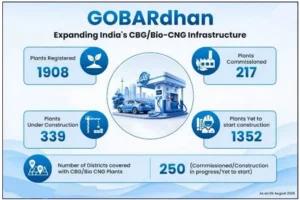
  • End Products: Organic waste is converted into Compressed Biogas (CBG) for transport and industrial use and organic manure for sustainable agriculture.
  • Example: Paddy straw, instead of being burnt, can be converted into CBG, simultaneously reducing air pollution, generating clean fuel, and producing organic fertiliser.

Key Features of the Scheme

  • Large Financial Outlay: The scheme provides an outlay of ₹23,731 crore up to 2035–36 to establish a long-term and predictable ecosystem for bioenergy production.
  • Scaling up CBG Production: It seeks to increase India’s Compressed Biogas production nearly ten-fold, transforming CBG into an important component of the country’s clean energy mix.
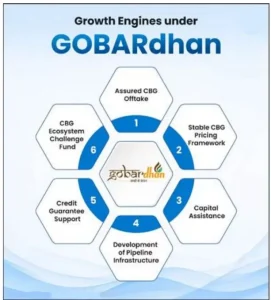
  • GOBARdhan SchemeAssured Offtake: The scheme provides guaranteed procurement of CBG, thereby reducing market uncertainty and encouraging private investment.
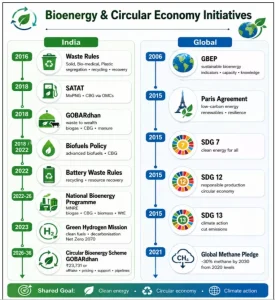
  • Administered Pricing: It introduces an administered price of ₹2,110 per Million British Thermal Units (MMBTU), providing revenue certainty to producers while maintaining affordability for consumers.
  • Capital Financial Assistance: Eligible greenfield and brownfield expansion projects will receive capital assistance of up to ₹2 crore per tonne per day (TPD) of installed CBG capacity, reducing upfront investment costs.
  • GOBARdhan SchemePipeline Infrastructure: The scheme supports cluster-based and standalone pipeline infrastructure to connect CBG plants with City Gas Distribution (CGD) networks and the national gas grid, ensuring efficient evacuation and wider market access.
  • Access to Finance: It facilitates easier institutional finance for private enterprises, MSMEs, cooperatives, farmer producer organisations (FPOs), and rural entrepreneurs.
  • Integrated Value Chain: Financial support extends beyond plant machinery to include feedstock aggregation, storage, logistics, and organic manure processing, thereby strengthening the entire bioenergy value chain.

Significance of GOBARdhan Scheme

  • Energy Security: The scheme strengthens India’s energy security by increasing domestic production of renewable gaseous fuel and reducing dependence on imported Liquefied Natural Gas (LNG) and fossil fuels.
  • Circular Economy: It operationalises the Circular Economy by converting agricultural, livestock, and municipal waste into valuable energy and fertiliser, thereby transforming waste into wealth.
  • Waste Management: Scientific utilisation of municipal organic waste, cattle dung, and industrial bio-waste improves sanitation while reducing landfill pressure and methane emissions.
  • Rural Employment: Expansion of nearly 5,000 CBG plants is expected to generate large-scale rural employment across biomass collection, transportation, plant operations, and organic manure production.
  • Climate Change Mitigation: Replacing fossil fuels with CBG reduces greenhouse gas emissions, while improved waste management limits uncontrolled methane release from decomposing biomass.
  • Organic Agriculture: Bio-slurry generated during CBG production serves as a nutrient-rich organic fertiliser, reducing dependence on chemical fertilisers and improving soil health.

Challenges that need to be Considered

  • Feedstock Availability: Ensuring continuous collection, aggregation, storage, and transportation of biomass remains a major operational challenge.
  • High Initial Investment: Despite financial support, establishing commercial-scale CBG plants requires significant capital investment and long gestation periods.
  • Weak Waste Segregation: Poor segregation of biodegradable municipal waste limits the availability of quality feedstock for bioenergy production.
  • Infrastructure Gaps: Limited pipeline connectivity, storage facilities, and transportation infrastructure constrain efficient evacuation of CBG.
  • Technology and Skill Constraints: Efficient bio-digestion technologies and skilled manpower remain limited, particularly in rural areas.
  • Financial Viability: Small-scale projects often face difficulties in obtaining timely credit, achieving economies of scale, and ensuring consistent profitability.
  • Institutional Coordination: Effective implementation requires close coordination among ministries dealing with energy, agriculture, rural development, urban affairs, environment, and finance.

Way Forward

  • Strengthen Feedstock Supply Chains: Promote organised biomass aggregation, Farmer Producer Organisations (FPOs), biomass banks, and efficient logistics to ensure year-round feedstock availability.
  • Expand CBG Infrastructure: Accelerate development of pipeline connectivity, CGD integration, storage, and transport infrastructure to improve offtake and market access.
  • Enhance Financial Support: Ensure timely capital subsidies, improve access to low-cost finance, encourage blended finance, and attract greater private-sector participation through stable policy support.
  • Promote Technology & Innovation: Invest in advanced bioenergy technologies, improve plant efficiency, strengthen research and development, and encourage indigenous manufacturing under Atmanirbhar Bharat.
  • Strengthen Circular Economy: Integrate waste management, bioenergy, organic manure production, and resource recovery to convert agricultural and municipal waste into valuable economic resources.
  • Improve Institutional Coordination: Enhance convergence among MoPNG, MNRE, Ministry of Agriculture, Ministry of Housing & Urban Affairs, State Governments, Urban Local Bodies, and Oil Marketing Companies (OMCs) for effective implementation.

Click to Know UPSC Offline Courses

Conclusion

A robust Compressed Biogas (CBG) ecosystem can enhance energy security, waste management, rural livelihoods, and the circular economy. Through GOBARdhan, India can convert organic waste into wealth, reduce fossil fuel imports, and advance Viksit Bharat@2047, Net Zero by 2070, and Atmanirbhar Bharat.

Check Out UPSC CSE Books

Visit PW Store

online store 1

GOBARdhan Scheme: National Circular Bioenergy Scheme, CBG & Benefits

Need help preparing for UPSC or State PSCs?

Connect with our experts to get free counselling & start preparing

Free Counselling for UPSC Aspirants

Connect with our experts and take the right next step.

Expert Guidance
Personalized Strategy
100% Free

Book Your Free Session

NEED ASSISTANCE?

Request a Callback

Our counsellor will connect with you and help you choose the right course and centre.

  • Expert Guidance
  • Course & Fee Information
  • Quick Callback Support

Request a Callback

Books
UPSC PYQs
UPSC Notes
Current Affairs
Quick Revise Now !
AVAILABLE FOR DOWNLOAD SOON
UDAAN PRELIMS WALLAH
Comprehensive coverage with a concise format
Integration of PYQ within the booklet
Designed as per recent trends of Prelims questions
हिंदी में भी उपलब्ध
Quick Revise Now !
UDAAN PRELIMS WALLAH
Comprehensive coverage with a concise format
Integration of PYQ within the booklet
Designed as per recent trends of Prelims questions
हिंदी में भी उपलब्ध

<div class="new-fform">


    </div>

    Subscribe our Newsletter
    Sign up now for our exclusive newsletter and be the first to know about our latest Initiatives, Quality Content, and much more.
    *Promise! We won't spam you.
    Yes! I want to Subscribe.