UPSC PYQs

Prelims, Mains & Optional PYQs

UPSC Notes

Comprehensive & Short Notes

Geothermal Wells: India’s First Deep Geothermal Energy Project

20 Jul 2026

Geothermal Wells: India’s First Deep Geothermal Energy Project

Subject: GS 3: Environment

Context: Recently, the Lieutenant Governor of Ladakh has commissioned India’s first and deepest geothermal wells at Puga Valley, Ladakh.
UPSC Online Coaching

Key Highlights about the Geothermal Wells

Geothermal Wells

  • Two wells, each 1,000 metres deep, drilled at an altitude of over 14,000 feet.
  • A maximum temperature of 135°C was recorded at a depth of 400 metres, with further testing underway to find even higher temperatures.
  • Pilot Geothermal Power Project: The wells will support India’s first 1 MW demonstration-scale geothermal power project, being implemented by the ONGC Energy Centre.
  • Significance: The project is expected to serve as a blueprint for geothermal energy development in India, contribute to Ladakh’s carbon-neutral goal, diversify India’s renewable energy mix, and support Net Zero commitments.

About Geothermal Energy: (UPSC Prelims 2013)

Geothermal Wells

  • Geothermal energy is a renewable energy source derived from the natural heat stored beneath the Earth’s surface, used for electricity generation and direct heating.
  • Source of Heat: The heat originates primarily from radioactive decay within the Earth and residual heat retained since the planet’s formation.
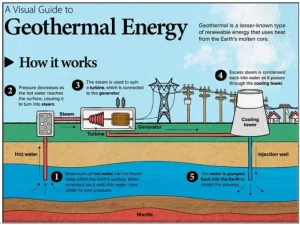
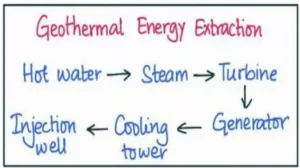
  • Working Principle: Wells are drilled into geothermal reservoirs to extract hot water or steam, which drives turbines for electricity generation or is used directly for heating.

Types of Geothermal Resources

  • Hydrothermal Systems: Naturally occurring hot water and steam reservoirs.
  • Enhanced Geothermal Systems (EGS): Artificially engineered reservoirs in hot dry rocks.
  • Geopressured Resources: Hot, pressurised brine reservoirs.
  • Hot Dry Rock Resources: Deep underground rocks with high temperatures but limited natural water.

Geothermal Wells

Puga Geothermal Field

  • Location: Situated in the Changthang region of Leh district, Ladakh, within the Puga Valley.
  • Geological Setting: Lies within the Himalayan Geothermal Belt, formed due to the collision of the Indian Plate and Eurasian Plate.
  • Features: Characterised by hot springs, fumaroles, mud pools, sulphur deposits and steam vents, indicating active geothermal systems.
  • Potential: Considered India’s most promising geothermal resource for electricity generation and direct heat applications.

Significance of Geothermal Energy

  • Clean & Renewable Source: Provides continuous low-carbon energy with negligible greenhouse gas emissions.
  • Base-load Power: Delivers 24×7 uninterrupted power, unlike solar and wind energy.
  • Energy Security: Reduces dependence on imported fossil fuels and diversifies India’s renewable energy portfolio.
  • Regional Development: Suitable for remote Himalayan regions, reducing reliance on diesel-based electricity generation.
  • Multiple Applications: Supports space heating, greenhouses, aquaculture, industrial heating and tourism, besides electricity generation.

Global Status of Geothermal Energy:

  • Global Installed Capacity: Geothermal power capacity exceeds 17 GW (2025), generating around 100 TWh of electricity annually.
  • Share in Global Electricity: Geothermal energy contributes less than 1% of global electricity generation (around 0.3–0.4%), but provides reliable 24×7 baseload power.
  • Leading Countries (Power Generation):
    • United States (largest producer)
    • Indonesia
    • Philippines

UPSC Coaching Classes

Geothermal Energy Potential in India

  • Estimated Potential: The Geological Survey of India (GSI), in its Geothermal Atlas of India, 2022, estimates India’s geothermal power potential at approximately 10,600 MW across 381 thermally anomalous areas.
  • Pilot Projects: India’s first operational 20 kW geothermal power plant was commissioned by Singareni Collieries Company Limited (SCCL) at Manuguru, Telangana, using Binary Organic Rankine Cycle (ORC) technology.

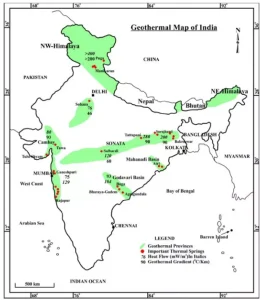
Major Geothermal Provinces:

  • Puga–Chumathang (Ladakh)
  • Cambay Basin (Gujarat)
  • Son–Narmada–Tapti (SONATA) Belt
  • West Coast Province (Maharashtra–Goa)
  • Godavari Basin
  • Mahanadi Basin
  • Andaman & Nicobar Islands
  • Himalayan Geothermal Province (Himachal Pradesh, Uttarakhand, Jammu & Kashmir)

Challenges that need to be Addressed

  • High Initial Investment: Exploration and deep drilling require significant capital with high geological uncertainty.
  • Technological Constraints: Limited indigenous expertise in advanced geothermal drilling and reservoir management.
  • Resource Exploration: Inadequate geological surveys and resource assessment.
  • Remote Locations: Most resources are located in high-altitude and infrastructure-deficient regions.
  • Policy Support: Absence of a dedicated National Geothermal Energy Policy has slowed commercial deployment.

Click to Know UPSC OnlyIAS Coaching Centres

Way Forward

  • National Policy: Formulate a dedicated National Geothermal Energy Policy with targeted financial incentives.
  • Technology & Investment: Promote Public-Private Partnerships (PPP) and international technology collaboration.
  • Scale-up Projects: Expand pilot and demonstration projects before commercial deployment.
  • Renewable Integration: Integrate geothermal energy into India’s renewable energy and Net Zero strategy.
  • Capacity Building: Strengthen geological exploration, resource mapping and indigenous technological capabilities.

Check Out UPSC CSE Books

Visit PW Store

online store 1

Geothermal Wells: India’s First Deep Geothermal Energy Project

Explore UPSC Foundation Batches

Need help preparing for UPSC or State PSCs?

Connect with our experts to get free counselling & start preparing

Free Counselling for UPSC Aspirants

Connect with our experts and take the right next step.

Expert Guidance
Personalized Strategy
100% Free

Book Your Free Session

NEED ASSISTANCE?

Request a Callback

Our counsellor will connect with you and help you choose the right course and centre.

  • Expert Guidance
  • Course & Fee Information
  • Quick Callback Support

Request a Callback

Books
UPSC PYQs
UPSC Notes
Current Affairs
Quick Revise Now !
AVAILABLE FOR DOWNLOAD SOON
UDAAN PRELIMS WALLAH
Comprehensive coverage with a concise format
Integration of PYQ within the booklet
Designed as per recent trends of Prelims questions
हिंदी में भी उपलब्ध
Quick Revise Now !
UDAAN PRELIMS WALLAH
Comprehensive coverage with a concise format
Integration of PYQ within the booklet
Designed as per recent trends of Prelims questions
हिंदी में भी उपलब्ध

<div class="new-fform">


    </div>

    Subscribe our Newsletter
    Sign up now for our exclusive newsletter and be the first to know about our latest Initiatives, Quality Content, and much more.
    *Promise! We won't spam you.
    Yes! I want to Subscribe.