Subject: GS 3: Environment
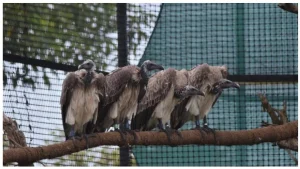
Context: Recently, five slender-billed vultures bred in captivity at the Bombay Natural History Society (BNHS)’s conservation facility in Assam were released into the wild, marking the first such release anywhere in the world.
- Five captive-bred white-rumped vultures, were transported from the Vulture Conservation Breeding Centre at Rani near Guwahati in the Kaziranga National Park and Tiger Reserve.
Some initiatives in India for Vulture Conservation
- Vulture Action Plan (VAP) 2020–2025: Provides a national framework for vulture conservation, focusing on population recovery, habitat protection, monitoring and captive breeding.
- Ban on veterinary diclofenac: The veterinary use of diclofenac was banned in 2006 because residues in livestock carcasses caused fatal kidney failure in vultures.
- Drugs Regulation: Drugs harmful to vultures, such as ketoprofen and aceclofenac, have also been targeted through regulatory measures.
- Vulture Conservation and Breeding Centres: Centres have been established at places such as Pinjore (Haryana), Rani (Guwahati), Buxa (West Bengal), and other locations for breeding and conservation research.
- SAVE (Saving Asia’s Vultures from Extinction): India participates in this regional conservation initiative aimed at restoring vulture populations through research, advocacy, veterinary-drug regulation and conservation programmes.
|
UPSC Online Coaching
About Slender-Billed Vultures (Gyps tenuirostris)
- The slender-billed vulture is an Old World vulture species native to sub-Himalayan regions and Southeast Asia.
- Distribution: Mainly found in the Indian subcontinent, particularly parts of northern and northeastern India.
- It is also found in north and central Bangladesh, southern Nepal, Burma and Cambodia.
- Habitat: Open landscapes, grasslands, agricultural areas and areas around human settlements where livestock carcasses are available.
- Diet: Primarily feeds on dead animals, playing an important role in nutrient recycling and disease control.
- Conservation status:
- IUCN Red List: Critically Endangered
- CITES: Appendix II list
- Wildlife Protection Act, 1972: Schedule I
- Major threat: Use of the veterinary drug diclofenac, which causes fatal kidney failure when vultures consume carcasses of treated livestock.
- Other threats: Habitat loss, food scarcity, poisoning, electrocution and collision with infrastructure.
About Bombay Natural History Society
- It is one of India’s oldest and most prominent organisations dedicated to biodiversity and wildlife conservation.
- Established in: 1883
- Headquarters: Mumbai, Maharashtra.
|
About White-rumped Vulture (Gyps bengalensis)
- It is a small Old World vulture native to South and Southeast Asia.
- Distribution: They occur in northern and central India, Pakistan, Nepal, Bangladesh, and southeast Asia.
- Habitat: They inhabit plains with woods, near human habitations, plantations, orchards, and in villages, towns, and cities. They rarely can be found in hilly areas.
- Diet: Feeds mainly on carcasses of livestock and other animals, helping in natural waste disposal and disease control.
- Conservation status:
- IUCN Red List: Critically Endangered
- Wildlife (Protection) Act, 1972: Schedule I
- CITES: Listed under Appendix II
- Major threats: Disease, pesticides, environmental contamination, poisoning, reduced food availability, calcium deficiency, reduced nesting habitat, nest predators, hunting, and aircraft strikes are the most common.
Click to Know UPSC Offline Courses
 8 Aug 2026