Subject: GS 3: Environment
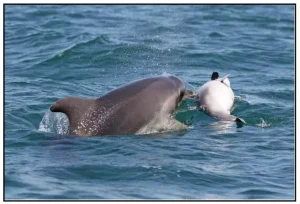
Context: A viral video of a dolphin carrying its dead calf has renewed global attention on dolphins’ intelligence, social behaviour, and conservation.
UPSC Coaching Classes
About Dolphins
- Dolphins are highly intelligent aquatic mammals belonging to the order Cetacea and suborder Odontoceti (toothed whales), with more than 40 species distributed across marine and freshwater ecosystems.
 Distribution
-
- Marine Habitat: Most dolphin species inhabit tropical, subtropical and temperate oceans, while some occur in cold subpolar waters.
- Freshwater Habitat: A few specialised species are restricted to major river systems such as the Ganga, Indus, Amazon, Orinoco, Mekong and Ayeyarwady.
- Key Features
- Physical Characteristics: Dolphins possess streamlined bodies, horizontal tail flukes, pectoral flippers, a dorsal fin and a blowhole, enabling efficient swimming and air breathing, while the melon helps focus echolocation signals.
- Diet: Dolphins are carnivorous predators feeding mainly on fish and squid, while some coastal and riverine species also consume crustaceans, molluscs and other aquatic organisms.
- Communication: Dolphins communicate through whistles, clicks and body movements, and use echolocation to navigate, locate prey and identify objects in murky or deep waters.
- Social Behaviour: Dolphins live in cooperative social groups called pods, displaying complex behaviours such as coordinated hunting, calf care, defence against predators and evidence of empathy and grief.
- Conservation Status: Depending on the specific species, a dolphin’s conservation status on the IUCN Red List ranges from Least Concern to Critically Endangered.
Types of Dolphins (UPSC prelims 2019, 2015)
- Marine Dolphins
-
- Coastal/Inshore Dolphins: Inhabit coastal waters, estuaries and bays; examples include the Common Bottlenose Dolphin (Least Concern) and Indo-Pacific Humpback Dolphin (Vulnerable).
Conservation of Dolphins in India
- Project Dolphin: Launched in 2020, it focuses on protecting riverine and marine dolphins through habitat conservation, pollution control and anti-poaching measures.
- Habitat & Research: Namami Gange supports dolphin conservation, while the National Dolphin Research Centre (NDRC), Patna promotes scientific research on Gangetic dolphins.
- Protected Areas: Vikramshila Gangetic Dolphin Sanctuary in Bihar protects a 50-km stretch of the Ganga and is India’s first dolphin sanctuary.
|
-
- Pelagic Dolphins: Occupy the open ocean and often form large groups; examples include the Spinner Dolphin (Least Concern), Striped Dolphin (Least Concern), and Pantropical Spotted Dolphin (Least Concern).
- Blackfish (Large Delphinids): Large-bodied dolphins include the Orca/Killer Whale (Least Concern), Pilot Whales (Near Threatened), and False Killer Whale (Near Threatened).
- River Dolphins
- Ganges River Dolphin: Found in the Ganga–Brahmaputra–Meghna River System and Chambal river of India, Nepal and Bangladesh.
- It is also the national aquatic animal of India
- Protection Status:
- IUCN Status: Endangered
- Wildlife (Protection) Act, 1972: Schedule I
- CITES: Appendix
- Indus River Dolphin: Occurs in the Indus River basin of Pakistan and the Beas River in India; IUCN Status: Endangered.
- Amazon River Dolphin (Boto): Distributed in the Amazon and Orinoco river basins of South America; IUCN Status: Endangered.
- Irrawaddy Dolphin: Found in the Ayeyarwady, Mekong and Mahakam river systems and estuarine waters; IUCN Status: Endangered.
- Tucuxi: A freshwater dolphin of the Amazon River basin belonging to the marine dolphin family; IUCN Status: Endangered.
- Franciscana (La Plata Dolphin): Occurs in the coastal waters and estuaries of Brazil, Uruguay and Argentina; IUCN Status: Vulnerable.
- Baiji (Chinese River Dolphin): Formerly endemic to the Yangtze River in China and now considered Extinct (functionally extinct; IUCN lists it as Critically Endangered–Possibly Extinct
Click to Know UPSC OnlyIAS Coaching Centres
 8 Aug 2026