Bihar to Replace ‘Fail’ with ‘Eligible for Skills’ in Board Marksheets
Context: The Bihar government has announced plans to replace the term “fail” with “eligible for skills” (kaushal ke liye patra) in marksheets of students appearing for Class 10 and 12 board exams in the State.
UPSC Online Courses
Key Highlights

- Objective: Reduce the stigma associated with examination failure and protect students’ morale.
- Implementation: The Education Department will amend rules and issue directives to the Bihar School Examination Board (BSEB).
Other Recent Initiatives
- Bihar Vidya Saathi: 24×7 digital learning platform for Classes 9–12, providing one-on-one academic support from around 75,000 teachers.
- Teacher Support Portal: To facilitate State-level recognition of teachers, with one teacher from each district to be honored.
- Saraswati Vidya Niketan Model Schools: A platform covering 700 schools across Bihar, providing AI-enabled learning tools and digital resources for conceptual learning and preparation for Bihar Board, JEE and NEET examinations.
National Company Law Tribunal (NCLT)
Context: The National Company Law Tribunal (NCLT) has approved Subhash Chandra’s offer to pay ₹6.5 crore against creditors’ claims of about ₹22,006 crore.
- HDFC Bank has opposed the offer and is considering an appeal before the National Company Law Appellate Tribunal (NCLAT).
Background
- Subhash Chandra, founder of Zee TV and Essel Group, was a personal guarantor for loans taken by associated companies.
- Following defaults, personal insolvency proceedings were initiated against him under the Insolvency and Bankruptcy Code, 2016.
About the National Company Law Tribunal (NCLT)
- Establishment: Constituted under the Companies Act, 2013.
- Role: Adjudicating authority for corporate insolvency under the Insolvency and Bankruptcy Code, 2016.
- Appeal: Orders can be appealed before the National Company Law Appellate Tribunal.
About the National Company Law Appellate Tribunal (NCLAT)
- Establishment: Constituted under the Companies Act, 2013.
- Role: Appellate authority against orders of the National Company Law Tribunal.
- Other Appeals: Hears specified appeals against orders of the Insolvency and Bankruptcy Board of India and the Competition Commission of India.
- Further Appeal: Appeals on questions of law lie before the Supreme Court.
Typhoon Saudel
Context: Typhoon Saudel intensified rapidly over the western Pacific in August 2026, affecting parts of East Asia before weakening after landfall.
About Typhoon Saudel
- Typhoon Saudel, also known as Typhoon Obet in the Philippines, was the 18th named storm of the 2026 Pacific typhoon season.
- Origin: Saudel developed from a tropical disturbance over the northwestern Pacific, about 3,000 km east of Mindanao, Philippines, and intensified over unusually warm waters.
- Rapid Intensification: Saudel strengthened rapidly from a tropical disturbance into a powerful typhoon, reaching peak sustained winds of around 175 km/h, with higher gusts.
- Erratic Track: Its movement was influenced by the interaction between a westerly trough and subtropical high-pressure ridge, causing it to curve through the Ryukyu Islands before moving westward into the East China Sea.
- Double Landfall: Saudel reportedly made two landfalls on China’s eastern coast, striking Taizhou and Wenzhou before weakening rapidly over land.
- Affected Region
-
- Japan: The Ryukyu and Okinawa Islands experienced heavy rainfall, strong winds, power disruptions, landslide risks and major flight cancellations.
- China: Zhejiang, Fujian and surrounding eastern regions faced heavy rainfall, flooding and major transport disruptions, with large-scale evacuations in affected areas.
- Philippines: Although the storm remained largely offshore, its outer circulation strengthened the Habagat (Southwest Monsoon), contributing to heavy rainfall and flooding in western Luzon and Metro Manila.
- Taiwan: Southern Taiwan experienced intense rainfall, prompting precautionary closures.
UPSC Online Classes
Gnani Artha
Context: Recently, Vice President C. P. Radhakrishnan launched Gnani Artha, a sovereign AI stack developed by GNANI AI.
About Gnani Artha
- Gnani Artha is an indigenous sovereign AI stack designed to connect advanced AI capabilities with real-world work, institutions and public services.
- Key Features
- Evon 3.3 – Large Language Model: Evon 3.3 is the large language model (LLM) forming the AI intelligence layer of the Gnani Artha stack.
- Plexus – AI Integration Platform: Plexus connects AI intelligence with real-world workflows, institutions and applications, enabling practical deployment of AI capabilities.
- Sovereign AI Capability: Gnani Artha seeks to strengthen India’s technological and strategic autonomy by developing indigenous AI capabilities rather than relying solely on imported technologies.
- Key Applications
- Multilingual Governance: AI can support access to government and institutional information across multiple Indian languages, contributing to inclusive digital governance.
- Parliamentary Applications: AI-based technologies are being used through Digital Sansad for multilingual access to parliamentary debates and papers, while simultaneous AI interpretation can facilitate communication across Indian languages.
- Employment and Growth: AI is expected to create new employment opportunities, enhance productivity and support economic growth, contributing to India’s Viksit Bharat @ 2047 objective.
Ammannia Telanganensis
Context: A new freshwater flowering plant from Telangana, Ammannia telanganensis, has been described in the international taxonomy journal Phytotaxa.
About Ammannia telanganensis
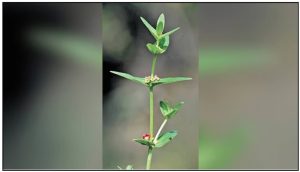
- Ammannia telanganensis is a newly described annual, herbaceous, semi-aquatic flowering plant belonging to the Lythraceae (loosestrife) family and the genus Ammannia.
- Discovery: The species was discovered through field surveys in Telangana, with specimens collected from Narsingi and Gachibowli in Rangareddy district and Vatwarlapalle in the Amrabad Tiger Reserve, Nagarkurnool district.
- The type specimen was collected near Vatwarlapalle
- Key Features
- Stalked Flower Clusters: The species possesses pedunculate cymes, meaning its flower clusters are borne on distinct stalks, unlike closely related species with sessile clusters.
- Magenta Petals: It bears four conspicuous magenta petals, a notable feature distinguishing it from species such as Ammannia cordata, which is generally apetalous.
- Brain-like Seed Coat: Its seeds possess a distinctive cerebriform (brain-like) surface pattern, providing an important microscopic character for species identification.
- Wetland Adaptation: The plant grows in wet sandy soils along seasonal streams and freshwater margins, flowering and fruiting mainly between November and February.
Click to Know UPSC Coaching Centres in India
The discovery enriches Telangana’s floral diversity and highlights the ecological importance of seasonal wetlands and stream fringes, particularly amid increasing urbanisation.
 29 Aug 2026