Subject: GS 3: Disaster Management
Context: Recently, an ammonia gas leak at a shrimp processing unit in Periyapalayam, Tamil Nadu, caused deaths and injuries, highlighting gaps in chemical disaster preparedness and industrial safety management in India.
UPSC Course Fees Online
Core Concepts & Hazard Profile
- Classification as a Disaster: This incident is classified as a Chemical Industrial Disaster—a category of man-made disasters involving the sudden release of hazardous substances due to mechanical, structural, or systemic technological failures.
- Historic and Contemporary Examples:
- Bhopal Gas Tragedy (1984): India’s benchmark industrial catastrophe, caused by the lethal release of Methyl Isocyanate (MIC) gas from a pesticide plant.
- Visakhapatnam Gas Leak (2020): A major toxic chemical release involving hazardous Styrene gas at the LG Polymers facility in Andhra Pradesh during post-lockdown resumption of operations.
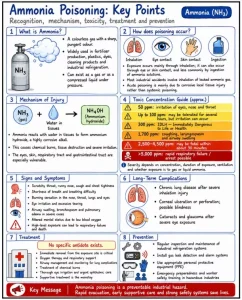
- Hazard Profile of Ammonia (NH3):
- Characteristics: It is a toxic, colorless gas with a highly sharp, pungent, and suffocating odor.
- Industrial Use: Because seafood spoils rapidly, immediate freezing is mandatory.
- Ammonia is heavily utilized as an industrial refrigerant due to its high cooling efficiency, low operational cost, and better environmental performance (zero Ozone Depletion Potential) compared to ozone-depleting synthetic chlorofluorocarbons.
- Health Impacts: Inhalation triggers severe chemical burns in the respiratory tract, causing acute breathing difficulty, chemical pneumonitis, severe lung damage, and asphyxiation at high exposure levels.
Haber-Bosch Process
- The Haber-Bosch process involves the transformation of Atmospheric nitrogen (N2) into ammonia (NH3) via a reaction with hydrogen (H2).
- This process employs a metal catalyst (iron) and operates under high temperatures and pressures.
Key Impact of the Haber-Bosch Process
- Increased Food Production: By enabling the mass production of ammonia, a key ingredient in synthetic fertilisers, the Haber-Bosch process allowed for a dramatic increase in crop yields, making it possible to feed the rapidly growing global population.
- Synthetic Nitrogen Fertilisers: The process removed 100 million tonnes of nitrogen from the atmosphere annually, converting it into 165 million tonnes of reactive nitrogen fertilisers. This surpasses the nitrogen added naturally through biological processes.
- Population Growth: It is estimated that one-third of the global population today depends on food grown using nitrogen fertilisers made possible by this process. Without it, widespread famine and malnutrition would be far more common.
- Impact on Ecosystems: Excess nitrogen from fertilisers has caused environmental damage, including acid rain, soil degradation, waterway pollution, and the depletion of oxygen in aquatic systems due to eutrophication.
|
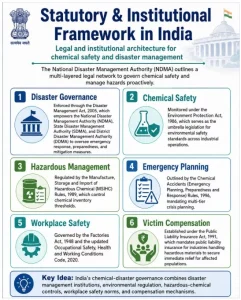
Statutory & Institutional Framework in India
The National Disaster Management Authority (NDMA) outlines a multi-layered legal network to govern chemical safety and manage hazards proactively:
- Disaster Governance: Enforced through the Disaster Management Act, 2005, which empowers the National Disaster Management Authority (NDMA), State Disaster Management Authority (SDMA), and District Disaster Management Authority (DDMA) to oversee emergency response, preparedness, and mitigation measures.
- Chemical Safety: Monitored under the Environment Protection Act, 1986, which serves as the umbrella legislation for environmental safety standards across industrial operations.
- Hazardous Management: Regulated by the Manufacture, Storage and Import of Hazardous Chemical (MSIHC) Rules, 1989, which control chemical inventory thresholds.
- Emergency Planning: Outlined by the Chemical Accidents (Emergency Planning, Preparedness and Response) Rules, 1996, mandating multi-tier crisis planning.
- Workplace Safety: Governed by the Factories Act, 1948 and the updated Occupational Safety, Health and Working Conditions Code, 2020.
- Victim Compensation: Established under the Public Liability Insurance Act, 1991, which mandates public liability insurance for industries handling hazardous materials to secure immediate relief for affected populations.
Disaster Management Cycle Analysis
- Prevention & Mitigation: Strengthening institutional safety audits, verifying equipment layout blueprints, installing automatic leak detection systems, and ensuring absolute regulatory compliance to eliminate mechanical failure.
- Preparedness: Formulating mandatory On-site Emergency Plans (prepared by factory occupiers) and Off-site Emergency Plans (prepared by district authorities for the peripheral community).
- This requires regular joint mock drills involving industry personnel, the DDMA, fire services, and police.
- Response: Activating immediate, multi-agency coordination between regional administrative bodies, health units, and specialized NDRF CBRN teams for safe perimeter evacuation and medical triage.
- Recovery & Rehabilitation: Dispensing ex gratia compensation/solatium, providing specialized respiratory medical care, and fixing swift criminal accountability for operational oversights.
Key Challenges in Chemical Disaster Management
- Weak Regulatory Compliance: Industrial units often view safety frameworks as reactive tasks. Preliminary scrutiny and the government-ordered probe should examine whether gaps in plant approval, leak detection, warning systems, and emergency infrastructure aggravated this disaster.
- Poor Emergency Infrastructure: Remote food-processing clusters frequently operate far from city limits, missing automated regional telemetry alerts or immediate access to specialized respiratory medical wings.
- Lack of an Institutional Safety Culture: Lower-income factory floor workers are rarely trained on how to read chemical safety signage or execute rapid evacuation drills.
- Vulnerability of inter-State Migrant Workers: These workers face severe language barriers, lack access to local social security networks, and are frequently housed inside factory-provided compounds adjacent to heavy chemical storage tanks, placing them directly in high-risk zones.
UPSC Online Courses
Global Actions & Initiatives:
- Global Framework on Chemicals (GFC): Adopted in September 2023 at the fifth International Conference on Chemicals Management (ICCM5) alongside the Bonn Declaration, this framework targets 28 key goals to protect workers from toxic chemical hazards throughout their lifecycle.
- International Labour Organization (ILO) Convention No. 174: The Prevention of Major Industrial Accidents Convention, 1993, which sets global benchmarks for identifying major hazard installations and outlines the safety duties of employers.
- UNEP Chemical Accident Prevention and Preparedness (CAPP) Program: Supports developing nations in strengthening chemical accident prevention through robust legal and institutional response systems.
- Sendai Framework for Disaster Risk Reduction 2015-2030: Emphasizes improving risk governance and disaster preparedness for both natural and man-made/technological hazards to “Build Back Better.”
|
Way Forward
- Proactive Risk Governance: Shifting chemical safety from post-incident compensation to preventive monitoring via real-time digital leak detection and automated alerts linked to district emergency control rooms.
- Enforcement of Legal Codes: Guaranteeing strict adherence to the MSIHC and EPPR Rules, alongside fast-tracking the implementation of the Occupational Safety, Health and Working Conditions Code, 2020 to safeguard worker rights.
- Separation of Housing and Hazards: Mandating strict spatial segregation between worker residential camps and hazardous chemical storage units.
- Community Risk Communication: Designing multilingual warning signage, installing automated sirens, and empowering local community volunteers via Community-Based Disaster Management (CBDM).
Click to Know UPSC Coaching Centres in India
Conclusion
The Tiruvallur ammonia leak highlights the need to shift from reactive response to proactive industrial safety. Protecting workers, especially inter-State migrant labourers, requires strict regulatory compliance, swift accountability, and technology-driven early warning systems to ensure that economic growth does not come at the cost of human lives.
 22 Jun 2026