Subject: GS 2: Polity & Governance
Context: Recently, Kerala has objected to the removal of its nominee from the Comprehensive Dam Safety Evaluation Committee (CDSEC) constituted to inspect the Mullaperiyar dam.
- The National Dam Safety Authority (NDSA) constituted a five-member CDSEC under the Dam Safety Act, 2021 following a Supreme Court directive.
- Kerala’s nominee was removed from the committee without prior consultation.
- Kerala demanded reinstatement, arguing that dam safety requires cooperation between Kerala and Tamil Nadu.
IAS coaching
About Mullaperiyar Dam
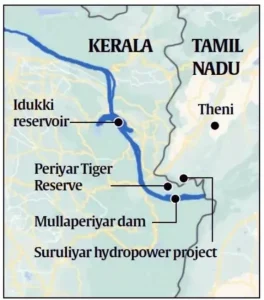
- Location: Mullaperiyar Dam is situated in the Cardamom Hills of the Western Ghats on the Kerala-Tamil Nadu border, near Kumily, in Idukki district.
- The dam is located in Kerala, it is operated by Tamil Nadu.
- Construction: Built in 1895 using limestone and surkhi, the dam diverts water from the Periyar River (Kerala) to Tamil Nadu’s Vaigai basin for irrigation and drinking water needs.
 Water Security Significance: The dam plays a crucial role in supplying water to southern Tamil Nadu for agricultural and drinking water needs.
- Inter-State Dispute: It has been a longstanding point of contention between Kerala and Tamil Nadu, particularly over issues of dam safety and operational control.
- Controversy: Tamil Nadu asserts the dam’s safety and its importance for water supply.
- Kerala highlights the risks posed by potential breaches, especially considering recent climate-induced calamities like landslides.
- It lies in a seismically active zone, further raising concerns about its safety, especially during heavy rains.
- Mullaperiyar Inter-State Water Dispute: Tamil Nadu wants the water level raised to 142 ft in accordance with the 2014 Supreme Court decision, whereas Kerala insists on maintaining it at 139 ft due to damage to dams and environmental concerns. Kerala also objects about the fairness of the lease agreement.
Why the Mullaperiyar Dam Issue Matters ?
- Dam Safety Concerns: The ageing Mullaperiyar Dam raises concerns regarding structural integrity, seismic vulnerability, flood resilience, and the safety of downstream populations.
- Federalism and Inter-State Relations: The dispute underscores challenges in managing inter-State river resources, balancing riparian interests, and ensuring effective Centre–State coordination.
- Disaster Risk Management: Any dam failure could trigger large-scale human casualties, ecological damage, and infrastructure losses, highlighting the need for a risk-based safety approach.
- Water and Livelihood Security: The dam remains critical for irrigation, drinking water supply, and agricultural livelihoods in southern Tamil Nadu.
- Climate Change Challenge: Increasing instances of extreme rainfall and unpredictable weather patterns intensify concerns over dam operations and emergency preparedness.
Legal & Institutional Framework:
- Dam Safety Act, 2021: Establishes a comprehensive framework for dam surveillance, inspection, operation, maintenance, and prevention of dam-related disasters.
- National Dam Safety Authority (NDSA): Provides technical oversight, resolves specified dam-safety issues, and ensures implementation of national safety standards.
- National Committee on Dam Safety: Formulates policies, regulations, and technical guidelines for effective dam safety governance.
- State Dam Safety Organisations (SDSOs): Responsible for regular inspections, monitoring, safety evaluations, and maintenance of dams within States.
- Emergency Action Plans (EAPs): Mandated for dams to facilitate early warning, evacuation, and disaster response during emergencies.
|
Key Challenges in Dam Safety in India
- Ageing Infrastructure: A large number of dams have exceeded their intended design life and require rehabilitation, strengthening, and modernization.
- Climate Change Impacts: Rising frequency of extreme rainfall events, cloudbursts, and floods increases pressure on dam infrastructure.
- Inter-State Coordination Issues: Jurisdictional disputes and differing risk perceptions often delay timely decision-making.
- Inadequate Monitoring Systems: Many dams still lack real-time instrumentation, automated surveillance, and advanced risk-assessment tools.
- Sedimentation and Reduced Capacity: Reservoir siltation reduces storage capacity and affects flood moderation potential.
- Emergency Preparedness Gaps: Limited public awareness, warning systems, and evacuation planning increase downstream vulnerability.
Way Forward
- Technology-Driven Monitoring: Deploy remote sensing, IoT-based sensors, AI-assisted analytics, and real-time surveillance systems for continuous safety assessment.
- Strengthen Cooperative Federalism: Resolve disputes through scientific assessments, institutional dialogue, and consensus-based decision-making.
- Periodic Safety Audits: Conduct regular structural health assessments, seismic evaluations, and independent safety reviews.
- Enhance Disaster Preparedness: Establish robust flood forecasting, early warning systems, and evacuation protocols for downstream communities.
- Dam Rehabilitation and Modernisation: Prioritise repair, retrofitting, and capacity enhancement of ageing dams under national programmes.
- Integrated River Basin Management: Adopt a basin-wide approach that integrates water security, dam safety, ecological sustainability, and disaster resilience.
Click to Know UPSC Coaching Centres in India
Conclusion
The Mullaperiyar issue goes beyond a dam-safety dispute; it represents the intersection of water security, disaster resilience, and cooperative federalism. A balanced approach based on scientific assessment, robust safety standards, and inter-State cooperation is essential to safeguard lives while ensuring sustainable water management for future generations.
 22 Jun 2026