Subject: GS 2: Polity & Governance
Context: Recently, the Union Cabinet has approved the National Investment Policy for Urea–2026 (NIPU–2026).
UPSC Coaching Classes
About the National Investment Policy for Urea–2026 (NIPU–2026)
- It is being implemented by the Ministry of Chemicals and Fertilizers (Department of Fertilizers) to promote investment in gas-based urea manufacturing, enhance domestic urea production, and achieve self-sufficiency in fertilisers under Atmanirbhar Bharat.
- Coverage: The policy will apply to new gas-based urea manufacturing units.
- Successor Policy: NIPU–2026 succeeds the New Investment Policy (NIP), 2012, whose investment window ended in October 2019.
Key Features of NIPU-2026
| Feature |
Detail |
| Cost structure |
Separates fixed and variable costs in the pricing framework |
| Return on Equity (RoE) |
Introduces a band of 12%–16% |
| Forex risk mitigation |
Fixed costs to be converted into rupees after 4 years, based on prevailing exchange rate |
| Expected savings |
Over ₹250 crore per plant compared to NIP-2012 projects |
| Administering body |
Department of Fertilizers will cover new gas-based urea units under this policy |
About Urea
Urea (NH₂CONH₂) is a nitrogenous chemical fertiliser and the most widely used fertiliser in Indian agriculture due to its high nitrogen content.
- Highest Nitrogen Content: Contains about 46% nitrogen, the highest among all solid nitrogenous fertilisers, making it essential for improving crop growth and productivity, particularly for wheat, paddy, sugarcane, and other nutrient-intensive crops.
- Critical for Food Security: Plays a key role in enhancing agricultural productivity, ensuring food security, and supporting farmers’ incomes.
- Government-Regulated Pricing: Urea is provided under the Urea Subsidy Scheme, with its Maximum Retail Price (MRP) statutorily fixed by the Government of India to ensure affordability. In contrast, non-urea fertilisers are covered under the Nutrient Based Subsidy (NBS) Scheme.
|
Need for the Policy
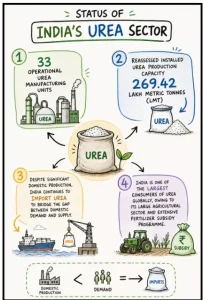
- Import Dependence: India continues to import substantial quantities of urea despite being one of the world’s largest producers and consumers of fertilizers.
- Growing Demand: Rising fertilizer demand driven by agricultural expansion and food security necessitates additional domestic production capacity.
- Expiry of NIP–2012: Following the closure of the investment window under NIP–2012, the Government received fresh proposals for new urea plants, requiring a revised investment framework.
- Energy Efficiency: Encouraging gas-based urea plants, which are more energy-efficient and environmentally cleaner than naphtha-based plants, aligns with sustainable industrial development.
Earlier New Investment Policy (NIP), 2012
- Launched by: Department of Fertilizers.
- Objective: To promote investment in:
- Greenfield urea projects.
- Brownfield expansion projects.
- Revamp and expansion of existing plants.
- Revival of closed urea units.
- Achievements: Under NIP–2012, six new urea plants were established:
- Four through joint ventures of Public Sector Enterprises (PSEs).
- Two by private sector companies.
Significance of NIPU–2026
- Strengthens Fertilizer Security: Enhances domestic manufacturing capacity and reduces vulnerability to global supply disruptions.
- Reduces Import Dependence: Lowers India’s dependence on imported urea, thereby improving the trade balance.
- Supports Farmers: Ensures a stable and timely supply of urea for the agricultural sector.
- Promotes Investment: Provides greater policy certainty and encourages private and public sector participation in fertilizer manufacturing.
- Improves Fiscal Efficiency: Transparent pricing mechanisms and revised cost structures are expected to reduce government expenditure on urea production support.
- Advances Atmanirbhar Bharat: Promotes self-reliance in a strategically important agricultural input.
Click to Know UPSC OnlyIAS Coaching Centres
Conclusion
The National Investment Policy for Urea–2026 represents a significant step towards achieving self-reliance in fertilizer production by encouraging investment in efficient gas-based urea plants. Its success, however, will depend on timely project implementation, assured availability of natural gas, and complementary efforts to promote balanced and sustainable fertilizer use in Indian agriculture.
 24 Jul 2026