Subject: GS 2: Polity & Governance
Context: The UDISE+ 2025–26 Report has highlighted concerns over the stagnation in the enrolment of Children with Special Needs (CWSN).
- The Report is indicating that despite various initiatives for inclusive education, a significant proportion of children with disabilities remain outside the formal school system.
UPSC Online Preparation
About Children with Special Needs (CWSN)
- Definition: Children with Special Needs (CWSN) are children requiring additional educational, physical, psychological, or social support due to disabilities, developmental delays, or learning difficulties.
- Legal Basis: Under the Rights of Persons with Disabilities (RPwD) Act, 2016, 21 categories of disabilities are recognised, replacing the earlier 7 (later expanded to 8) categories under the Persons with Disabilities Act, 1995.
- Educational Objective: CWSN are entitled to inclusive, equitable and quality education under the Right of Children to Free and Compulsory Education (RTE) Act, 2009, the RPwD Act, 2016, and the National Education Policy (NEP), 2020.
Key Findings of the UDISE+ 2025–26 Report
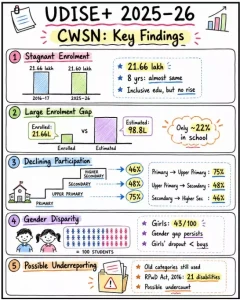
- Stagnant Enrolment: The number of CWSN enrolled in schools remained almost unchanged at around 21.66 lakh over the last eight years, despite policy emphasis on inclusive education.
- Large Enrolment Gap: Based on NFHS-5 disability prevalence and Government population projections, India is estimated to have around 98.8 lakh CWSN in 2025–26, implying that only about 22% of children with disabilities are enrolled in schools.
- Declining Participation at Higher Levels: The proportion of CWSN decreases sharply with each successive stage of education:
- Around 75% of primary-level CWSN continue to upper primary.
- Only about 48% progress from upper primary to secondary.
- Around 46% continue from secondary to higher secondary.
- Gender Disparity: Only about 43 out of every 100 CWSN enrolled in schools are girls, indicating persistent gender inequality. However, girls with disabilities exhibit comparatively lower dropout rates than boys.
- Possible Underreporting: Many schools continue to classify disabilities using the older disability categories instead of the 21 disabilities recognised under the RPwD Act, 2016, leading to possible underestimation of CWSN enrolment.
Challenges in Inclusive Education for CWSN
- Identification and Underreporting: Lack of updated disability assessment and continued use of outdated disability classifications result in under-identification of eligible children.
- Low Enrolment and High Dropouts: A significant proportion of children with disabilities remain outside the education system, while transition rates decline sharply at secondary and higher secondary levels.
- Inadequate Infrastructure: Many schools continue to lack barrier-free infrastructure, accessible toilets, ramps, assistive devices, and transport facilities.
- Shortage of Special Educators: Insufficient availability of trained special educators, therapists, and counsellors affects learning outcomes.
- Social Stigma and Gender Barriers: Disability-related stigma, discrimination, and gender bias discourage school enrolment and retention, particularly among girls.
- Weak Data Systems: Delayed surveys, absence of updated disability estimates, and inconsistencies in reporting affect evidence-based policy formulation.
Associated Government Initiatives
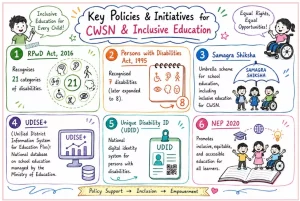
- Right of Children to Free and Compulsory Education (RTE) Act, 2009: Ensures free and compulsory education for children aged 6–14 years, including children with disabilities.
- Accessible India Campaign (Sugamya Bharat Abhiyan), 2015: Promotes accessibility in public buildings, transportation, and information & communication technologies, including educational institutions.
- Unique Disability ID (UDID) Project, 2016: Creates a national database of persons with disabilities and streamlines access to welfare schemes and services.
- Rights of Persons with Disabilities (RPwD) Act, 2016: Recognises 21 categories of disabilities and guarantees the right to inclusive education without discrimination.
- Samagra Shiksha, 2018: Provides support for inclusive education through resource teachers, assistive devices, home-based education, transport allowance, and accessible infrastructure.
- National Education Policy (NEP), 2020: Emphasises inclusive and equitable education, universal access, barrier-free schools, assistive technologies, and teacher capacity building.
Way Forward
- Strengthen Early Identification: Ensure universal screening and timely identification of children with disabilities through convergence between the health and education sectors.
- Improve Data Quality: Update school reporting systems in line with the 21 disability categories under the RPwD Act, 2016, and conduct regular disability surveys.
- Expand Inclusive Infrastructure: Ensure all schools comply with universal accessibility standards, including ramps, accessible classrooms, toilets, transport, and assistive technologies.
- Enhance Teacher Capacity: Recruit more special educators and provide continuous training to regular teachers on inclusive pedagogy.
- Improve Retention: Strengthen scholarships, counselling, caregiver support, and transition planning to reduce dropouts at secondary and higher secondary levels.
- Promote Community Awareness: Address stigma and discrimination through awareness campaigns and encourage greater participation of girls with disabilities in education.
Click to Explore UPSC Offline Coaching
Conclusion
Achieving inclusive education requires effective implementation, accessible infrastructure, trained teachers, and data-driven planning to realise the constitutional ideals of equality, dignity, and social justice, ensuring that no child with special needs is left behind.
 24 Jul 2026