Subject: GS 2: Polity and Governance
Context: Recently, the NITI Aayog has released the report “Reimagining Care: Strategies for Empowering Caregivers in Viksit Bharat@2047”.
UPSC Course Fees Online
Key Highlights of the Report
The report envisions a comprehensive caregiving ecosystem as a key pillar of inclusive growth, social development, and human capital formation, while positioning India as a global hub for skilled caregiving professionals.
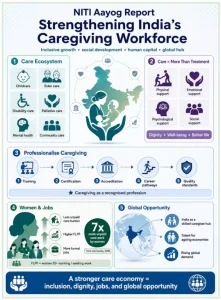
- Comprehensive Care Ecosystem: The report recommends developing an integrated caregiving ecosystem covering childcare, elderly care, disability care, palliative care, mental health support, and community-based care services to meet India’s evolving demographic and social needs.
- Care Beyond Medical Treatment: It recognises that caregiving extends beyond healthcare by providing physical, emotional, psychological, and social support, thereby enhancing dignity, well-being, and quality of life.
- Professionalisation of Caregiving: The report advocates standardised training, certification, accreditation, and career pathways to transform caregiving into a recognised profession with quality standards.
- Women’s Economic Empowerment: Expanding the formal care economy can reduce the burden of unpaid care work, increase Female Labour Force Participation (FLFP), and generate large-scale employment opportunities.
- According to the Time Use Survey (2019), Indian women spend over seven times more time on unpaid domestic and caregiving work than men.
- Global Workforce Opportunity: India can emerge as a global supplier of skilled caregivers, particularly for ageing economies experiencing shortages of trained care professionals.
About Care Economy
- Definition: The care economy comprises all paid and unpaid activities and services that provide physical, emotional, psychological, and social support to individuals requiring assistance due to childhood, old age, illness, disability, or dependency.
- It includes childcare, elderly care, disability support, healthcare, rehabilitation, and long-term care.
- Growing Relevance: Rising life expectancy, population ageing, urbanisation, changing family structures, and increasing female labour force participation are significantly increasing the demand for professional, affordable, and quality caregiving services in India and globally.
|
| Aspect |
Care Economy |
Silver Economy |
Purple Economy |
| Meaning |
- Economic activities providing care and support services to dependent individuals.
|
- Economic activities catering to the needs of the ageing population (60+ years).
|
- Economic model integrating culture, creativity, and heritage into economic development.
|
| Target Group |
- Children, elderly, persons with disabilities, patients, and dependents.
|
|
- Society at large, especially creative industries and cultural sectors.
|
| Examples |
- Caregiving services, Anganwadis, home nursing, rehabilitation centres.
|
- Senior living communities, geriatric hospitals, assistive devices, pension services.
|
- Handloom sector, museums, heritage conservation, film industry, cultural festivals.
|
Need for Caregiving Ecosystem in India
- Inclusive Growth: A robust caregiving ecosystem strengthens support for children, elderly persons, persons with disabilities, and chronically ill individuals, ensuring equitable access to quality care.
- Demographic Preparedness: Rising life expectancy, population ageing, and changing family structures are increasing the demand for long-term care.
- According to the United Nations World Population Prospects 2024, nearly one in five Indians is expected to be aged 60 years or above by 2050.
- Employment Generation: The care economy can generate large-scale formal employment, particularly for women and youth, while supporting entrepreneurship in health and social services.
- Growing Care Needs: According to the Census 2011, India has 26.8 million persons with disabilities (2.21% of the population), including children with special needs who primarily depend on family caregivers, thereby increasing the demand for accessible and quality caregiving services.
- Human Capital Development: Improved caregiving enhances health outcomes, nutrition, education, productivity, and overall human development, contributing to the vision of Viksit Bharat@2047.
IAS coaching
Challenges that need to be Tackled
- Predominance of Informal Care: A large proportion of caregiving is provided by family members, particularly women, without adequate training, financial recognition, or social security.
- Skill and Certification Gaps: Limited availability of professional training, certification, and accreditation affects the quality of care services and international employability.
- Low Social Recognition: Care work continues to receive limited economic and social recognition despite its critical contribution to society.
- Institutional Fragmentation: Responsibilities relating to caregiving are spread across multiple ministries, resulting in fragmented policy implementation.
- Limited Care Infrastructure: India continues to face shortages of quality eldercare facilities, childcare centres, rehabilitation services, and trained caregivers.
India’s Initiatives
- National Programme for Health Care of the Elderly (NPHCE) (2010): Provides preventive, promotive, curative, rehabilitative, and geriatric healthcare services for senior citizens.
- Maintenance and Welfare of Parents and Senior Citizens Act, 2007: Provides a legal framework for the maintenance, protection, and welfare of elderly persons.
- Mission Shakti (2022): Promotes women’s empowerment through initiatives relating to care, protection, and support services, including childcare.
- National Education Policy (NEP), 2020: Encourages vocational education and skill development, creating pathways for professional caregiving.
- SHATAYU (Senior Healthcare Assessment Tracking and Ageing Yield Utility) Dashboard: It is a digital monitoring platform launched by the Ministry of Health and Family Welfare (MoHFW) under the National Programme for Health Care of the Elderly (NPHCE).
- It enables real-time monitoring of geriatric healthcare services, beneficiary registration, screening, treatment, and follow-up of senior citizens across healthcare facilities.
- JEEVAN (Joint Evaluation and Enhanced Vigilance for Ageing Needs) App: It is a mobile application developed under the National Programme for Health Care of the Elderly (NPHCE).
- It facilitates digital health assessment, screening, follow-up, and referral of elderly persons at the community level.
- Certificate Course in Caregiving (CCCG): Offered by the Department of Empowerment of Persons with Disabilities through its National Institutes and training centres recognised by the Rehabilitation Council of India (RCI) to develop a skilled caregiving workforce for persons with disabilities.
Global Initiatives
- International Labour Organization’s (ILO’s) 5R Framework: Promotes Recognise, Reduce, Redistribute, Reward, and Represent unpaid and paid care work to advance gender equality and decent work.
- UN Decade of Healthy Ageing (2021–2030): Supports integrated long-term care systems and age-friendly environments for healthy ageing.
- WHO Framework on Integrated People-Centred Health Services (2016): Encourages community-based, integrated, and people-centred healthcare throughout the life course.
- UN Women: Advocates greater public investment in the care economy to promote women’s economic empowerment and inclusive development.
Best Online Coaching for UPSC
Global Best Practices in Caregiving:
- Japan: Promotes community-based integrated care through the Long-Term Care Insurance (LTCI) System, ensuring universal access to elderly care while reducing the burden on families.
- Sweden: Provides universal, publicly funded childcare and eldercare with strong parental leave, enabling high Female Labour Force Participation (FLFP) and better work-life balance.
- Germany: Operates a mandatory Long-Term Care Insurance (LTCI) system that offers cash benefits and in-kind services, supporting both professional and family caregivers.
- Singapore: Strengthens ageing-in-place through the Community Care model, supported by caregiver training, financial assistance, and assistive technologies.
- South Korea: Integrates long-term care, home-based services, and digital healthcare to address the needs of its rapidly ageing population.
|
Way Forward
- Develop a National Care Economy Framework: Establish a coordinated policy integrating health, social justice, women and child development, labour, and skill development to strengthen caregiving services.
- Professionalise the Caregiving Workforce: Expand training, certification, accreditation, and career progression to improve service quality and global employability.
- Strengthen Social Protection: Ensure fair wages, social security, insurance coverage, and decent working conditions for caregivers in both formal and informal sectors.
- Promote Public–Private Partnerships: Encourage investment in care infrastructure, assisted living facilities, home-based care services, and digital health platforms.
- Leverage Technology: Adopt tele-care, assistive technologies, digital health platforms, and Artificial Intelligence-enabled care solutions to improve accessibility and efficiency.
- Recognise Unpaid Care Work: Incorporate Time Use Survey findings into policy planning, strengthen gender budgeting, and expand affordable childcare and eldercare services.
Click to Know UPSC Coaching Centres in India
Conclusion
A robust care economy strengthens human capital, gender equality, and inclusive growth. By professionalising caregiving, expanding care infrastructure, and recognising the value of care work, India can build an inclusive care ecosystem and emerge as a global hub for skilled caregiving under Viksit Bharat@2047.
 7 Aug 2026