Subject: GS 2: Polity and Governance
Context: Recently, the Supreme Court has directed the Centre, States, Reserve Bank of India (RBI), and telecom authorities to formulate Standard Operating Procedures (SOPs) to curb digital arrest scams.
Best Online Coaching for UPSC
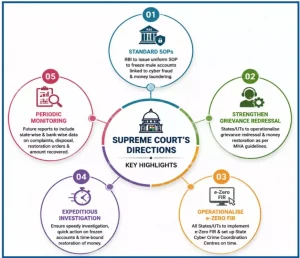
Key Highlights on the Supreme Court’s Directions (Refer Image)
What is a Digital Arrest Scam?
- A digital arrest scam is a form of cyber-enabled financial fraud in which fraudsters impersonate officials of agencies such as the Police, CBI, ED, Narcotics Control Bureau (NCB), or RBI, falsely accuse victims of criminal involvement, and coerce them through video calls, fake documents, and threats of arrest into transferring money or disclosing sensitive financial information.
Why are Digital Arrest Scams Increasing?
- Misuse of Digital Communication: Fraudsters exploit video calls, caller ID spoofing, deepfakes, and social engineering to impersonate government officials and create a false sense of authority.
- Psychological Manipulation: Victims are isolated through continuous monitoring, threats of arrest, and fabricated legal proceedings, compelling them to comply without verification.
- Rapid Digitalisation: The widespread adoption of digital payments, internet banking, and UPI has expanded opportunities for cyber-enabled financial fraud.
- Cross-Border Cyber Networks: Organised cybercriminal groups often operate across jurisdictions, making investigation, attribution, and prosecution more challenging.
Progress Made So Far
- Declining Complaints: Complaints relating to digital arrest scams on the National Cyber Crime Reporting Portal declined from 1,23,672 (2024) to 58,249 (2025) and further to 16,377 (up to 30 June 2026).
Existing Institutional Mechanism:
- Indian Cyber Crime Coordination Centre (I4C) (2018): Established under the Ministry of Home Affairs (MHA) as the nodal agency to coordinate efforts for the prevention, detection, investigation, and prosecution of cybercrimes across the country.
- National Cyber Crime Reporting Portal (NCRP) (2019): Launched by the MHA to enable citizens to report cyber-enabled offences, particularly financial frauds, and facilitate coordinated investigation by law enforcement agencies.
- National Cyber Crime Helpline (1930) (2021): Provides an immediate reporting mechanism for cyber-enabled financial frauds, enabling timely freezing of fraudulent transactions and improving the chances of fund recovery.
- Cyber Fraud Mitigation Centre (CFMC) (2024): Established under I4C to enable real-time coordination among banks, financial institutions, telecom service providers, internet service providers, and law enforcement agencies for the swift detection, prevention, and mitigation of cyber-enabled financial frauds.
|
- Banking Coordination: A Data Sharing MoU between the Reserve Bank Innovation Hub (RBIH) and Indian Cyber Crime Coordination Centre (I4C) was signed on 11 May 2026 to strengthen information sharing.
- Grievance Redressal: The grievance redressal mechanism now covers 1,23,590 branches of 69 banks, while the Money Restoration Mechanism Portal covers 57 banks across all 36 States and Union Territories.
- Money Restored: Financial losses have been restored in 36,290 cases, involving approximately ₹18.05 crore.
- Institutional Preparedness: The e-Zero FIR mechanism is operational in 19 States, while 14 States have notified State Cyber Crime Coordination Centres.
Click to Explore UPSC Offline Coaching
Conclusion
A robust legal framework, inter-agency coordination, technological innovation, and greater public awareness are essential to effectively combat digital arrest scams and strengthen India’s cyber resilience.
 5 Aug 2026