Subject: GS 2: Polity & Governance
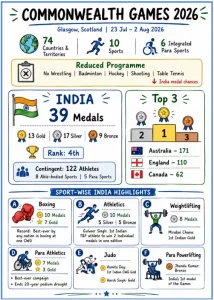
Context: India concluded its campaign at the Commonwealth Games 2026 in Glasgow by winning 39 medals (13 Gold, 17 Silver, 9 Bronze) to finish 4th.
Best Online Coaching for UPSC
About the Commonwealth Games
- The Commonwealth Games are a quadrennial international multi-sport event involving athletes from the Commonwealth of Nations, promoting sporting excellence, friendship, and cooperation.
- Organising Body: Organised by Commonwealth Sport (formerly the Commonwealth Games Federation (CGF)).
- Membership: The Commonwealth comprises 56 sovereign member countries.
- History: The inaugural edition was held in 1930 at Hamilton, Canada, as the British Empire Games.
- Frequency: Held every four years.
- 23rd Commonwealth Games (2026): Held in Glasgow, Scotland, marking the 23rd edition of the Commonwealth Games.
- 24th Commonwealth Games (2030): To be hosted by Ahmedabad, Gujarat, marking the second time India will host the Games after New Delhi (2010). This will make Ahmedabad the first Indian city after New Delhi to host the event.
- Motto: “Humanity, Equality, Destiny.”
- Unique Features:
-
- Only major multi-sport event featuring fully integrated competition between able-bodied and para athletes.
- Promotes inclusivity, gender equality, and equal medal opportunities.
- The host city has flexibility in selecting sports from the approved programme.
Key Highlights of Commonwealth Games 2026
- Host and Duration: Held in Glasgow, Scotland, from 23 July to 2 August 2026, featuring athletes from 74 countries and territories across a 10-sport programme, including 6 integrated para sports.
- Reduced Sports Programme: The 2026 Glasgow Commonwealth Games excluded nine sports from the 2022 Birmingham Games programme—Badminton, Cricket, Hockey, Squash, Table Tennis, Triathlon, Wrestling, Beach Volleyball, and Rugby Sevens—significantly reducing India’s medal opportunities.
- India’s Performance: Won 39 medals (13 Gold, 17 Silver, 9 Bronze) to finish 4th.
- Top Three Countries:
-
- Australia – 171 medals
- England – 110 medals
- Canada – 62 medals
- Indian Contingent: 122 athletes across 8 able-bodied sports and 5 integrated para sports.
India’s Performance by Sport
- Boxing: 10 medals, including a record 7 Gold medals, the highest ever by any nation in boxing at a single Commonwealth Games.
- Athletics: 10 medals (5 Silver, 5 Bronze).
- Gulveer Singh became the first Indian track and field athlete to win two individual medals at a single edition.
- Weightlifting: 8 medals, including India’s first Gold medal won by Mirabai Chanu.
- Para Athletics: 7 medals, including 3 Gold medals, marking India’s best-ever para athletics campaign and ending a 20-year podium drought.
- Judo: Asmita Dey became India’s first Commonwealth Games Gold medallist in judo, while Harsh Singh added another Gold medal.
- Para Powerlifting: Jhandu Kumar won India’s first medal of the Games with a Bronze medal.
Constitutional & Policy Framework:
- State Subject: Sports is placed under Entry 33 of the State List (Seventh Schedule), making it primarily the responsibility of State Governments.
- Draft National Sports Policy, 2024: Envisions sports as a people’s movement, economic sector, and tool for social inclusion, with a focus on Olympic excellence, grassroots development, and the sports economy.
Governance & Institutional Framework:
- Sports Authority of India (SAI) (1984): Apex national sports body under the Ministry of Youth Affairs and Sports, responsible for talent identification, training, sports infrastructure, and high-performance support.
- National Sports Development Code of India, 2011: Provides the governance framework for National Sports Federations (NSFs), promoting transparency, accountability, age and tenure limits, and free & fair elections.
- Indian Olympic Association (IOA): Apex body responsible for India’s participation in the Olympic Games, Commonwealth Games, Asian Games, and other multi-sport international events.
|
India’s Initiatives
- National Sports Development Fund (NSDF) (1998): Mobilises government and private sector resources to support elite athlete training, sports infrastructure, sports science, and international exposure.
- Khelo India Scheme (2017): Strengthens the sporting ecosystem through grassroots talent identification, sports infrastructure, coaching, sports science, and competitive opportunities, with the goal of establishing one Khelo India Training Centre in every district.
- Target Olympic Podium Scheme (TOPS) (2014): Provides elite athletes with international exposure, world-class coaching, sports science support, specialised equipment, and financial assistance for the Olympic and Paralympic Games.
- Fit India Movement (2019): Promotes physical fitness, mass participation in sports, and healthy lifestyles.
- Khelo India Rising Talent Identification (KIRTI) (2024): Identifies talent among children aged 9–18 years using scientific assessment, Artificial Intelligence (AI), and data analytics.
- Sports Goods Manufacturing Initiative (2026): Announced in the Union Budget 2026–27 to position India as a global sports goods manufacturing hub.
Click to Explore UPSC Offline Coaching
Conclusion
India’s performance at the Commonwealth Games 2026 reflects the success of sustained investments in grassroots sports, sports science, athlete development, and inclusive sporting infrastructure. Continued reforms and institutional support will be crucial to achieving India’s ambition of becoming a global sporting powerhouse.
 3 Aug 2026