Subject: GS 2: Polity & Governance
Context: Recently, the Supreme Court has passed an interim order prohibiting the unauthorised recording, editing, dissemination, and monetisation of livestreamed court proceedings to prevent misuse and safeguard the integrity of the judicial process.
UPSC Coaching Classes
Key Highlights of the Supreme Court’s Interim Order
- The order seeks to prevent the misuse, sensationalisation, and commercial exploitation of livestreamed court proceedings while preserving judicial dignity and public confidence in the justice delivery system.
- Prohibited Activities: Without prior permission from the Secretary General of the Supreme Court or the Registrar General of the concerned High Court, no person shall:
- Extract or record audio-video clips of judicial proceedings.
- Edit or modify such recordings.
- Upload, repost, or disseminate them on social media or digital platforms.
- Monetise or commercially exploit such recordings.
- Scope: The restriction applies only to unauthorised use of official court recordings and does not prohibit legitimate reporting of court proceedings.
- Nature of the Order: The Court clarified that the order is not a gag order against the media but an enforcement of the Model Rules for Live Streaming and Recording of Court Proceedings, 2022.
Need for the Interim Order
- Selective Editing: Short and out-of-context video clips are often circulated, misrepresenting judicial observations and proceedings.
Associated Constitutional and Legal Framework:
- Article 21: The right to access justice has been interpreted to include reasonable public access to court proceedings.
- Article 19(1)(a): Guarantees freedom of speech and expression, including freedom of the press, subject to reasonable restrictions under Article 19(2).
- Article 129: Declares the Supreme Court as a Court of Record, empowering it to preserve records and punish for contempt.
- Article 215: Declares every High Court to be a Court of Record with similar powers.
|
- Commercial Exploitation: Courtroom proceedings are increasingly being monetised on social media platforms for commercial gain.
- Misinformation: Edited recordings may distort judicial proceedings, creating misleading public narratives.
- Artificial Intelligence (AI) Risks: AI-based tools can manipulate audio and video recordings, enabling the creation of deceptive or fabricated content.
- Protection of Judicial Independence: Selective circulation of courtroom exchanges may expose judges and lawyers to trolling, harassment, and undue public pressure, thereby affecting the administration of justice.

Evolution of Live Streaming in India
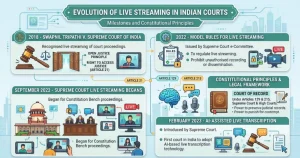
- Swapnil Tripathi v. Supreme Court of India (2018): The Supreme Court held that live streaming of court proceedings is an extension of the constitutional principle of open justice and advances the right to access justice under Article 21.
- Live Streaming of Constitution Bench Proceedings (2022): The Supreme Court commenced live streaming of Constitution Bench proceedings in September 2022.
- Model Rules for Live Streaming and Recording of Court Proceedings (2022): Framed by the Supreme Court e-Committee, these rules prohibit the unauthorised recording, reproduction, sharing, or dissemination of livestreamed proceedings.
- AI-assisted Live Transcription (2023): The Supreme Court became the first Indian court to introduce AI-assisted live transcription, creating an accurate digital archive of court proceedings.
Significance of Live Streaming
- Promotes Transparency: Strengthens openness and accountability in the judicial process.
- Enhances Access to Justice: Enables citizens, lawyers, researchers, and students to observe court proceedings remotely.
- Improves Public Awareness: Increases legal literacy and public understanding of constitutional and legal issues.
- Creates Official Records: Digital recordings and AI-assisted transcripts help preserve authentic judicial records.
- Strengthens Judicial Accountability: Public visibility enhances confidence in the justice delivery system.
Concerns Associated with Live Streaming
- Selective Presentation: Partial clips may misrepresent judicial reasoning and influence public perception.
- Social Media Trials: Viral circulation of edited content may lead to public opinion being formed before judicial decisions are delivered.
- Threat to Judicial Independence: Judges and lawyers may face trolling, intimidation, or reputational harm due to distorted online content.
- Privacy Concerns: Sensitive proceedings involving victims, children, or confidential matters require greater protection.
- AI-enabled Manipulation: Deepfakes and synthetic media can alter courtroom recordings, undermining the authenticity of judicial proceedings.
Way Forward
- Strengthen Regulatory Framework: Develop comprehensive guidelines governing the use, storage, and dissemination of judicial recordings.
- Official Digital Repository: Maintain authenticated archives of court proceedings with controlled public access.
- Platform Accountability: Require digital intermediaries to promptly remove manipulated or unauthorised judicial content upon notification.
- Use of Watermarking and Authentication: Introduce digital watermarking and content verification mechanisms to prevent tampering.
- Balanced Approach: Ensure that judicial transparency is preserved while protecting the dignity, independence, and integrity of the judiciary.
Click to Know UPSC OnlyIAS Coaching Centres
Conclusion
The Supreme Court’s interim order seeks to balance judicial transparency with the integrity and dignity of the justice delivery system, ensuring that technological advancements strengthen public access without undermining public confidence in the judiciary.