Subject: GS 2: Polity & Governance
Context: Recently, the Prevention of Insults to National Honour (Amendment) Bill, 2026 was introduced in the Rajya Sabha to extend legal protection against insults to the National Song, “Vande Mataram,”.
- The Bill amends the Prevention of Insults to National Honour Act, 1971.
- The 1971 Act currently makes it a punishable offence to intentionally prevent the singing of the National Anthem or to disturb an assembly engaged in singing it.
UPSC Online Preparation

About the Prevention of Insults to National Honour (Amendment) Bill, 2026
- The Bill seeks to prohibit intentional insults, obstruction, or disturbance during the singing of the National Song (Vande Mataram) by extending the legal protection currently available to the National Anthem.
- Legislative Amendment: It proposes to amend Section 3 of the Prevention of Insults to National Honour Act, 1971.
- Proposed Change: The Bill seeks to bring the National Song within the ambit of Section 3, making similar acts of intentional obstruction or disturbance punishable.
Key Features of the Prevention of Insults to National Honour (Amendment) Bill, 2026
- Extends Legal Protection: Brings the National Song (Vande Mataram) within the ambit of the Prevention of Insults to National Honour Act, 1971, placing it on par with the National Anthem (Jana Gana Mana).
- It also seeks to accord the same statutory protection to the National Song as the National Anthem.
- Amendment to Section 3: Substitutes Section 3 of the 1971 Act to extend existing penal provisions applicable to the National Anthem to the National Song.
- Criminalises Intentional Obstruction: Makes it an offence to intentionally prevent the singing of the National Song or cause disturbance to any assembly engaged in its rendition.
- Prescribed Penalties: Violations are punishable with imprisonment up to three years, fine, or both.
- For second and subsequent convictions, a minimum imprisonment of one year is prescribed under the parent Act.
- Addresses Legal Gap: Seeks to provide statutory protection to Vande Mataram, which previously lacked specific penal safeguards despite its recognition as the National Song.
About the Prevention of Insults to National Honour Act, 1971
- It was enacted to prevent disrespect and insults to India’s National Flag, Constitution, and National Anthem, thereby preserving their dignity and sanctity.
- Legal Basis: Provides statutory protection to national symbols in addition to the Fundamental Duty under Article 51A(a), which requires every citizen to respect the Constitution, the National Flag, and the National Anthem.
Constitutional and Historical Background of National Song:
- Constitutional Status: The Constitution of India does not expressly recognise or define the National Song.
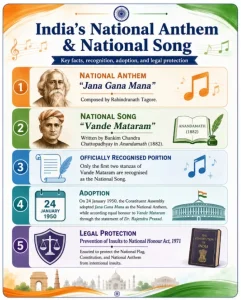
- Constituent Assembly Decision: On 24 January 1950, Dr. Rajendra Prasad, President of the Constituent Assembly, stated that “Jana Gana Mana” would be the National Anthem, while “Vande Mataram” would enjoy equal honour and respect as the National Song.
- Legal Position: This declaration was not incorporated into the Constitution and does not have the status of a constitutional provision.
- National Song: The first two stanzas of “Vande Mataram”, composed by Bankim Chandra Chattopadhyay in the novel Anandamath (1882), are recognised as the National Song.
|
- Key Provisions:
- Prohibits intentional insult to the National Flag or the Constitution of India through acts such as burning, mutilating, defacing, defiling, disfiguring, destroying, trampling upon, or showing contempt.
- Prohibits intentional prevention or disturbance of the singing of the National Anthem.
- Punishment: Offenders are punishable with imprisonment for up to three years, or with fine, or with both.
- Related Rules: The Flag Code of India, 2002 lays down the rules governing the display, hoisting, and use of the National Flag, while the 1971 Act prescribes penalties for acts amounting to its insult.
Arguments in Favour of the Bill
- Protection of National Symbols: The Bill seeks to provide statutory protection to a symbol closely associated with India’s freedom movement.
- Removal of Legal Gap: It addresses the absence of a specific legal provision protecting the National Song from intentional insults.
- Promotion of National Unity: The Government argues that protecting national symbols strengthens patriotism, national unity, and constitutional values.
- Consistency in Legal Framework: It seeks to extend protection similar to that already available for the National Anthem.
Best Online Coaching for UPSC
Concerns Associated with the Bill
- Constitutional Validity: Critics argue that Parliament cannot, through an ordinary law, confer a status equivalent to the National Anthem when the Constituent Assembly consciously adopted a different constitutional position.
- Freedom of Speech: Criminalising certain conduct may invite scrutiny under Article 19(1)(a) relating to freedom of speech and expression, subject to reasonable restrictions under Article 19(2).
- Legislative Competence Debate: Some members contend that the Bill effectively alters a constitutional understanding without a constitutional amendment.
- Potential Misuse: Concerns have been expressed regarding possible misuse of the law against individuals for symbolic or political expression.
Important Judicial Pronouncements
- Bijoe Emmanuel v. State of Kerala (1986): The Supreme Court held that students belonging to the Jehovah’s Witnesses faith could not be compelled to sing the National Anthem if they respectfully stood during its rendition.
- The Court held that compelling them violated Article 19(1)(a) and Article 25.
- Shyam Narayan Chouksey v. Union of India (2018): The Supreme Court clarified that playing the National Anthem in cinema halls is not mandatory, while reiterating the need to show due respect to national symbols.
Click to Explore UPSC Offline Coaching
Conclusion
The proposed amendment seeks to strengthen statutory protection for the National Song and reinforce respect for national symbols. However, its implementation must remain consistent with the constitutional principles of liberty, freedom of expression, and the intent of the Constituent Assembly, ensuring that patriotism is promoted within the framework of constitutional democracy.