Subject: GS 3: Economy
Context: The United States has imposed a 10% tariff on goods imported from India (and 16 other countries), citing concerns over the use of forced labour in production.
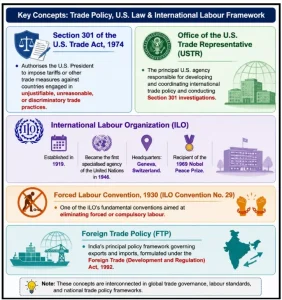
- The tariffs, announced under Section 301 of the Trade Act, 1974.
IAS coaching

Background
- The measure replaces the temporary 10% universal tariff imposed after the U.S. Supreme Court invalidated the Trump administration’s earlier reciprocal tariffs imposed under emergency powers.
- Section 301 of the U.S. Trade Act, 1974, allows the U.S. President to take unilateral trade actions against countries engaged in unjustifiable, unreasonable, or discriminatory trade practices.
Tariff Structure
| Tariff Rate |
Countries |
Basis |
| 10% |
India, Canada, UK, Bangladesh, Pakistan, and 12 others (17 total) |
Have laws banning forced-labour imports, but enforcement deemed inadequate (or have committed to improve it) |
| 12.5% |
China, Japan, and 42 others (43 total) |
Deemed to lack laws prohibiting import of forced-labour-produced goods |
Tariff Exemptions
- Raw materials whose restrictions could create domestic shortages.
- Products likely to cause economy-wide supply disruptions.
- Goods that cannot be produced in sufficient quantities within the United States.
- Oil, natural gas, fertilisers, fuel, and selected food products.
- Automobiles, metals, and pharmaceuticals are already covered under separate sector-specific tariffs.
- Goods eligible for duty-free treatment under the United States-Mexico-Canada Agreement (USMCA).
About Forced Labour
- Definition: According to the International Labour Organization (ILO) Forced Labour Convention, 1930 (Convention No. 29), forced labour refers to “all work or service exacted from any person under the menace of any penalty and for which the person has not offered himself or herself voluntarily.”
- Global Estimate: According to the ILO, nearly 27.6 million people were living in conditions of forced labour worldwide in 2021.
- Forms of Forced Labour: It includes debt bondage, human trafficking, compulsory labour, state-imposed forced labour, and other forms of involuntary work.
|
India’s Position
India prohibits forced labour through a robust constitutional and legal framework, primarily under Article 23 of the Constitution (Right against Exploitation) and the Bonded Labour System (Abolition) Act, 1976.
- Policy Response: India amended its Foreign Trade Policy (FTP) to prohibit the import of goods produced using forced labour, strengthening its domestic regulatory framework.
- Diplomatic Stand: India has challenged the U.S. investigations, arguing that such issues should be addressed through the proposed India–U.S. Bilateral Trade Agreement (BTA) and within the framework of the World Trade Organization (WTO).
- Change in Tariff Category: Following the amendment to the Foreign Trade Policy, India’s proposed tariff was reduced from 12.5% to 10%, as the U.S. acknowledged India’s legal prohibition while expressing concerns regarding enforcement.
- Exempted Items: India has separately exempted 1,600 items deemed critical to its needs from its own retaliatory/regulatory measures, and has called the U.S. approach “inconsistent.”
Click to Know UPSC Coaching Centres in India
Implications for India
- Export Competitiveness: The tariff could reduce the price competitiveness of Indian exports in the U.S. market, particularly in labour-intensive sectors.
- Trade Negotiations: The issue may become an important agenda item in the ongoing India–U.S. Bilateral Trade Agreement (BTA) negotiations.
- Supply Chain Compliance: Indian exporters may face greater scrutiny regarding labour standards, supply chain transparency, and traceability.
- Policy Reforms: The measure may accelerate reforms relating to labour governance, ethical sourcing, and corporate due diligence.
- Global Trade Trends: The action reflects the increasing use of labour, environmental, and sustainability standards as instruments of international trade policy.