Subject: GS 2: Polity & Governance
Context: The Growing cuts in Development Assistance for Health (DAH), rising public debt, and persistent health financing gaps have renewed focus on improving the efficiency, prioritisation, and governance of public health spending to build resilient and equitable health systems.
UPSC Coaching Classes
- Development Assistance for Health (DAH): It refers to financial and technical assistance provided by bilateral donors, multilateral organisations, development banks, philanthropic foundations, and non-governmental organisations to support health programmes in Low- and Middle-Income Countries (LMICs).
|
Why are Strong Public Health Systems Important?
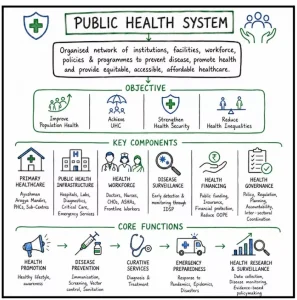
- Foundation of Universal Health Coverage (UHC): Strong public health systems ensure equitable, affordable, and quality healthcare for all while protecting households from catastrophic health expenditure.
- Health Security: Robust health systems improve preparedness for pandemics, emerging diseases, and public health emergencies, thereby strengthening national health security.
- Economic Growth: Better population health enhances labour productivity, human capital development, and long-term economic growth.
- Achievement of Sustainable Development Goals (SDGs): Strong health systems are essential for achieving Sustainable Development Goal 3 (SDG 3)- Good Health and Well-being and contribute to reducing poverty and inequality.
Current Global Scenario
- Persistent Health Financing Gap: According to the World Bank, per capita public spending on Universal Health Coverage (UHC) in Low- and Middle-Income Countries (LMICs) remains only about half of the minimum benchmark despite gradual increases in health expenditure.
- Declining Development Assistance for Health (DAH): Global Development Assistance for Health (DAH), which peaked during the COVID-19 pandemic, has declined sharply.
- In 2025, the United States reduced foreign assistance by 67%, followed by the United Kingdom (39%), France (35%), and Germany (12%), while the Organisation for Economic Co-operation and Development (OECD) estimates global health funding could fall by up to 60% from its 2022 peak.
- Rising Public Debt: According to the United Nations Conference on Trade and Development (UNCTAD), global public debt reached US$102 trillion in 2024, including US$31 trillion owed by developing countries, reducing fiscal space for health and other social sectors.
Health Financing Challenges in India
- High Out-of-Pocket Expenditure (OOPE): Despite increasing public health expenditure, Out-of-Pocket Expenditure (OOPE) continues to impose a significant financial burden on households.
- As per the latest figures from the National Health Accounts Estimates for India 2022–23, OOPE is nearly half of the current health expenditure, and financial protection for health emergencies remains incomplete, though government and insurance spending has increased.
- Underutilisation of Budget Allocations: Health budgets often remain partially unspent. In 2024–25, only about two-thirds of the allocation under the Pradhan Mantri-Ayushman Bharat Health Infrastructure Mission (PM-ABHIM) was utilised, while only 26% of funds under the National Health Mission (NHM) for communicable and non-communicable disease programmes were spent.
- Inadequate Public Health Spending: India’s public health expenditure remains below the National Health Policy, 2017 target of 2.5% of Gross Domestic Product (GDP), limiting investments in health infrastructure and service delivery.
Key Challenges in Public Health Spending
- Low Budget Execution: Many Low- and Middle-Income Countries (LMICs) execute only 85–90% of allocated health budgets, indicating weak implementation despite budgetary commitments.
- Skewed Spending Priorities: Public expenditure continues to favour secondary and tertiary curative care, while preventive and primary healthcare remain underfunded.
- Insufficient Investment in Public Health Functions: Essential interventions such as infectious disease control, immunisation, sanitation, disease surveillance, and health promotion receive comparatively lower investments despite generating the highest public health gains.
- Weak Public Financial Management: Delays in fund release, procurement inefficiencies, poor budget credibility, and rigid financial procedures reduce the effectiveness of public spending.
- Governance Deficits: Weak institutional capacity, corruption, and inadequate accountability mechanisms diminish the impact of increased public expenditure on health outcomes.
Why is Better Public Spending Necessary?
- Improve Budget Utilisation: Timely utilisation of allocated funds can significantly improve service delivery without necessarily increasing overall expenditure.
- Prioritise Preventive Healthcare: Greater investments in primary healthcare, disease prevention, vaccination, sanitation, and health promotion yield higher long-term health and economic returns than excessive focus on curative care.
- Strengthen Public Health Infrastructure: Investments should prioritise laboratories, disease surveillance systems, emergency preparedness, digital health infrastructure, and frontline healthcare workers.
- Enhance Value for Money: Efficient procurement systems, evidence-based budgeting, and performance-oriented expenditure can maximise health outcomes from available resources.
UPSC Online Preparation
Governance Reforms for Better Health Outcomes
- Strengthen Public Financial Management: Improving budget credibility, timely fund disbursement, flexible budgeting, and efficient expenditure tracking can significantly enhance programme implementation.
- Improve Accountability: Greater involvement of public health institutions and frontline providers in planning and budgeting can improve ownership, transparency, and service quality.
- Strengthen Decentralised Governance: Enhancing the administrative and financial capacity of States, districts, and local governments is essential for responsive and context-specific health service delivery.
- Promote Transparent Procurement: Digital procurement systems and competitive purchasing can improve cost efficiency, transparency, and quality of health resources.
India’s Initiatives
- National Health Mission (NHM) (2013): Supports States in strengthening primary healthcare, maternal and child health services, disease control programmes, and health infrastructure.
- National Health Policy, 2017: Targets increasing government health expenditure to 2.5% of Gross Domestic Product (GDP) while strengthening preventive and primary healthcare.
- Ayushman Bharat Programme (2018): Strengthens healthcare through Ayushman Bharat-Pradhan Mantri Jan Arogya Yojana (AB-PMJAY) for financial protection and Ayushman Arogya Mandirs for comprehensive primary healthcare.
- Pradhan Mantri-Ayushman Bharat Health Infrastructure Mission (PM-ABHIM) (2021): Develops public health laboratories, critical care facilities, disease surveillance systems, and emergency health infrastructure.
- Ayushman Bharat Digital Mission (ABDM) (2021): Promotes digital health records, interoperable health systems, and integrated healthcare delivery.
Global Such Actions
- Primary Health Care (PHC) Approach (1978; renewed in 2018): Promoted by the World Health Organization (WHO) and United Nations Children’s Fund (UNICEF), emphasising prevention, community participation, equity, and integrated health services.
- Universal Health Coverage (UHC) (2015): Adopted under the Sustainable Development Goals (SDGs) to ensure access to quality health services without financial hardship.
- Sustainable Development Goal 3 (SDG 3) (2015): Seeks to ensure healthy lives and promote well-being for all through stronger health systems and universal access to essential healthcare.
- Health Financing Frameworks: The World Bank and the Organisation for Economic Co-operation and Development (OECD) advocate efficient public financial management, strategic purchasing, and results-based financing to improve health system performance.
Click to Know UPSC OnlyIAS Coaching Centres
Conclusion
Achieving Universal Health Coverage (UHC) requires not only higher public health spending but also efficient utilisation, strategic allocation, and strong governance to build resilient, equitable, and health-secure systems.
 3 Aug 2026