Subject: GS 2: Polity & Governance
Context: Recently, the Indian Parliament has passed the Public Examinations (Prevention of Unfair Means) Amendment Bill, 2026.
About the Public Examinations (Prevention of Unfair Means) (Amendment) Bill, 2026
- The Bill seeks to amend the Public Examinations (Prevention of Unfair Means) Act, 2024 to curb paper leaks, organised examination fraud, and technology-enabled malpractices.
UPSC Course Fees Online
Key Amendments
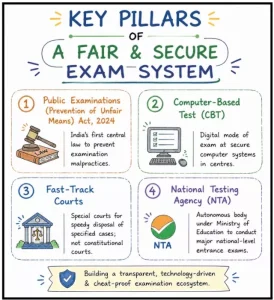
- Computer-Based Tests (CBTs): Includes CBTs within the definition of public examinations, extending statutory protection against unfair means to digital examinations.
- Special Task Force (STF): Empowers the Central Government to constitute a specialised STF for investigating examination frauds, with investigations to be completed within 2 months (60 days).
- Mandatory Fast-Track Courts: Mandates every State and Union Territory, in consultation with the Chief Justice of the High Court, to designate Special Fast-Track Courts for day-to-day trial of offences under the Act.
- Time-Bound Justice: Requires completion of trials within 3 months of filing the chargesheet. Appeals must be filed within 30 days (extendable up to 90 days) and disposed of by a two-judge High Court Bench within 3 months.
- Extended Vendor Debarment: Increases the debarment period for guilty examination service providers from 4 years to 8 years.
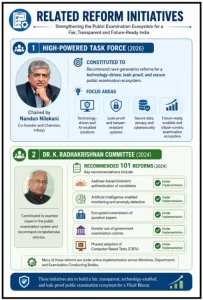 Asset Confiscation: Enables attachment and confiscation of movable and immovable property acquired through organised examination fraud.
- Institutional Accountability: Strengthens the liability of examination authorities, private vendors, and officials involved in organised examination malpractice.
Major Changes over the 2024 Act
- Individuals Using Unfair Means: Punishment enhanced from 3–5 years’ imprisonment and fine up to ₹10 lakh to 5–10 years’ imprisonment and fine up to ₹50 lakh.
- Organised Examination Crimes: Minimum imprisonment increased from 5 years to 7 years, while the minimum fine rises from ₹1 crore to ₹10 crore.
- Service Providers: Maximum penalty increased from ₹1 crore to ₹5 crore, along with recovery of examination costs and extension of debarment from 4 years to 8 years.
About the Public Examinations (Prevention of Unfair Means) Act, 2024
- It is India’s first dedicated central legislation to curb paper leaks and organised examination malpractices, ensuring fair, transparent, and credible public examinations.
- Objective: To prevent paper leaks, organised cheating, impersonation, and other unfair means in public examinations.
- Coverage: Applies to examinations conducted by UPSC, SSC, NTA, RRBs, IBPS, and other notified public authorities.
- Nature of Offences: Offences are cognizable, non-bailable, and non-compoundable.
Need for the Amendment
- Curbing Recurrent Examination Frauds: Addresses the persistent incidence of paper leaks, impersonation, and organised cheating that undermine the credibility of public examinations.
- Addressing Emerging Digital Threats: Expands the legal framework to tackle technology-enabled malpractices, including offences in Computer-Based Tests (CBTs).
- Ensuring Timely Investigation and Justice: Introduces statutory timelines for investigations and trials to minimise delays and improve enforcement.
- Strengthening Deterrence: Prescribes stricter punishments, higher monetary penalties, and asset confiscation to discourage organised examination crime.
- Protecting Merit-Based Recruitment: Preserves the fairness, transparency, and integrity of public examinations, thereby safeguarding meritocracy in recruitment and admissions.
Significance
- Enhances the Credibility of Public Examinations: Reinforces the fairness, transparency, and integrity of the examination system.
- Creates a Stronger Deterrent Framework: Enhanced punishments, extended debarment, and property confiscation significantly raise the cost of engaging in examination fraud.
- Facilitates Speedy Delivery of Justice: Time-bound investigations, mandatory Fast-Track Courts, and expedited appeals ensure quicker adjudication of offences.
- Strengthens the Security of Digital Examinations: Extends statutory safeguards to Computer-Based Tests (CBTs), promoting secure and technology-driven examinations.
- Improves Institutional Accountability: Fixes greater responsibility on examination authorities, private vendors, and public officials involved in conducting examinations.
- Restores Public Confidence: Reinforces trust in merit-based recruitment, higher education admissions, and the overall credibility of public institutions.
Click to Know UPSC Offline Courses
Conclusion
The amendment strengthens merit-based, transparent, and technology-driven public examinations through stricter enforcement, faster justice, and enhanced institutional accountability.
 1 Aug 2026