Subject: GS 2: Polity & Governance
Context: The Central Government has constituted the National Road Safety Board (NRSB) under Section 215B of the Motor Vehicles Act, 1988, amid rising road accident fatalities.
- According to the Road Accidents in India 2024 report of the Ministry of Road Transport and Highways (MoRTH), 1,77,175 people lost their lives in road accidents in 2024, the highest number recorded so far.
UPSC Course Fees Online
Reasons Behind the High Number of Road Accidents and Fatalities in India:
- Human Errors: Over-speeding, drunk driving, distracted driving, non-use of helmets/seat belts, and traffic rule violations are the leading causes.
- Unsafe Road Infrastructure: Poor road design, black spots, inadequate road signage, lack of pedestrian facilities, and poor road maintenance.
- Weak Enforcement & Governance: Inadequate enforcement of traffic laws, weak driver licensing, and poor institutional coordination among road safety agencies.
- Unsafe Vehicles & Rapid Motorisation: Poor vehicle fitness, overloaded vehicles, rapid motorisation, and mixed traffic without adequate infrastructure.
- Inadequate Post-Crash Care: Delayed emergency response, lack of trauma centres, insufficient ambulances, and poor utilisation of the Golden Hour.
|

About the National Road Safety Board (NRSB)
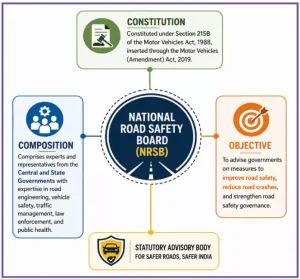
- Constitution: The National Road Safety Board (NRSB) is a statutory advisory body constituted under Section 215B of the Motor Vehicles Act, 1988, inserted through the Motor Vehicles (Amendment) Act, 2019.
- Composition: The Board comprises experts and representatives from the Central and State Governments with expertise in road engineering, vehicle safety, traffic management, law enforcement, and public health.
- Objective: To advise governments on measures to improve road safety, reduce road crashes, and strengthen road safety governance.
Mandate of the Board
- Advises the Central and State Governments on road safety matters.
- Comprises a mix of technical experts and government officials.
- Positioned as a coordinating and advisory body rather than a regulator with enforcement powers.
Associated International Framework
- UN Decade of Action for Road Safety (2021–2030): Seeks to reduce road traffic deaths and injuries by at least 50% by 2030.
- Sustainable Development Goal (SDG) 3.6: Calls for halving the number of global deaths and injuries from road traffic accidents.
- Sustainable Development Goal (SDG) 11.2: Promotes safe, affordable, accessible, and sustainable transport systems for all.
- Safe System Approach (WHO/UN): Advocates designing roads, vehicles, speeds, and post-crash care in a manner that minimises fatalities even when human errors occur.
|
Click to Know UPSC Offline Courses
Associated Constitutional and Legal Provisions
- Constitutional Provisions:
- Article 21: The Right to Life includes the right to safe roads and safe mobility, as recognised through judicial interpretation.
- Article 38: Directs the State to promote the welfare of people by securing a social order based on justice.
- Article 47: Mandates the State to improve public health, which includes preventing deaths and injuries caused by road accidents.
- Seventh Schedule: Road transport and traffic involve shared responsibilities of the Union and the States, requiring cooperative federalism for effective road safety governance.
- Legal Provisions:
- Motor Vehicles Act, 1988: Provides the legal framework for road transport, licensing, vehicle registration, road safety, and traffic regulation.
- Motor Vehicles (Amendment) Act, 2019: Introduced Section 215B, enabling the establishment of the National Road Safety Board and strengthened penalties for traffic violations.
- Central Motor Vehicles Rules, 1989: Prescribe standards relating to vehicle safety, registration, licensing, and emission norms.