UPSC PYQs

Prelims, Mains & Optional PYQs

UPSC Notes

Comprehensive & Short Notes

India–Uzbekistan Relations: Strategic to Comprehensive Strategic Partnership

31 Aug 2026

India–Uzbekistan Relations: Strategic to Comprehensive Strategic Partnership

Subject: Paper 2: International Relations 

Context: Recently, during Prime Minister Narendra Modi’s visit to Uzbekistan, India and Uzbekistan elevated their 15-year Strategic Partnership to a Comprehensive Strategic Partnership.

  • Uzbekistan conferred the ‘Oliy Darajali Do’stlik’ Order on Prime Minister Narendra Modi during his two-day state visit to Tashkent.

Best Online Coaching for UPSC

About Uzbekistan

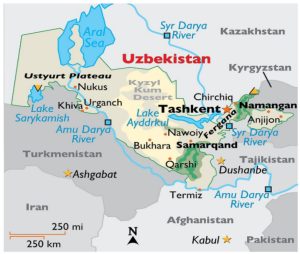
  • Location: Uzbekistan is a sovereign, doubly landlocked country located in Central Asia
    • It is bordered by Kazakhstan to the north, Kyrgyzstan to the northeast, Tajikistan to the southeast, Afghanistan to the south, and Turkmenistan to the southwest
    • It is one of only two doubly landlocked countries in the world, the other being Liechtenstein
  • Capital: Tashkent
  • Major Rivers: Amu Darya and Syr Darya are the principal rivers associated with Uzbekistan and the wider Aral Sea basin.
  • Major Resources: Uranium, gold, natural gas, copper, and other mineral resources. 
  • SCO: Uzbekistan is a member of the Shanghai Cooperation Organisation (SCO).

About India–Uzbekistan Relations

India–Uzbekistan Relations

  • Historical ties: India–Uzbekistan relations have deep historical roots, shaped by centuries of trade, cultural exchange, and people-to-people contact along the Silk Routes. 
  • Early recognition: India was among the first countries to recognise Uzbekistan’s sovereignty after its independence in 1991.
  • Diplomatic relations: The Protocol on the Establishment of Diplomatic Relations was signed in Tashkent on 18 March 1992, formally establishing diplomatic ties. 
  • Strategic Partnership: India and Uzbekistan elevated their relationship to a Strategic Partnership in 2011.
  • Trade: India is among the top 10 trade partners of Uzbekistan, with bilateral trade of USD 1.32 billion.
    • India’s major exports: Pharmaceuticals, mechanical equipment, vehicle parts, services, frozen buffalo meat, optical instruments and equipment, and mobile phones.
    • India’s major imports: Fruits and vegetables, services, fertilizers, juice products and extracts, and lubricants.

Central Asia–India Framework

  • The India-Central Asia Framework is a strategic partnership aimed at enhancing cooperation and connectivity between India and the Central Asian Republics (CARs).
  • Key Components: 
    • Connect Central Asia Policy (2012): India’s broad policy framework to deepen political, economic, cultural and strategic engagement with Central Asia.
    • India–Central Asia Dialogue: Foreign Ministers-level platform, initiated in 2019 at Samarkand, for regular political and strategic consultations.
    • India–Central Asia Summit: Heads of State/Government-level mechanism, initiated in January 2022, providing a higher-level platform for regional cooperation.
    • Connectivity: India seeks to strengthen access to Central Asia through Chabahar Port and the International North–South Transport Corridor (INSTC), helping overcome geographical and connectivity constraints.
    • Core Areas: Cooperation focuses on security, energy, trade and investment, connectivity, education, healthcare, IT, banking, and people-to-people exchanges.

Key Outcomes of the India–Uzbekistan Summit

  • Trade Target: Both sides aim to increase annual bilateral trade from the current level of over $1 billion to $5 billion by 2030.
  • Uranium Supply: Agreed to establish a long-term arrangement for uranium supply from Uzbekistan to India, supporting cooperation in the peaceful uses of nuclear energy.
  • Critical Minerals: Cooperation in geological exploration, mining, mineral processing, value-added production and recycling.
  • Defense Cooperation: Focus on direct linkages, co-development and co-production of military hardware.
  • Digital Payments: NPCI International Payments Limited and Uzbekistan’s National Interbank Processing Center agreed on a framework enabling Indian UPI apps to scan Uzbekistan’s UZQR for merchant payments.
  • Institutional Mechanisms:
    • Coordination Council at the Foreign Ministers’ level.
    • The existing Joint Commission was upgraded from the Secretary level to the Ministerial level.
    • Joint India–Uzbekistan Business Summit to strengthen commercial ties.
  • Cultural Cooperation: Letter of Intent for restoration and conservation of the Buddhist sites of Fayaz Tepa and Kara Tepa.
    • These ancient Buddhist monasteries in southern Uzbekistan highlight how Buddhism spread along the Silk Road and flourished in Central Asia.
  • Environment: India announced a $1 million grant for afforestation in the Aral Sea region.
    • Environmental cooperation reflects convergence between Uzbekistan’s Yashil Makon initiative and India’s Ek Ped Maa Ke Naam initiative.
  • Regional Cooperation: 
    • Central Asia: Strengthening the Central Asia–India format as a platform for regional engagement.
    • SCO: Cooperation through the Shanghai Cooperation Organisation on security, trade, investment and humanitarian issues.
    • United Nations: Coordination on UN reform and Security Council reform; Uzbekistan supports India’s candidature for permanent membership of the UNSC.
    • Global initiatives: Cooperation through platforms such as the International Solar Alliance (ISA) and the International Big Cat Alliance (IBCA)

Strategic Significance

  • Central Asian Outreach: The partnership strengthens India’s strategic engagement with Central Asia and Uzbekistan’s role as a key regional partner.
  • Energy Security: Long-term uranium supply from Uzbekistan helps India diversify its nuclear fuel sources.
  • Critical Minerals: Cooperation provides India with access to Uzbekistan’s critical and strategic mineral resources and associated value chains.
  • Defense Cooperation: Defense cooperation enables India and Uzbekistan to undertake joint development and production of military equipment.
  • Trade and Connectivity: Improved payment, banking and connectivity mechanisms facilitate India’s trade and investment in Central Asia.
  • Regional Security: A joint commitment to combating terrorism, extremism, and separatism strengthens regional security cooperation.

Click to Know UPSC Offline Courses

Way Forward

  • Strengthen Connectivity: Accelerate Chabahar Port and INSTC to overcome geographical constraints and reduce transport costs.
  • Expand Trade: Diversify trade in pharmaceuticals, automobiles, engineering and electrical goods to achieve the $5 billion target by 2030.
  • Build Critical-Mineral Value Chains: Promote joint exploration, processing, value addition, and recycling.
  • Deepen Defense Cooperation: Move towards co-development and co-production and strengthen joint military cooperation.
  • Improve Market Access: Address non-tariff barriers, regulatory issues and banking/payment constraints.
  • Ensure Implementation: Effectively use the Foreign Ministers-led Coordination Council and Ministerial-level Joint Commission to monitor agreements and projects.

Check Out UPSC CSE Books

Visit PW Store

online store 1

India–Uzbekistan Relations: Strategic to Comprehensive Strategic Partnership

Need help preparing for UPSC or State PSCs?

Connect with our experts to get free counselling & start preparing

Free Counselling for UPSC Aspirants

Connect with our experts and take the right next step.

Expert Guidance
Personalized Strategy
100% Free

Book Your Free Session

NEED ASSISTANCE?

Request a Callback

Our counsellor will connect with you and help you choose the right course and centre.

  • Expert Guidance
  • Course & Fee Information
  • Quick Callback Support

Request a Callback

Books
UPSC PYQs
UPSC Notes
Current Affairs
Quick Revise Now !
AVAILABLE FOR DOWNLOAD SOON
UDAAN PRELIMS WALLAH
Comprehensive coverage with a concise format
Integration of PYQ within the booklet
Designed as per recent trends of Prelims questions
हिंदी में भी उपलब्ध
Quick Revise Now !
UDAAN PRELIMS WALLAH
Comprehensive coverage with a concise format
Integration of PYQ within the booklet
Designed as per recent trends of Prelims questions
हिंदी में भी उपलब्ध

<div class="new-fform">


    </div>

    Subscribe our Newsletter
    Sign up now for our exclusive newsletter and be the first to know about our latest Initiatives, Quality Content, and much more.
    *Promise! We won't spam you.
    Yes! I want to Subscribe.