Sun’s Early Warning Signs Before Solar Flares
Context: A study using Aditya-L1 observations has identified small, short-lived brightening events that appear hours before a major solar flare and cluster around the same location where the flare later occurs.
UPSC Online Courses
About Solar Flares
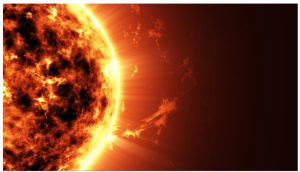
- Solar flares are sudden, intense releases of energy and electromagnetic radiation from the Sun’s atmosphere, particularly in active regions.
- Cause: They occur due to the rapid release of magnetic energy associated with the restructuring of the Sun’s magnetic fields.
- Impact: Strong flares can affect satellites, communication systems, and other critical technologies and pose risks to astronauts.
- Space weather: Solar flares are a major phenomenon driving space-weather disturbances, making reliable flare forecasting important.
Key Findings
- Pre-flare signals: Solar Ultraviolet Imaging Telescope (SUIT), particularly its Mg II h filter, detected numerous small, short-lived brightening events in active regions before major solar flares.
- Magnetic energy release: Some events showed corresponding X-ray signatures, captured by SoLEXS and HEL1OS, indicating such release.
- SoLEXS (Solar Low Energy X-ray Spectrometer) measures low-energy X-ray emissions from energetic processes in the solar corona.
- HEL1OS (High Energy L1 Orbiting X-ray Spectrometer) measures high-energy X-ray emissions from energetic solar processes.
- Spatial clustering: These transient events clustered around the location where the major flare later occurred.
- Progressive destabilization: Repeated small-scale energy releases may gradually destabilize the magnetic field in an active region, eventually leading to a major solar flare.
- Forecasting potential: The findings provide insights into the physical processes triggering solar flares and could contribute to more reliable flare and space-weather forecasting.
About Aditya-L1
- India’s first space-based solar mission, launched by ISRO to study the Sun and its atmosphere.
- Location: Positioned around the Sun–Earth L1 (Lagrange) point, about 1.5 million km from Earth.
- Purpose: Enables continuous observation of the Sun and helps study solar activity and its impact on space weather.
- Payloads: Carries 7 scientific payloads, including SUIT, SoLEXS and HEL1OS.
Barrier Lake
Context: A barrier lake formed on the Tibetan side following a glacial collapse and debris blockage has created a fresh flooding threat downstream in Nepal.
About Barrier Lake

- It is a temporary lake formed when landslide debris completely blocks a river or stream.
- Major Triggers: Earthquakes and excessive rainfall can trigger the landslides that create such natural dams.
- Vulnerable Regions: Common in steep mountainous areas with narrow river valleys, making the Himalayas particularly susceptible.
- Risk of Breach: Continued water accumulation can cause the natural dam to overflow or suddenly collapse.
- LLOF: The sudden release of stored water causes a Landslide Lake Outburst Flood (LLOF).
- LLOFs are sudden, high-velocity floods caused by the breach of lakes formed when landslides block rivers or valleys, posing severe localized hazards in mountainous regions.
- This is similar in effect to a GLOF (Glacial Lake Outburst Flood), which occurs when water dammed by a glacier or moraine is suddenly released.
Potential Impacts of Barrier Lake Breaches
- Sudden flooding: A breach can release millions of cubic meters of water rapidly, causing catastrophic downstream flooding.
- High destructive force: Floodwaters carry rocks, mud and debris, intensifying damage to settlements and infrastructure.
- Cascading hazards: The flood can trigger secondary landslides, compounding the disaster.
- Uncertain timing: Natural dams may breach within days or even decades after formation, making risk assessment difficult.
- Transboundary threat: LLOFs can travel across borders, threatening downstream communities and infrastructure.
- The 1786 Sichuan LLOF traveled nearly 1,400 km downstream and killed around 1 lakh people.
Vacuum Birefringence
Context: A study published in Nature has reported evidence of vacuum birefringence by observing highly polarised X-rays from the magnetar 1E 1547.0−5408.
About Vacuum Birefringence
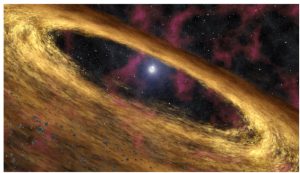
- Vacuum birefringence is a quantum phenomenon in which an extremely strong magnetic field causes the vacuum of space to behave like a birefringent crystal.
- Cause: According to Quantum Electrodynamics (QED), strong magnetic fields affect virtual electron–positron pairs in the vacuum, altering how light propagates through it.
- Effect on light: Light passing through such a region can become strongly polarised, with its behavior depending on the direction of its electric field.
- Extreme conditions: The effect becomes significant only in extremely strong magnetic fields, such as those surrounding magnetars.
UPSC Online Classes
Significance
- Tests QED: Supports a key prediction of quantum electrodynamics.
- Nature of vacuum: Shows that vacuum can behave as an active medium under extreme magnetic fields.
- Magnetar studies: Improve understanding of magnetars and their magnetic fields.
- Cosmic mapping: helps study magnetic fields and structures across the universe.
Indian Standard Time (IST) Rules, 2026
Context: Recently, the Union Government notified the Legal Metrology (Indian Standard Time) Rules, 2026, mandating IST as the common reference time for legal, administrative, commercial and official purposes, with a 180-day transition period.
Key Provisions

- Single Time Reference: IST will serve as the common reference for legal, administrative, commercial and official activities across the country.
- 180-Day Window: The Rules will become effective 180 days after Gazette publication, allowing government departments, businesses and institutions to upgrade their systems.
- Digital Synchronisation: Uniform time-stamping will support banking, digital payments, telecommunications, transport, power grids and digital governance.
- Legal Records: A common time reference will improve the reliability of government records, legal processes and time-sensitive services.
White Rabbit Technology
- Precision Synchronisation: In July 2026, the government commissioned a White Rabbit Technology-based IST Dissemination Demonstration Network at the Regional Reference Standard Laboratory (RRSL), Bengaluru.
- Function: It enables highly precise and reliable time synchronisation across geographically distributed systems.
- Applications: Banking, telecommunications, power, transportation and digital governance.
- Institutional Collaboration: Demonstrations involved CSIR-NPL, ISRO, SEBI, NSE and BSNL, showcasing secure transmission of IST between Bengaluru and Chennai.
Significance
- Reduced Dependence: Minimise reliance on foreign satellite-based time sources for critical systems.
- Indian Sources: IST will be disseminated through Indian institutions, with NavIC as an approved indigenous source.
- Critical Systems: Synchronised time supports banking, telecom, power, transport and digital governance.
- Security: Accurate time-stamping strengthens the integrity and traceability of digital transactions and records.
- Strategic Autonomy: Indigenous timing infrastructure enhances technological sovereignty and resilience.
- One Nation, One Time: Establishes a uniform and reliable national time reference.
UPSC Online Coaching
Nancy Grace Roman Space Telescope
Context: NASA’s Nancy Grace Roman Space Telescope, a next-generation space observatory, is designed to study dark energy, dark matter, cosmic expansion and exoplanets, complementing the capabilities of Hubble and James Webb.
About Roman Space Telescope

- It is a roughly $4 billion NASA project and is being developed as a follow-on to the Hubble Space Telescope and the James Webb Space Telescope.
- Named After: It is named after Nancy Grace Roman, NASA’s first chief astronomer, who played a key role in establishing NASA’s space astronomy programme.
- Launch: The telescope is planned to be launched aboard SpaceX’s Falcon Heavy rocket from the Kennedy Space Center in Florida.
- Complementary Mission: Roman is not intended to replace Hubble or Webb; rather, its capabilities will expand and complement the knowledge obtained from these pioneering observatories.
Orbit and Observational Capability
- Lagrange Point 2 (L2): It will operate around Sun–Earth L2, about 1.6 million km from Earth.
- Favourable Position: Provides a stable Sun–Earth-spacecraft geometry for efficient observations.
- Wide-Field Survey: Designed to survey large areas of the sky, unlike telescopes focused mainly on individual objects.
- Massive Survey: Expected to observe over two billion galaxies, helping trace cosmic evolution.
- Complementary to Webb: Like the James Webb Space Telescope, Roman will operate around L2, but with a much wider field of view.
Major Scientific Objectives
- Dark Energy: Roman will help investigate dark energy by measuring how the Universe has expanded over time.
- Dark Energy is a mysterious form of energy driving the accelerating expansion of the Universe.
- Dark Matter: It will study the role of dark matter in shaping the distribution and evolution of galaxies and other cosmic structures.
- Dark Matter is invisible matter inferred from its gravitational effects on galaxies and cosmic structures.
- Galaxy Evolution: Its observations will help scientists understand how stars, galaxies and clusters of galaxies formed and evolved.
- Testing Gravity: Roman will enable scientists to test whether our existing understanding of gravity remains valid at very large cosmological scales.
- Exoplanets: It will also search for and study planets beyond the Solar System, expanding knowledge of planetary systems.
- Exoplanets are planets orbiting stars beyond our Solar System.
Click to Know UPSC Coaching Centres in India
Its Significance for Astronomy
- Large-Scale Understanding: Roman will provide a much broader view of the Universe by combining large-scale surveys with precise astronomical measurements.
- Understanding Cosmic Expansion: Its observations can provide important evidence about the factors responsible for the accelerating expansion of the Universe.
- Complement to Hubble and Webb: While Hubble has provided high-resolution observations across multiple wavelengths and Webb specialises in detailed infrared observations, Roman is particularly suited to wide-field surveys.
- Mapping Cosmic Evolution: By observing billions of galaxies and their distribution, Roman can help scientists reconstruct the growth and evolution of cosmic structures.
 31 Aug 2026