Subordinate/District Judiciary
Context: The Supreme Court has asked States and Union Territories to consider extending subordinate judicial officers’ retirement age from 60 to 61 years.
- While the larger question of a uniform enhancement to 62 years across the country remains pending adjudication.
UPSC Online Courses
Structure of the Indian Judiciary
- Supreme Court: The apex court of India, headed by the Chief Justice of India, with jurisdiction over constitutional, appellate and advisory matters.
- High Courts: The highest courts at the State/Union Territory level, exercising writ, appellate and supervisory jurisdiction.
- Subordinate Courts: Include District and Sessions Courts and lower civil and criminal courts functioning under the supervision of respective High Courts.
About Subordinate/District Judiciary
- The subordinate judiciary forms the grassroots tier of India’s judicial system, functioning at district and local levels and serving as the primary point of access to justice for citizens.
- It deals with civil and criminal cases and operates under the administrative and appellate supervision of the respective High Courts.
Constitutional Provisions: Chapter VI of Part VI of the Constitution provides the constitutional framework for the subordinate judiciary.
- Article 233: The Governor appoints, posts and promotes district judges in consultation with the High Court. Direct recruits from the Bar must have at least seven years of advocacy experience.
- Article 234: Recruitment of judicial officers other than district judges is made through the State Public Service Commission and the High Court.
- Article 235: Vests control over district and subordinate courts, including posting, promotion and leave, in the respective High Court.
- Articles 236–237: Define the expression “district judge” and provide for the application of these provisions to specified classes of magistrates.
- Retirement Age at Different Levels
- Supreme Court Judges: Judges of the Supreme Court retire at 65 years under the constitutional framework.
- High Court Judges: Judges of High Courts retire at 62 years.
- Subordinate Courts: 60 years for the subordinate judiciary in most States
Kutki (Picrorhiza kurroa)
Context: Farmers in Mandi district, Himachal Pradesh have pioneered a sustainable, stolon-based cultivation method for Kutki (Picrorhiza kurroa).
About Kutki (Picrorhiza kurroa)

- A high-value medicinal herb native to the alpine and sub-alpine Himalayan regions (2,700–4,500 m).
- Used as an ingredient in over 2,000 herbal formulations.
- Conservation Status:
- IUCN status: Endangered.
- CITES status: Listed under Appendix II — permits international trade only under regulated conditions, requiring export permits to ensure trade doesn’t harm wild populations.
- Key Features
- The plant’s medicinally valuable part is its stolon, a specialised side stem that creeps along the soil surface and bears nodes, rather than its fibrous roots.
- As a high-altitude Himalayan medicinal plant, Kutki contributes to the region’s biodiversity and traditional medicinal-resource base.
- Threats
- Destructive Harvesting: Traditional collection involved uprooting the entire plant, preventing regeneration and severely reducing wild populations.
- Commercial Pressure: Rising demand from the herbal and pharmaceutical industries, combined with declining wild populations, has increased market prices and encouraged further pressure on natural populations.
The Innovation: Stolon-Based Harvesting
- A stolon is a side branch/creeping stem with nodes that grows along the soil surface — commonly (and mistakenly) believed by traditional harvesters to be the plant’s “root,” which is falsely assumed to hold the medicinal value.
- In reality, the plant’s actual roots are fibrous and possess no medicinal content; only the dried stolons carry market/medicinal value.
- The new method harvests only the stolons, leaving the mother plant intact, allowing it to regenerate and produce continuously — turning Kutki cultivation into a perennial rather than one-time/destructive activity.
PM-YASASVI
Context: The Government has reaffirmed its commitment to strengthening educational opportunities for OBC, EBC and DNT students through the PM-YASASVI Scheme.
About PM-YASASVI (Prime Minister Young Achievers Scholarship Award Scheme for Vibrant India) Scheme
- It is a central sector umbrella scholarship scheme of the Ministry of Social Justice and Empowerment.
- Origin: Launched in 2021-22 to consolidate multiple existing scholarship programs.
- Objective: To reduce financial barriers and promote inclusive, equitable and quality education.
- Key Features of PM-YASASVI
- Target Beneficiaries: Focuses on marginalised student communities, specifically OBC, EBC, and Denotified Tribes (DNT).
- Income Limit: Restricts eligibility to families earning under ₹2.5 lakh annually
- Five Sub-Schemes: Bundles of structural assistance via Pre-Matric, Post-Matric, Top Class School, Top Class College scholarships, and dedicated hostel construction.
- Financial Structure: Offers tiered aid, providing up to ₹75,000 yearly for class 9–10 and up to ₹1,25,000 for class 11–12 top school students.
- Gender Focus: Guarantees inclusivity by reserving 30% of all slots for girl students.
- NSP Application: Implements an online application process entirely routed through the National Scholarship Portal (NSP) using Aadhaar-linked One-Time Registration
UPSC Online Classes
Bab el-Mandeb Strait
Context: Yemen’s Houthi rebels announced their first-ever naval blockade targeting Saudi Arabia through the Bab el-Mandeb Strait.
About Bab el-Mandeb Strait
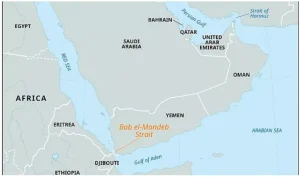
- Meaning: Bab el-Mandeb means “Gate of Tears” in Arabic.
- Location: A narrow waterway connecting the Red Sea and the Gulf of Aden.
- Lies between Yemen, Djibouti and Eritrea (Horn of Africa).
- Located at the mouth of the Red Sea, which leads to the Suez Canal—the gateway between Asia and Europe.
- At its narrowest point, it is 29 km wide, with two shipping channels for inbound and outbound traffic.
- Strategic Importance: One of the world’s most important maritime chokepoints.
- Carries around 12% of global trade.
- Around 4.1 billion barrels of oil and petroleum products (about 5% of the global total) passed through it in 2024.
- A full closure to Saudi shipping could disrupt Saudi oil exports to Asia and reduce global oil supply by around 7%.
- Acts as a key export route for Saudi oil transported through the East-West (Petroline) Pipeline, which connects the Abqaiq oil field to the Red Sea port of Yanbu.
Project Kusha
Context: DRDO successfully conducted the maiden flight-test of the indigenous Kusha Long-Range Surface-to-Air Missile from APJ Abdul Kalam Island off the coast of Odisha.
About Kusha Missile System
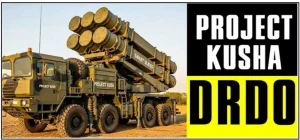
- Kusha, also known as the Extended Range Air Defence System (ERADS), is an indigenous long-range surface-to-air missile programme designed to provide India with a multi-layered air defence shield.
- Objective: To neutralise diverse aerial threats, including fighter aircraft, UAVs, cruise missiles and other high-speed aerial targets, while strengthening India’s strategic air-defence capabilities.
- Developed By: Defence Research and Development Organisation (DRDO).
- Key Features
-
- Multi-Range Interceptors: The system is planned with three interceptor variants—M1 (around 150 km), M2 (around 250 km) and M3 (around 350–400 km)—enabling interception of threats at different ranges.
- Advanced Threat Neutralisation: Kusha is designed to counter a broad spectrum of aerial threats, including stealth aircraft, unmanned aerial vehicles, cruise missiles and potentially ballistic and hypersonic threats.
- Integrated Air Defence: The system is intended to integrate with the Indian Air Force’s Integrated Air Command and Control System (IACCS), enabling coordinated detection, tracking and engagement of aerial threats.
- Strategic Significance: Indigenous development of Kusha can reduce India’s dependence on imported air-defence systems, strengthen Aatmanirbhar Bharat in Defence, and enhance the country’s ability to protect critical infrastructure and strategic assets.
Click to Know UPSC Coaching Centres in India
India’s Existing Air Defence System
- Strategic Outer Shield: The S-400 tracks and destroys fighters and ballistic missiles up to 400 km.
- Tactical Intermediate Grid: Indigenous Akash and Medium-Range Surface-to-Air Missiles neutralize threats within 25–100 km.
- Unified Digital Command: The automated Integrated Air Command and Control System fuses radar data for instant coordination.
 24 Jul 2026