Subject: GS 1: Indian Society & Social Issues
Context: Repeated examination paper leaks across India have triggered widespread protests led largely by Gen Z aspirants, demanding transparent recruitment processes, stricter anti-cheating laws, and greater accountability from authorities.
- India, with the world’s largest youth population (371 million), stands at a critical stage of its demographic dividend.
IAS coaching
About India’s Gen Z
- Generation Z comprises individuals born between 1997 and 2012, succeeding Millennials and preceding Generation Alpha.
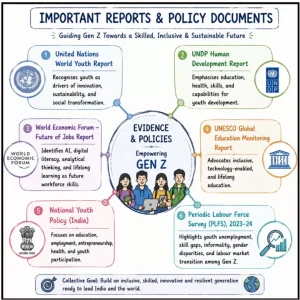
- Demographic Profile: PLFS 2023–24 estimates 29.94 crore working-age Gen Z (15–26 years) in India.
- Digital Natives: First generation to grow up with smartphones, social media, Artificial Intelligence (AI), digital payments, and high-speed internet.
- Significance: Forms India’s future workforce, entrepreneurs, innovators, consumers, and democratic participants, making it central to the country’s human capital.
Key Social Characteristics of India’s Gen Z
- Digital Natives: Digital technologies shape education, employment, communication, finance, and governance, reflecting Manuel Castells’ Network Society. Widespread use of UPI, DigiLocker, Aadhaar, and ABHA highlights seamless integration with Digital Public Infrastructure (DPI).
- Individualism: Personal autonomy, self-expression, career flexibility, and work-life balance increasingly guide life choices, reflecting Ulrich Beck’s Individualisation Theory.
- Changing Families: Delayed marriages, nuclear families, women’s financial independence, and shared household responsibilities are transforming family structures.
- Skill Orientation: Digital literacy, multidisciplinary education, continuous upskilling, and industry-relevant skills are replacing degree-centric employment, in line with NEP 2020.
- Global Outlook: Exposure to global media, digital platforms, and international work cultures has created a generation that is globally connected while rooted in local identities, reflecting Anthony Giddens’ Cultural Globalisation.
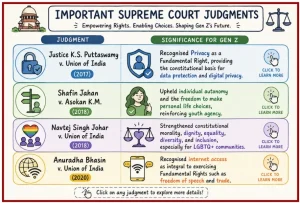
- Social Consciousness: Greater focus on climate action, gender equality, mental health, constitutional rights, diversity, and inclusion, with active participation in Mission LiFE and digital civic movements.
Why is Gen Z Important for India?

- Demographic Dividend: Represents India’s largest productive human capital, critical for economic growth, social development, and global competitiveness.
- Digital Leadership: Driving adoption of Artificial Intelligence (AI), Digital Public Infrastructure (DPI), fintech, and digital governance through platforms such as UPI, DigiLocker, Aadhaar, and ABHA.
- Social Transformation: Reshaping family structures, gender relations, career aspirations, political participation, and cultural identities through social media, digital activism, and changing workplace norms.
- Innovation Economy: Strengthening the startup ecosystem through entrepreneurship, research, and technology-led innovation in sectors such as fintech, healthtech, agritech, electric mobility, and climate technology.
Positive Contributions to Indian Society
- Innovation Ecosystem: Strengthening India’s startup ecosystem through fintech, healthtech, agritech, electric mobility, and climate technology (e.g., Razorpay, Zepto, Niramai, Ather Energy), making India the third-largest startup ecosystem globally.
- Digital Governance: Accelerating financial inclusion and citizen-centric governance through UPI, DigiLocker, CoWIN, Aadhaar, and ABHA.
- Entrepreneurial Culture: Expanding the creator economy via YouTube, Instagram, LinkedIn, Moj, and ShareChat, enabling youth to build brands and generate livelihoods.
- Gender Equality: Promoting women’s education, STEM participation, entrepreneurship, and financial independence, with increasing representation in startups, civil services, and corporate leadership.
- Democratic Participation: Strengthening issue-based civic engagement through social media campaigns, online petitions, and movements such as Mission LiFE and climate advocacy.
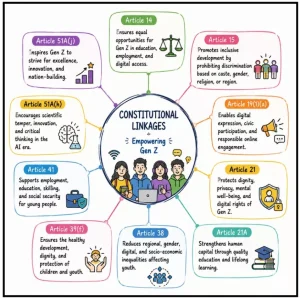
- Scientific Temper: Encouraging Artificial Intelligence (AI), innovation, scientific inquiry, and evidence-based decision-making, advancing Article 51A(h).
- Social Inclusion: Increasing acceptance of persons with disabilities, LGBTQ+ communities, mental health awareness, and diversity, supported by digital awareness campaigns.
Emerging Social Challenges
- Employment & School-to-Work Transition: PLFS 2023–24 reports 11.9% Gen Z unemployment (vs 2% among Millennials), while only 14.8% of men and 4.7% of women are in regular salaried employment, reflecting weak labour market absorption and limited quality jobs.
- Education–Employment Mismatch: Graduate unemployment stands at 29% among young men and 36.9% among young women, indicating a skill-industry mismatch. Prolonged preparation for UPSC, State PSCs, SSC, and Banking examinations further delays labour market entry.
- Informalisation & Regional Imbalances: Rising gig and platform-based employment (e.g., Blinkit, Zepto, Swiggy Instamart, Urban Company, Rapido) leaves only 20.1% of workers covered by social security. Simultaneously, Northern States remain in the demographic dividend phase, while Southern States face population ageing, increasing inter-state migration and labour market disparities.
- Gender & Mental Health Challenges: Around 27.1% of Gen Z women are engaged in unpaid domestic work (vs 0.32% of men) due to care responsibilities, safety concerns, and social norms. Academic pressure, unemployment, and digital comparison have also increased stress, anxiety, and depression, addressed through Tele-MANAS.
Digital & Technological Risks: Digital addiction, misinformation, deepfakes, and algorithm-driven echo chambers weaken social capital, while Generative Artificial Intelligence (AI) creates both productivity gains and concerns over job displacement, ethical AI, and continuous reskilling.
Impact on Indian Society
- Education: Shift towards competency-based learning, digital classrooms, online certifications (e.g., SWAYAM, NPTEL), and multidisciplinary education under NEP 2020.
- Employment: Expansion of remote work, freelancing, gig economy, platform work, and the creator economy through platforms such as Upwork, LinkedIn, and YouTube.
- Family: Rise of delayed marriages, nuclear families, shared parenting, and greater individual autonomy.
- Politics: Increased digital campaigns, online consultations, youth advocacy, and issue-based mobilisation through MyGov and social media.
- Culture: Emergence of hybrid cultural identities, alongside promotion of regional languages, local entrepreneurship, and vernacular digital content through platforms such as ShareChat and Moj.
UPSC Online Preparation
Government Initiatives for Empowering Gen Z

- Digital India Mission (2015): Expands digital infrastructure, digital literacy, and digital governance.
- Skill India Mission (2015): Enhances industry-oriented skills, employability, and vocational training.
- Startup India (2016): Promotes entrepreneurship, innovation, and the startup ecosystem.
- Atal Innovation Mission (2016): Supports innovation, incubation, and entrepreneurship through Atal Tinkering Labs and Atal Incubation Centres.
- National Apprenticeship Promotion Scheme (NAPS) (2016): Encourages industry-linked apprenticeships and practical skill development.
- National Education Policy (NEP), 2020: Promotes multidisciplinary education, experiential learning, critical thinking, and skill development.
- FutureSkills PRIME (2020): Builds capabilities in Artificial Intelligence (AI), cybersecurity, cloud computing, and other emerging technologies.
- Tele-MANAS (2022): Strengthens access to mental healthcare and psychological counselling.
- Skill India Digital Hub (2023): Provides a unified platform for digital skilling, certification, and employment opportunities.
- Prime Minister Internship Scheme (2024): Facilitates industry exposure and strengthens the school-to-work transition.
Way Forward
- Future-ready Education & Employability: Align NEP 2020, vocational education, industry-academia partnerships, apprenticeships, internships, and career counselling to strengthen the school-to-work transition.
- Quality & Inclusive Employment: Expand labour-intensive sectors, green industries, and digital services while promoting formal employment, social security, and higher women’s workforce participation through safe mobility, childcare, equal pay, and flexible work.
- Digital Inclusion & Ethical Technology: Bridge the digital divide through universal internet access and digital literacy, while strengthening Artificial Intelligence (AI) governance, data privacy, cybersecurity, and digital ethics in line with the Digital Personal Data Protection Act, 2023.
- Balanced Regional Development & Recruitment Reforms: Promote employment-intensive industrialisation in demographically young States, while ensuring timely recruitment, exam integrity, and faster vacancy filling to improve the education-to-employment transition.
- Mental Well-being & Social Resilience: Expand Tele-MANAS, institutional counselling, psychological support, and awareness programmes to build a healthy and resilient youth population.
- Inclusive & Participatory Development: Reduce regional, gender, socio-economic, and digital inequalities, while promoting youth participation in policymaking, innovation, and local governance, consistent with Articles 14, 15 & 38 and SDGs 3, 4, 5, 8, 10 & 16.
- Innovation-driven Growth: Foster entrepreneurship, startups, research, and emerging technologies to transform Gen Z into the engine of Viksit Bharat 2047.
Click to Know UPSC OnlyIAS Coaching Centres
Conclusion
Generation Z can power Viksit Bharat 2047 through quality education, productive jobs, innovation, and inclusive growth. Realising India’s demographic dividend requires empowering its youth with the skills, opportunities, and resilience to thrive.