Antyodaya in India: Inclusive Development, Last-Mile Delivery & Empowerment of Marginalized Communities

13 Jun 2026

Antyodaya in India: Inclusive Development, Last-Mile Delivery & Empowerment of Marginalized Communities

For generations, India’s most deprived communities have waited at the margins, underserved for long. This has changed over the last 12 years, with the Union Government adopting Antyodaya as its mantra. 
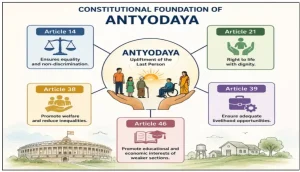
  • The approach aligns with the vision of Sabka Saath, Sabka Vikas, Sabka Vishwas by prioritizing welfare delivery to the last mile.
  • Antyodaya Diwas is an annual national observance in India celebrated on September 25. 

Best Online Coaching for UPSC

About Antyodaya (Rise of the Last Person)

  • Antyodaya means the upliftment of the last person in society, ensuring that development reaches the poorest and most marginalized sections.
  • Origin: The concept was inspired by Mahatma Gandhi’s philosophy of Sarvodaya (welfare of all) and later developed by Pandit Deendayal Upadhyaya through the idea of Integral Humanism.
  • AntyodayaCore Philosophy: Antyodaya focuses on inclusive development, where economic growth is meaningful only when it improves the lives of the weakest sections.
  • Human-Centric Development: It emphasizes dignity, self-reliance, and empowerment rather than viewing poor citizens merely as beneficiaries of welfare schemes.

Contemporary Relevance of Antyodaya 

  • Inclusive Growth: Antyodaya ensures that economic development benefits the poorest and vulnerable sections rather than only higher-income groups.
    • India’s multidimensional poverty rate declined from around 29.17% (2013-14) to 11.28% (2022-23), reflecting the impact of targeted welfare and development interventions.
  • Reducing Inequality: It addresses social and economic disparities by improving access to basic services; initiatives like Aspirational Districts Programme (2018) focus on improving indicators in health, education, agriculture, and infrastructure in 112 underdeveloped districts.
  • Poverty Eradication: Antyodaya supports poverty reduction through welfare and livelihood programmes; Pradhan Mantri Garib Kalyan Anna Yojana (PMGKAY) provides free food grains to around 80 crore beneficiaries, strengthening food security among vulnerable groups.
  • Last Mile Delivery: The philosophy emphasizes reaching benefits to remote communities; through Direct Benefit Transfer (DBT), the government transferred over ₹40 lakh crore cumulatively (as reported by government sources) directly to beneficiaries, reducing leakages and improving transparency.
  • Financial Inclusion: Antyodaya promotes access to formal finance; under Pradhan Mantri Jan Dhan Yojana (PMJDY), more than 50 crore bank accounts have been opened, bringing marginalized populations into the banking system.
  • Human Capital Development: Development of people through education, health, and skills is central to Antyodaya; programmes like Ayushman Bharat PM-JAY provide health insurance coverage of ₹5 lakh per family per year to eligible poor and vulnerable families.
  • Women Empowerment: Antyodaya recognizes women as partners in development; under Deendayal Antyodaya Yojana–National Rural Livelihood Mission (DAY-NRLM), millions of rural women have been organized into Self Help Groups (SHGs) promoting entrepreneurship and financial independence.
  • Digital Inclusion: Technology enables transparent welfare delivery; platforms like Aadhaar, UPI, and DBT have created a digital ecosystem for faster payments and reduced duplication in welfare schemes.
  • Social Justice and Dignity: Antyodaya shifts welfare from charity to empowerment by ensuring access to basic dignity; Swachh Bharat Mission built over 10 crore household toilets, improving sanitation and public health outcomes.
  • Sustainable Development Goals (SDGs): Antyodaya aligns with SDGs such as No Poverty (SDG-1), Zero Hunger (SDG-2), and Reduced Inequalities (SDG-10) by focusing on inclusive development.
  • Viksit Bharat Vision: Antyodaya supports the goal of a developed India by ensuring growth reaches the last citizen; schemes like PM Vishwakarma support traditional artisans through training, credit, and market linkage, promoting inclusive entrepreneurship.

Antyodaya Through Government Initiatives

Scheme/Initiative Target Group Objective & Key Features Impact/Data
Pradhan Mantri Janjati Adivasi Nyaya Maha Abhiyan (PM JANMAN) Particularly Vulnerable Tribal Groups (PVTGs) Launched in November 2023 to improve socio-economic conditions of isolated tribal communities through housing, water, electricity, roads, healthcare, and education. Implemented through 11 interventions by 9 ministries. Targets 75 PVTG communities across 18 states and 1 UT with a total budget outlay of ₹24,104 crore.
Eklavya Model Residential Schools (EMRS) Scheduled Tribe (ST) students Provides quality residential education, modern infrastructure, and holistic development for tribal students from Classes VI–XII in tribal-dominated areas. Expands educational opportunities and promotes inclusion of tribal youth in mainstream development.
Van Dhan Vikas Kendras (VDVKs) PVTG and tribal communities Supports collection, processing, value addition, and marketing of forest-based products, creating livelihood opportunities. Implemented with support from TRIFED, along with entrepreneurship training by NIESBUD and IIE across 15 states.
Pradhan Mantri Anusuchit Jaati Abhyuday Yojana (PM-AJAY) Scheduled Caste (SC) communities Launched in 2021 for integrated development of SC-majority villages through infrastructure creation, skill development, and livelihood support. Covers 47,334 villages across 597 districts in 26 states, benefiting over 4 crore SC citizens and 83 lakh+ households.
Development Action Plan for Scheduled Castes (DAPSC) Scheduled Caste communities Provides a framework for SC-focused expenditure planning by different ministries; ensures dedicated funds for SC welfare and development. Improves coordination and ensures targeted allocation of resources for SC development.
Scholarships for Higher Education for Young Achievers Scheme (SHREYAS) SC, OBC, and EBC students Supports higher education, research, competitive exams, and overseas studies by reducing financial barriers. In 2025–26, supported 4,156 SC students in premier institutions; 990 students received free coaching support; 72 students benefited from National Overseas Scholarship.
Pre-Matric & Post-Matric Scholarships Scheduled Caste students Provides educational financial assistance to prevent dropout and support higher education through Direct Benefit Transfer (DBT). In 2025–26, pre-matric scholarships released ₹359.47 crore, benefiting 17.14 lakh students; SC higher education enrolment reached 66.23 lakh in 2021–22, a 44% rise since 2014–15.

Role of Technology in Antyodaya

  • Transparent Welfare Delivery: Technology enables efficient and accountable delivery of government schemes through Direct Benefit Transfer (DBT), reducing leakages and ensuring benefits reach the intended beneficiaries.
  • Digital Financial Inclusion: Platforms like Aadhaar, Jan Dhan accounts, and UPI have expanded access to banking services, allowing poor and marginalized groups to participate in the formal economy.
  • Efficient Identification of Beneficiaries: Aadhaar-based authentication helps reduce duplication and improves targeting of welfare schemes by identifying genuine beneficiaries.
  • Improving Governance: Digital platforms enhance transparency, monitoring, and real-time tracking of government programmes, strengthening last-mile implementation.
  • Access to Basic Services: Technology improves access to healthcare, education, and social security through platforms like telemedicine, digital learning, and online service delivery.
  • Empowering Rural Communities: Digital tools support rural entrepreneurship, SHGs, and small businesses by improving access to markets, credit, and information.
  • Example: The JAM Trinity (Jan Dhan–Aadhaar–Mobile) has created a digital ecosystem for direct transfer of subsidies and welfare benefits, reflecting the Antyodaya vision of reaching the last person in society.

Challenges in Achieving Antyodaya

  • Last Mile Delivery Gaps: Despite large-scale welfare programmes, challenges remain in reaching the poorest and remote communities due to administrative delays, weak infrastructure, and lack of awareness; improving last-mile delivery remains a key governance challenge in India’s welfare system.
  • Digital Divide: Technology-based welfare delivery can exclude people lacking internet access, digital literacy, and connectivity; rural and tribal regions often face difficulties due to poor digital infrastructure, affecting inclusive access. 
  • Implementation Challenges: Weak monitoring, limited administrative capacity, and accountability gaps reduce the effectiveness of welfare schemes; issues like delays and leakages continue to affect grassroots delivery.
  • Regional Inequalities: Uneven development across states creates differences in access to healthcare, education, employment, and basic services, limiting uniform achievement of Antyodaya goals.
  • Beneficiary Identification Issues: While digital identification improves targeting, errors in databases and authentication challenges can create exclusion risks for deserving beneficiaries; reforms in welfare systems focus on ensuring every eligible person receives benefits. 
  • Infrastructure Constraints: Lack of adequate health centres, schools, transport facilities, and banking access in backward regions restricts the impact of welfare initiatives.
  • Sustainable Empowerment Challenge: Welfare support must move beyond assistance towards livelihood creation, skill development, and self-reliance to ensure long-term empowerment.
  • Social Barriers: Caste, gender, and social inequalities can restrict equal access to opportunities, making social inclusion and community participation essential for achieving Antyodaya.

Way Forward

  • Strengthen Local Governance: Empower Panchayats and local institutions for better implementation.
  • Improve Social Infrastructure: Increase investment in health, education, nutrition, and skill development.
  • Outcome-Based Governance: Shift focus from scheme delivery to measurable improvements in quality of life.
  • Community Participation: Encourage citizens and local organizations to participate in development processes.
  • Inclusive Digital Ecosystem: Ensure technology reaches vulnerable groups without creating new exclusions.

Click to Know UPSC Offline Courses

Conclusion

  • Antyodaya represents a development philosophy where the true measure of progress is the upliftment of the weakest section of society.
  • By combining welfare, empowerment, technology, and inclusive growth, India can achieve a development model based on dignity, opportunity, and equitable progress.

Check Out UPSC CSE Books

Visit PW Store

online store 1

Antyodaya in India: Inclusive Development, Last-Mile Delivery & Empowerment of Marginalized Communities

Explore UPSC Foundation Course

Need help preparing for UPSC or State PSCs?

Connect with our experts to get free counselling & start preparing

Aiming for UPSC?

Download Our App

      
Quick Revise Now !
AVAILABLE FOR DOWNLOAD SOON
UDAAN PRELIMS WALLAH
Comprehensive coverage with a concise format
Integration of PYQ within the booklet
Designed as per recent trends of Prelims questions
हिंदी में भी उपलब्ध
Quick Revise Now !
UDAAN PRELIMS WALLAH
Comprehensive coverage with a concise format
Integration of PYQ within the booklet
Designed as per recent trends of Prelims questions
हिंदी में भी उपलब्ध

<div class="new-fform">


    </div>

    Subscribe our Newsletter
    Sign up now for our exclusive newsletter and be the first to know about our latest Initiatives, Quality Content, and much more.
    *Promise! We won't spam you.
    Yes! I want to Subscribe.