The Economic Advisory Council to the Prime Minister (EAC-PM), in its working paper titled “Re-imagining the Care Economy: From Private Burden to Social and Economic Infrastructure”, has called for a major policy overhaul in India’s care sector.
- It proposes transforming India’s care sector from a private burden into social infrastructure to address high demand, expected to exceed 30 million care workers by 2050.
Best Online Coaching for UPSC
Key Highlights of the EAC-PM Paper
- Dedicated Care Workforce Development: Setting up a dedicated fund and building a skilled and well-remunerated care workforce.
- Establishment of Carepreneur Fund: It has suggested setting up a ‘Carepreneur Fund’ to offer finance at concessional rates to entrepreneurs and co-operatives.
- Reform in Parental Leave Policies: The paper recommended the Ministry of Labour and Employment to introduce phased reforms in parental leaves, beginning with statutory paid paternal leaves in the private sector, followed by a gender balanced parental leave policy.
- Innovative Financing for Care Infrastructure: It also emphasised the need for expansion of innovative financing for the development of care infrastructure and ‘carepreneurs’.
- Proposal for “Parivar Seva Kosh”: The paper proposed setting up an outcome-based government-to-government (G2G) fund, Parivar Seva Kosh (Family Care Fund), under the Finance Ministry.
- Underinvestment in Formal Care Economy: Despite women’s unpaid care and domestic work contributing about 15%-17% of the GDP in economic value, investments in formal care provision remain limited.
About the Care Economy
- According to the International Labour Organisation (ILO), the care economy refers to “The production and provision of goods and services that are necessary for the physical, social, emotional and intellectual well-being of people.”
- It Includes:
-
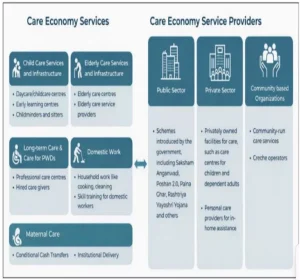
- Unpaid Care and Domestic Responsibilities: This includes household activities such as cooking, cleaning, collecting water and fuel, caring for children, the elderly, sick individuals, and persons with disabilities, along with managing everyday family needs and routines.
- Emotional and Mental Care Labour: It involves providing emotional support to family members, maintaining social and family relationships, resolving interpersonal conflicts, organizing household responsibilities, and ensuring the overall well-being of the family.
- Paid Care Work: This category covers professional caregiving occupations such as nurses, ASHA workers, Anganwadi workers, domestic workers, teachers, childcare providers, and elderly care professionals who deliver essential social and health services.
UPSC Online Courses
Importance of Investing in the Care Economy
- Employment Generation Potential of the Care Sector: The care sector can generate significant employment in both domestic and global markets with rising demand for care workers.
- Strengthening Family-friendly Social Protection: Greater investment in the care economy can deepen family-friendly policies that reduce time poverty, cushion households from childcare income shocks, especially in the informal sector, and raise caregiver labour force participation,”
- Promoting Gender Equality in Care Responsibilities: Care economy investments can redistribute unpaid care responsibilities from households to the state and markets, while gender-neutral policies can actively encourage sharing of care labour between men and women.
- Improving Human Capital Development – Quality childcare, healthcare, nutrition, and elderly support services contribute to healthier, better educated, and more productive populations, strengthening long-term economic growth.
- Supporting the Needs of an Ageing Population – Investment in geriatric care, assisted living, and long-term healthcare systems becomes essential in addressing the rising demands of India’s growing elderly population.
- Boosting Inclusive and Sustainable Economic Growth – The care economy stimulates demand, increases workforce productivity, generates income opportunities, and promotes socially inclusive development alongside economic expansion.
Applications of Artificial Intelligence in the Care Economy
- AI-enabled Assistive Technologies: AI-enabled assistive technologies address mobility, safety, and independence challenges in eldercare.
- Walkfit, an AI-powered sensor attachment for walking sticks is a low-cost innovation that detects postural asymmetry patterns to predict fall risk.
- For PwDs, tools like Trestle Labs’ Kibo language processing platform, and DeepVision Tech’s sign language translation tools are expanding access to education and employment in cost-effective ways.
- Healthcare Diagnostics and Service Delivery: AI-powered diagnostic tools, predictive analytics, and automated medical systems are improving healthcare accessibility, reducing diagnostic errors, supporting early disease detection, and addressing shortages of trained healthcare professionals, especially in rural and low-resource regions.
- Disability Support and Accessibility: AI applications such as sign-language translation tools, speech-to-text systems, language processing platforms, and assistive communication devices are enhancing educational, workplace, and social inclusion opportunities for Persons with Disabilities (PwDs).
- Early Childhood Education and Childcare: AI-driven learning platforms and adaptive educational tools are helping improve foundational literacy, numeracy, and personalized learning experiences for children by offering interactive and multilingual educational support even in underserved and remote communities.
- Care Workforce Management and Skill Development: Artificial Intelligence is assisting the care economy by enabling digital training platforms, workforce scheduling systems, performance monitoring, and skill enhancement programmes that improve the efficiency and professionalism of caregivers and healthcare workers.
- Public Policy, Governance, and Care Infrastructure Planning: Governments and institutions are increasingly using AI-based data analytics, predictive modelling, and digital governance systems to improve planning, resource allocation, policy implementation, and delivery of integrated care services across healthcare, childcare, disability support, and eldercare sectors.
Challenges
- Unique Paradox: Care work presents a unique paradox. It is one of the most socially and economically valuable activities, yet it remains largely underpaid, undercounted in standard economic metrics and characterised by limited measured productivity growth.
- Low Public Investment in Care Infrastructure: India’s inadequate spending on childcare, elderly care, and community support systems has created a major gap in accessible and affordable care services, particularly in rural and marginalized regions.
- Burden of Unpaid Care Work on Women: Women continue to shoulder disproportionate unpaid domestic and caregiving responsibilities, limiting their labour force participation and reinforcing gender inequality in society and the economy.
- Informal and Exploitative Care Workforce: Most care workers remain employed in the informal sector without proper wages, legal safeguards, social security, or dignified working conditions.
- Shortage of Skilled Care Professionals: India faces a deficit of trained nurses, caregivers, geriatric experts, and mental health professionals despite rising demand due to demographic and social changes.
- Ageing Population and Rising Dependency: The increasing elderly population and weakening joint family structures are generating growing pressure on India’s healthcare and long-term care systems.
- Urban–Rural Disparities in Care Services: Rural areas continue to lack quality healthcare, childcare, and elderly care facilities, while urban services remain costly and unevenly distributed.
- Fragmented Policy and Weak Institutional Coordination: Care-related policies are scattered across multiple ministries, resulting in poor coordination, implementation gaps, and absence of a unified care framework.
- Economic Undervaluation of Care Work: Unpaid care labour remains largely invisible in GDP calculations and policymaking despite its critical contribution to sustaining households and human development.
- Low Female Labour Force Participation: The absence of affordable childcare and family-friendly workplace policies forces many women to reduce or leave formal employment after marriage or motherhood.
- Weak Private Sector Participation: Limited investment, regulatory uncertainty, and low institutional support have restricted the growth of care entrepreneurship and organized care services in India.
- Social Stigma Around Care Services: Institutional elderly care, disability care, and mental health support often face societal stigma, discouraging families from seeking professional assistance.
- Digital Divide in Care Delivery: Unequal access to digital infrastructure and low digital literacy hinder the expansion of telemedicine, e-health, and technology-driven care solutions across India.
Way Forward
- Expand Financing for Care Infrastructure: Expand financing through public investment, public-private partnerships, and corporate social responsibility to fund multigenerational community care infrastructure.
- Encourage Carepreneurship and Care Cooperatives: Build a professional care workforce and encourage carepreneurship through standardized training, certification, incubators for care entrepreneurs, and establishing care co-operatives.
- Reform Policies Across Multiple Sectors: Review key provisions and policies across sectors such as urban planning, parental leave, and repurposing existing government facilities to create innovative care services.
- Establish Quality Assurance Standards: Establish quality assurance standards to ensure consistent service quality across public, private, and NGO providers.
- Establish national minimum quality standards for care services: The Ministry of Women and Child Development and Ministry of Social Justice and Empowerment can establish national quality standards for care facilities across public, private, and community-based providers covering staffing ratios, infrastructure norms, health and safety protocols, and service delivery guidelines.
- These standards should be differentiated by care types like childcare, eldercare and multi-generational care to reflect varying risk profiles and service needs.
- Scaling community-based workforce development: Models like Kerala’s Kudumbashree which trains local women as caregivers can address local care demand as well as livelihoods.
Sustainable Development Goal (SDG) 5: Gender Equality and Women’s Empowerment
- Eliminating Discrimination Against Women and Girls (Target 5.1) – SDG 5 seeks to abolish all forms of discrimination, exclusion, and unequal treatment faced by women and girls across social, economic, political, and cultural spheres.
- Recognising and Valuing Unpaid Care Work (Target 5.4) – The goal emphasizes acknowledging unpaid domestic and caregiving responsibilities through improved public services, social protection measures, infrastructure development, and promotion of shared household responsibilities.
- Ensuring Equal Participation and Leadership Opportunities (Target 5.5) – SDG 5 promotes women’s full, effective, and equal participation in leadership and decision-making roles across political, economic, and public institutions.
|
Initiatives Taken Regarding the Care Economy in India
| Initiative / Scheme |
Significance for the Care Economy |
| Mission Saksham Anganwadi and POSHAN 2.0 |
Strengthens childcare, nutrition services, maternal support, and early childhood care through upgraded Anganwadi infrastructure. |
| Pradhan Mantri Matru Vandana Yojana (PMMVY) |
Provides financial assistance to pregnant and lactating mothers to support maternal healthcare and reduce income insecurity. |
| PALNA Scheme and Anganwadi-cum-Crèches |
Expands daycare and crèche facilities to support working women and institutional childcare services. |
| Maternity Benefit (Amendment) Act, 2017 |
Enhances paid maternity leave, promotes workplace crèches, and improves work-life balance for women employees. |
| Mission Shakti |
Promotes women’s empowerment, social protection, and access to integrated care and support services. |
| Strengthening ASHA and Anganwadi Workforce |
Improves training, honorariums, and working conditions for frontline healthcare and nutrition workers. |
| Early Childhood Care and Education (ECCE) Initiatives |
Focuses on holistic child development, foundational learning, nutrition, and preschool education. |
Click to Know UPSC OnlyIAS Coaching Centres
Conclusion
- India stands at a demographic and economic inflection point. The rise in the elderly population, persistently low urban fertility and increasing fertility gap, combined with the stagnation of women’s labour force participation are not isolated trends – they are interconnected symptoms of a care deficit that has long been treated as a household problem rather than a national policy priority.
 7 May 2026