At the 37th Foundation Day of Small Industries Development Bank of India in Mumbai, the Union Finance Minister launched new digital portals and MSME-focused schemes.
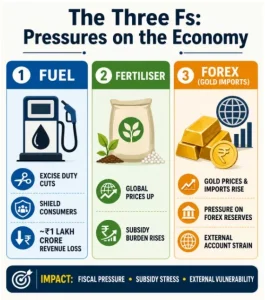
- Amid the West Asia crisis, she stressed India’s economic resilience and highlighted the importance of the “Three Fs” — Fuel, Fertiliser, and Forex.
UPSC Online Classes
About India’s MSME Sector
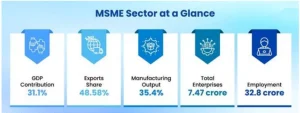
- MSMEs form the backbone of India’s industrial economy and play a vital role in promoting inclusive growth.
- Contribution: India’s MSME sector is the second-largest employer in the country after agriculture, providing jobs to over 32.82 crore people across more than 7.47 crore enterprises.
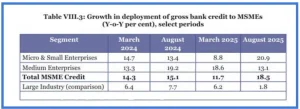 The sector accounts for roughly 31.1% of India’s GDP, 35.4% of manufacturing output, and 48.58% of total exports.
- Employment Generation: MSMEs provide employment to over 32 crore people through nearly 7.47 crore enterprises across the country.
New Strategic Initiatives Launched by SIDBI
- SIDBI MachFin Mart (Machinery Portal): Functions as a centralized, investment-ready digital B2B marketplace designed to replace obsolete, manual machinery with modern, automated assembly lines.
- It provides a transparent price discovery system and utilizes a standardization matrix with mandatory quality-benchmark filters.
- Regional Rural Bank (RRB) Co-Lending Portal: Establishes an operational, data-sharing bridge between SIDBI and RRBs to channel formal, structured capital into remote, unbanked rural micro-enterprises.
- It merges SIDBI’s capital with the extensive localized ground network of RRBs via a risk-sharing framework and features automated digital underwriting.
- MoRE (Modernisation of Rural Enterprises) Programme: A targeted, transformational three-year framework (2026–2029) designed to modernize 10,000 rural micro and artisanal units across non-farming activities using cluster-based interventions to avoid fragmented individual funding.
- Micro Credit Card Scheme: A formal financial inclusion tool providing Udyam-registered micro-enterprises with unsecured revolving operational credit of up to ₹5 lakh featuring a 75% guarantee coverage.
Major Government Initiatives for Strengthening India’s MSME Sector
- Credit Guarantee Scheme (CGS): Provides collateral-free and third-party guarantee-free credit to micro and small enterprises.
 The institutional guarantee ceiling stands enhanced from ₹5 crore to ₹10 crore for commercial banks, with special provisions offering transgender entrepreneurs a 10% concession in guarantee fees and up to 85% risk coverage. The institutional guarantee ceiling stands enhanced from ₹5 crore to ₹10 crore for commercial banks, with special provisions offering transgender entrepreneurs a 10% concession in guarantee fees and up to 85% risk coverage.
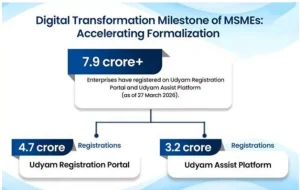
- Udyam & Udyam Assist Platform (UAP): A mass digital formalization infrastructure that brings unregistered micro-units into the formal banking fold.
- The UAP specifically registers Informal Micro Enterprises (IMEs) lacking GST documentation, granting them immediate access to low-cost Priority Sector Lending (PSL) pools. Together, the platforms have formalized over 7.9 crore small businesses.
- Self-Reliant India (SRI) Fund: Addresses the critical shortage of risk capital and equity financing faced by growth-oriented MSMEs.
- Operating through a Mother Fund–Daughter Fund structure managed by a SEBI-registered Category-II Alternative Investment Fund, it utilizes a ₹50,000 crore equity support corpus to help small units scale up without accumulating debt.
- PM Vishwakarma Scheme: Delivers end-to-end holistic support to traditional artisans across 18 manual trades (e.g., potters, weavers).
- It provides formal skill certification, a daily training stipend of ₹500, ₹15,000 toolkit e-vouchers, and collateral-free enterprise loans up to ₹3 lakh at a highly concessional 5% interest rate (backed by an 8% state interest subvention).
- TReDS & SAMADHAAN Framework: A legal-digital architecture designed to resolve the MSME working capital and liquidity crisis caused by delayed payments.
- Backed by the MSMED Act, 2006, which legally mandates invoice clearance within 45 days, it uses the Trade Receivables Discounting System (TReDS) for electronic bill discounting alongside an Online Dispute Resolution (ODR) portal for end-to-end digitized dispute adjudication.
|
Significance of New Strategic Initiatives for the Indian Economy
- Evolution of SIDBI’s Mandate: Backed by the Union Cabinet’s ₹5,000 crore additional equity support, SIDBI is transitioning from a traditional credit delivery institution into a “Market Maker” and risk-sharing partner to add 25 lakh new beneficiaries by 2028.
- Formalization of Rural Industry: By focusing on cluster-based schemes like MoRE, the initiatives bridge the productivity gap between rural manufacturing and organized urban supply chains, advancing the Viksit Bharat 2047 vision.
Click to Know UPSC Offline Courses
About Small Industries Development Bank of India (SIDBI)
- Statutory Foundation: Established on April 2, 1990, under the Small Industries Development Bank of India Act, 1989, passed by the Parliament.
- Apex Regulatory Classification: It is classified as one of India’s five All India Financial Institutions (AIFIs). It operates under the regulatory and supervisory oversight of the Reserve Bank of India (RBI), alongside NABARD, EXIM Bank, NHB, and NaBFID.
- Nodal Ministry: Functions under the Department of Financial Services, Ministry of Finance, Government of India.
- Headquarters: Lucknow, Uttar Pradesh
- Equity Structure: Originally a wholly owned subsidiary of the Industrial Development Bank of India (IDBI), its shareholding was subsequently diversified.
- Capital is now held collectively by the Government of India and state-backed institutions, including public sector banks and the Life Insurance Corporation of India (LIC).
- Statutory Mandate & Core Objectives: Under Section 13 of its founding Act, SIDBI is designated as the Principal Financial Institution for three distinct objectives concerning the micro, small, and medium enterprise (MSME) sector:
- Promotion: Cultivating entrepreneurship and formalizing traditional, unorganized village industries.
- Financing: Maximizing the flow of both debt and equity capital into credit-starved industrial segments.
- Development & Coordination: Serving as the central node to coordinate the operational functions of various state and central financial bodies engaged in small-scale industrial advancement.
- Operational Lending Framework: SIDBI deploys capital through three primary, distinct operational tracks:
- Indirect Lending (Refinancing Engine): This accounts for the overwhelming majority of SIDBI’s credit book.
- Rather than lending directly to every shop floor, SIDBI provides refinance facilities to primary lending institutions—including Commercial Banks, Small Finance Banks (SFBs), and Non-Banking Financial Companies (NBFCs)—leveraging their branches to create a credit multiplier effect.
- Direct Lending (Demonstrative Gap Financing): Designed to target specific market failures where traditional commercial banks exhibit risk-aversion.
- SIDBI directly extends term loans, production working capital, and structured asset finance to clean-energy units, high-tech manufacturing upgrades, and export-oriented micro-firms.
- Equity and Venture Capital (The Startup Track): SIDBI manages the central government’s Fund of Funds for Startups (FFS). Instead of choosing individual startups, it invests capital into SEBI-registered Alternative Investment Funds (AIFs), which are contractually mandated to deploy those pools into early-stage, innovative enterprises.
- Specialized Subsidiaries and Associate Arms: To unblock specific functional bottlenecks across the MSME lifecycle, SIDBI has set up distinct associate organizations:
- MUDRA (Micro Units Development & Refinance Agency): A wholly owned subsidiary that refinances micro-loans up to ₹10 lakh offered under the Pradhan Mantri Mudra Yojana (PMMY) across three tiers: Shishu, Kishor, and Tarun.
- CGTMSE (Credit Guarantee Fund Trust for Micro and Small Enterprises): Set up jointly with the Ministry of MSME to operate a capital pool that provides collateral-free credit guarantees to primary institutional lenders.
- RXIL (Receivables Exchange of India Limited): A specialized trade receivables platform executing the TReDS (Trade Receivables Discounting System) framework, allowing small units to auction their supply invoices to liquid banks to reduce working capital locks.
- Acuité Ratings & Research Limited: A dedicated third-party credit rating institution created to provide standardized, low-cost credit risk profiling explicitly tailored for MSME enterprises.
- Transition to a “Market Maker” (Post-2026 Strategy): Backed by an additional ₹5,000 crore equity recapitalization approved by the Union Cabinet, SIDBI’s functional paradigm has evolved.
- It has transitioned from a traditional pass-through credit house into an aggressive Market Maker and Risk-Sharing Partner. This involves deploying automated, data-centric technology tools:
- SIDBI MachFin Mart: A digital B2B marketplace that combines competitive, vendor-neutral machinery discovery directly with low-interest backend asset financing.
- RRB Co-Lending Portal: A data-sharing digital interface that blends SIDBI’s underwriting capital with the deep, localized geographic reach of Regional Rural Banks (RRBs).
- Micro Credit Card Scheme: Grants Udyam-registered micro-units immediate access to unsecured revolving operating credit up to ₹5 lakh, insulated by a 75% state guarantee cover.
- GST Sahay: An application infrastructure enabling cash-flow-based lending directly on tap by evaluating real-time, authenticated GST invoice filings instead of relying on physical collateral.
- Institutional Bottlenecks:
- Asset-Quality Challenge: Small Industries Development Bank of India must balance its developmental mandate of supporting high-risk micro enterprises with maintaining prudent underwriting standards and healthy asset quality.
- Information Asymmetry: Many rural enterprises lack formal financial records, Goods and Services Tax (GST)-linked data, and verifiable cash-flow statements, making accurate algorithm-based credit assessment difficult.
- Digital Adoption Gap: Limited digital literacy and inadequate internet connectivity may restrict the effectiveness and outreach of platform-based lending systems.
- Delayed Payment Crisis: Large pending dues from corporate entities and Public Sector Undertakings (PSUs) weaken MSME working capital cycles and dilute the impact of fresh credit infusion.
- Credit Risk in Co-Lending: Co-lending arrangements with Regional Rural Banks (RRBs) require robust local verification, monitoring mechanisms, and clear risk-sharing frameworks to prevent future Non-Performing Assets (NPAs).
|
 27 May 2026