Udaan, Prahaar, Q&A Bank etc.
CA Magazines & Editorials
 14 Aug 2026
Subject: GS 2: Polity & Governance
Context: Recently, a report prepared by World Resources Institute (WRI) India at the request of the Economic Advisory Council to the Prime Minister (EAC-PM) proposed a National Urbanisation Policy (NUP) to provide an integrated framework for India’s rapidly changing urban landscape.
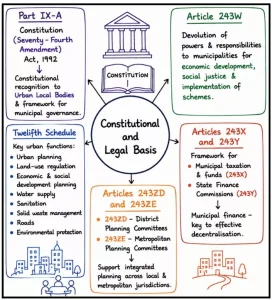
The NUP is proposed as an integrated national framework to guide India’s rapidly expanding and spatially transforming urbanisation. It seeks to move beyond isolated city-level planning towards coordinated planning across cities, small towns, Census Towns and peri-urban regions.
 Planning Reform: Promote statutory regional plans, standardised urban classification and municipalisation criteria, and stronger City-Region Planning Authorities.
 Urbanisation Beyond Municipalities: Urban growth increasingly extends into Census Towns and peri-urban settlements that may still be governed as rural areas.
| Challenge | Evidence / Example | Policy Response |
| Hidden Urbanisation | Around 7,428 small towns; many Census Towns remain under rural governance. | Standardised urban classification and municipalisation criteria |
| Peri-Urban Sprawl | Growth beyond municipal limits, including areas around Bengaluru’s Electronic City. | City-region planning |
| Fragmented Planning | Housing, transport, industry and infrastructure are often planned separately. | Statutory regional plans |
| Infrastructure Deficit | About 17% of waste remains uncollected and only around 26% is treated. | Integrated urban infrastructure and municipal services |
| Housing Shortage | Housing shortage rose from 18.78 million units in 2012 to around 29 million in 2018. | Affordable, serviced and climate-resilient housing |
| Climate Risks | Under a 3°C warming scenario, around 103 cities could face 150+ days above 35°C annually. | Climate-resilient and multi-hazard planning |
| Weak Municipal Finance | Property tax contributes only around 0.15% of Gross Domestic Product. | Strengthen the 3Fs |
| Urban Data Gap | Conventional classifications inadequately capture peri-urbanisation and rural-urban continuity. | National urban data ecosystem |
Check Out UPSC CSE Books
Visit PW Store


Connect with our experts to get free counselling & start preparing
Join India’s trusted platform for expert guidance, quality content, proven success.
Learn anytime, anywhere.



India's leading UPSC coaching platform helping aspirants prepare for IAS, IPS, IFS and other Civil Services examinations with the best faculty and proven strategies.
<div class="new-fform">
</div>