Subject: GS 2: Polity & Governance
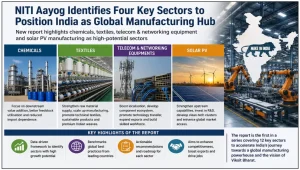
Context: Recently, NITI Aayog has released a report titled “Key Sectors to Position India as a Global Manufacturing Hub”, identifying chemicals, textiles, telecom and networking equipment, and solar photovoltaic (PV) as four high-potential sectors.
Best Online Coaching for UPSC
About Four Key Sectors

- Chemicals- Shift Towards Downstream Value Addition:
- Covers petrochemicals & organic chemicals, specialty chemicals and inorganic chemicals.
- Priorities include downstream production, better feedstock utilisation and higher investment.
- NITI Aayog’s Recommendations:
- Greater use of FTAs and stronger domestic capabilities can reduce import dependence and enhance exports.
- Textiles- Moving Towards Higher Value and Global Competitiveness:
- Contributes around 2% of GDP, 11% of manufacturing GVA and 9% of merchandise exports.
- Employs 45+ million people and is India’s second-largest employment generator after agriculture.
- India exported $37.7 billion of textiles in FY2025, accounting for 4.1% of global exports.
- Focus areas: raw-material availability, infrastructure, skilling, technology adoption and productivity.
- Recommendations: Promote technical textiles, MMF-based products, sustainable textiles and premium Indian weaves.
- Telecom & Networking Equipment – Build Domestic Components
- India is the world’s second-largest telecom market, with 1.2+ billion subscribers.
- Key priority is localisation of components and higher domestic value addition.
- Recommendations include joint ventures, technology transfers, industrial clusters, export-oriented segments, testing and certification.
- Stronger R&D and skill development can improve innovation, scale and productivity.
- Solar PV – Develop Upstream Capabilities
- India had 106 GW installed solar capacity by March 2025 and needs about 174 GW more to reach the 280 GW 2030 target.
- Domestic PV market is projected to grow at 17–20% CAGR during FY2023–FY2030.
- Priorities include upstream manufacturing, technology partnerships, R&D, performance-linked support and clean-tech clusters.
- Recommendations: Greater trade partnerships can expand solar exports and global market access.
Common Challenges Across the Four Sectors
- Low Domestic Value Addition: India needs to move from lower-value production towards higher-value manufacturing and upstream capabilities.
- Import Dependence: Dependence on imported raw materials, components and critical technologies remains a constraint in several strategic sectors.
- Technology Gap: Greater investment in Research and Development, technology transfer, innovation and skill development is required to compete with established global manufacturing hubs.
- Scale and Productivity: Indian manufacturers need greater economies of scale, modern infrastructure and productivity improvements.
- Global Market Access: Deeper trade integration, Free Trade Agreements and strategic international partnerships are necessary to expand India’s export footprint.
Coordinated Approach to Manufacturing
- Government–Industry Partnership: NITI Aayog emphasises closer coordination between government and industry to identify and address sector-specific constraints.
- Sector-Specific Strategy: A uniform manufacturing policy may not adequately address diverse sectoral requirements; interventions should therefore be tailored to sector-specific needs.
- Global Value Chains: Strengthening domestic capabilities, technology, scale and export competitiveness can enable India to move towards higher-value segments of global value chains.
- Integrated Ecosystem: Manufacturing competitiveness requires simultaneous attention to infrastructure, finance, skills, technology, logistics, standards, trade policy and market access.
Its Significance for Viksit Bharat
- Manufacturing-led growth: Stronger manufacturing can diversify India’s growth model and increase the contribution of industry to Gross Domestic Product and employment.
- Export competitiveness: Building globally competitive sectors can help India expand merchandise exports and reduce dependence on domestic demand alone.
- Import resilience: Greater domestic production of critical materials, components and technologies can strengthen economic and strategic resilience.
- Employment: Labour-intensive sectors such as textiles, along with emerging sectors such as telecom and clean technology, can generate significant employment opportunities.
- Technology upgrading: Increased Research and Development, technology partnerships and skill development can help India move towards higher-value manufacturing.
- Green transition: Strengthening solar photovoltaic manufacturing can support India’s clean-energy transition and its emergence as a global clean-technology manufacturing hub.
Way Forward
- Focus on value addition: Shift from volume-based manufacturing towards high-value, technology-intensive and knowledge-driven production.
- Strengthen domestic ecosystems: Develop integrated ecosystems covering raw materials, components, manufacturing, Research and Development, logistics and skilled manpower.
- Deepen trade integration: Use Free Trade Agreements and strategic trade partnerships to secure global markets for Indian manufacturers.
- Boost Research and Development: Increase public and private investment in research, innovation and technology development.
- Develop sectoral clusters: Create specialised industrial and clean-technology clusters with shared infrastructure, testing facilities and skilled manpower.
- Ensure policy coordination: Align industrial, trade, infrastructure, skilling and investment policies to create a predictable manufacturing environment.
Click to Explore UPSC Offline Coaching
Conclusion
The four sectors identified by NITI Aayog can strengthen India’s manufacturing base through higher value addition, technology, skills, stronger supply chains and exports, helping India move up global value chains and advance Viksit Bharat.