UPSC PYQs

Prelims, Mains & Optional PYQs

UPSC Notes

Comprehensive & Short Notes

Forest Fires in India: Causes, Himalayan Risks and Mitigation Measures

17 Aug 2026

Forest Fires in India: Causes, Himalayan Risks and Mitigation Measures

Subject: GS Paper 3: Disaster Management

Context: A Parliamentary Standing Committee has recommended measures to improve the monitoring, regulation, and management of forest fires.
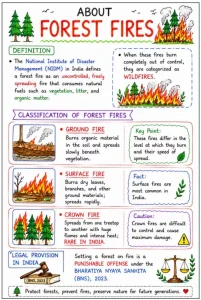
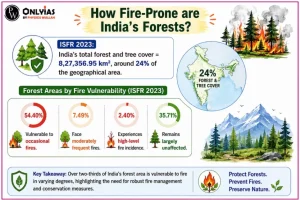
  • The recommendations were made in the report ‘Forest Fires in the Himalayan Region, its adverse effects and mitigation measures’, tabled in both Houses of Parliament.

UPSC Course Fees Online

Forest Fires in India

Key Recommendations of the Parliamentary Committee

  • Climate–Fire Study: Conduct region-specific studies to establish an empirical link between climate change and forest-fire frequency, examining temperature trends, precipitation, and dry spells.
  • NDRF Response Centers: Take a time-bound decision on establishing at least two regional NDRF response centers dedicated to forest fires in the Himalayan region.
  • National Pine-Needle Utilisation Policy: Identify zones and provide fiscal and market-access incentives for pine-needle collection.
  • Geostationary Satellite: Prioritise its launch for round-the-clock forest-fire monitoring.

Causes of Forest Fires

  • Anthropogenic Causes: Most forest fires are human-induced, linked to agricultural practices and unregulated land use.
    • Burning forests to promote good-quality grass.
    • Covering illegal tree cutting and poaching activities.
    • Electricity cables coming into contact with dry leaves.
    • Shifting cultivation (Jhum).
  • Natural Causes: Lightning is a major natural trigger of forest fires.
  • Region-Specific Drivers (NDMA): 
    • Western Himalayas: Accumulation of pine needles.
    • Central-Western India: The collection of Mohua leaf (tendu patta)
    • Northeast India: The cultivation of shifting cultivation (jhum cultivation)
  • Climate Change as an Intensifier: Climate change can increase the frequency, intensity and duration of forest fires through:
    • Forest Fires in IndiaRising temperatures, Erratic rainfall, Prolonged dry spells, Increased lightning activity.

Why are Himalayan Forests Particularly Vulnerable to Forest Fires?

  • High Fire Incidence: The Western and Eastern Himalayas constitute about 17% of India’s landmass but account for 57% of forest-fire incidents.
  • Dry and Hot Conditions: In the Western Himalayas, pre-monsoon heat and atmospheric dryness increase fire risk, while in the Eastern Himalayas, dryness and cultivation-linked burning practices contribute to fire risk.
  • Pine Forests as Fire-Prone Ecosystems: Chir pine, widely distributed in the Himalayan belt, is highly flammable.
    • Its dry, resin-rich needles, locally called Pirul, accumulate on the forest floor, forming a continuous layer of combustible material.
    • The accumulated dry needles can be ignited by a small spark, allowing fire to spread rapidly, particularly when combined with dry weather and human ignition.

Monitoring, Prevention and Management of Forest Fires In India

  • Forest Fire Monitoring: Currently, active fire monitoring relies on foreign polar-orbiting satellites, which observe India about eight times a day, leaving gaps in monitoring.
  • Role of Forest Survey of India: The Forest Survey of India (FSI) provides satellite-based forest-fire alerts to State Forest Departments and registered mobile users.
    • It currently uses AQUA and Suomi-NPP satellites for fire alerts.
  • FSI Van Agni Geo-Portal: Used by the Forest Protection Division to monitor and track large forest fires across States and Union Territories.
  • Institutional Framework: 
    • Ministry of Environment, Forest and Climate Change (MoEFCC): It is the nodal ministry for disaster management related to forest fires, among other specified hazards.
    • State Governments: Since forests are primarily managed by State Forest Departments, the primary responsibility for forest-fire prevention and management lies with the States.
  • Government Support: The Ministry of Environment, Forest and Climate Change provides financial assistance to States and Union Territories through:
    • Forest Fire Prevention and Management Scheme
    • Development of Wildlife Habitats
    • Compensatory Afforestation Fund Management and Planning Authority (CAMPA)
  • Key Prevention and Management Measures: 
    • Watch towers and fire watchers for early detection.
    • Fire lines to restrict the spread of fires.
    • Water conservation structures to improve moisture availability.
    • Local community participation in prevention and response.
    • Remote sensing and MODIS (Moderate Resolution Imaging Spectroradiometer) satellite data for detecting active fires.
  • Fire Lines: Fire lines are strips created in forests to break the continuity of vegetation and fuel, thereby slowing down or stopping the spread of a forest fire.  There are two types of fire lines:
    • Kachha or Covered Fire Lines: Undergrowth and shrubs are removed while trees are retained. They help reduce the available fuel load.
    • Pucca or Open Fire Lines: Clear-felled strips are created between forests, compartments, or blocks. They help check the spread of fires.
  • Remote Sensing and GIS: Satellite-based remote sensing and Geographic Information System technologies help in Early warning in fire-prone areas, Real-time monitoring of forest fires, and mapping burnt areas and fire scars.

About the National Action Plan on Forest Fires, 2018

  • Prepared by the Ministry of Environment, Forest and Climate Change (MoEFCC) to strengthen forest-fire prevention and management in India.
  • Objective: To minimise forest fires by informing, enabling and empowering forest-fringe communities and incentivising them to work with State Forest
  • The National Action Plan on Forest Fires (NAPFF) provides a framework for strengthening forest-fire management through:
    • Standardisation of protocols for estimating losses caused by forest fires.
    • Development and upgrading of firefighting equipment and protective clothing.
    • Training and capacity building of forest-fire personnel.
    • Strengthening post-fire management and restoration.
    • Promoting research and knowledge management on forest fires, invasive species, and climate-change-related vulnerability.

IAS coaching

Key Issues and Challenges

  • Inadequate Prevention: Limited mapping of fire-prone areas, inadequate information on forest fuel characteristics, and insufficient funding for preventive measures.
  • Gaps in Detection: Time lag in satellite-based detection, inadequate digitization of forest infrastructure, and limited ground-based detection systems.
  • Difficult Suppression: Hilly terrain, poor availability of water sources, inadequate firefighting equipment, shortage of trained personnel, and limited protective gear.
  • Weak Institutional Coordination: Need for better coordination among forest departments, disaster-management agencies, local administration, and communities.
  • Limited Post-fire Management: Lack of standardised damage assessment, site-specific restoration strategies, and adequate understanding of the long-term ecological impacts of forest fires.
  • Climate Change: Rising temperatures and changing climatic conditions can increase forest-fire vulnerability and the duration or intensity of fire seasons.
  • Community Participation: Greater involvement of local communities is required in prevention, early detection, and suppression

Way Forward

  • Adopt a Risk-Based Approach: Develop forest-fire risk maps and vulnerability assessments and integrate them into annual forest-management and disaster-preparedness plans.
  • Build an integrated Prevention and response system: Combine satellite monitoring, drones, ground patrols, and community reporting with improved firefighting infrastructure, trained personnel, and a clear Incident Response System.
  • Strengthen community and climate resilience: Involve forest-fringe communities in prevention and early response, while integrating temperature, rainfall, and drought trends into fire-risk assessment and preparedness.
  • Promote landscape restoration: Implement the Gandhinagar Implementation Roadmap (GIR) to strengthen the restoration of landscapes affected by forest fires and mining under the G20 Global Land Initiative.

Click to Know UPSC Coaching Centres in India

Check Out UPSC CSE Books

Visit PW Store

online store 1

Forest Fires in India: Causes, Himalayan Risks and Mitigation Measures

Need help preparing for UPSC or State PSCs?

Connect with our experts to get free counselling & start preparing

Free Counselling for UPSC Aspirants

Connect with our experts and take the right next step.

Expert Guidance
Personalized Strategy
100% Free

Book Your Free Session

NEED ASSISTANCE?

Request a Callback

Our counsellor will connect with you and help you choose the right course and centre.

  • Expert Guidance
  • Course & Fee Information
  • Quick Callback Support

Request a Callback

Books
UPSC PYQs
UPSC Notes
Current Affairs
Quick Revise Now !
AVAILABLE FOR DOWNLOAD SOON
UDAAN PRELIMS WALLAH
Comprehensive coverage with a concise format
Integration of PYQ within the booklet
Designed as per recent trends of Prelims questions
हिंदी में भी उपलब्ध
Quick Revise Now !
UDAAN PRELIMS WALLAH
Comprehensive coverage with a concise format
Integration of PYQ within the booklet
Designed as per recent trends of Prelims questions
हिंदी में भी उपलब्ध

<div class="new-fform">


    </div>

    Subscribe our Newsletter
    Sign up now for our exclusive newsletter and be the first to know about our latest Initiatives, Quality Content, and much more.
    *Promise! We won't spam you.
    Yes! I want to Subscribe.