UPSC PYQs

Prelims, Mains & Optional PYQs

UPSC Notes

Comprehensive & Short Notes

News In Shorts 01 October 2026: GEC-III, NCM 2.0, Sengol, UPSC & CAG

1 Oct 2026

News In Shorts 01 October 2026: GEC-III, NCM 2.0, Sengol, UPSC & CAG

Green Energy Corridor Phase III (GEC-III)

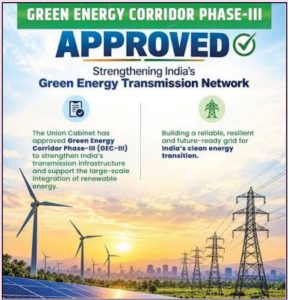
Context: Recently, the Union Cabinet approved Green Energy Corridor Phase III (GEC-III) with a total outlay of ₹1,86,405 crore to strengthen renewable energy transmission infrastructure.
UPSC Online Courses

About Green Energy Corridor Scheme

Green Energy Corridor Phase III

  • The Green Energy Corridor (GEC) is a central infrastructure initiative aimed at integrating renewable energy into the national grid through dedicated transmission networks.
  • Objective: To facilitate the evacuation of renewable electricity, reduce grid congestion, manage renewable energy intermittency and strengthen long-term energy security.
  • Nodal Body: The Ministry of New and Renewable Energy (MNRE) is the nodal ministry, while State Transmission Utilities (STUs) serve as the overall implementing agencies.
  • Phases
    • Phase I: Focused on eight renewable-rich states to integrate approximately 24 GW of renewable energy capacity.
    • Phase II: Expanded transmission infrastructure across seven states to evacuate approximately 20 GW of renewable power.
    • Phase III: Approved in 2026, it aims to develop intra-state transmission infrastructure to evacuate up to 135 GW of renewable energy by FY 2032–33.
  • Key Components of Phase III
    • Intra-State Transmission Infrastructure: An allocation of ₹1,36,378 crore will support the development and strengthening of Intra-State Transmission Systems (InSTS) across States and Union Territories.
    • Battery Energy Storage Systems (BESS): An allocation of ₹50,000 crore will support the deployment of 50 GWh of BESS to address intermittency, grid congestion, peak-hour curtailment and non-solar-hour demand.
    • Central Financial Assistance (CFA): The scheme provides ₹54,082 crore in Central Financial Support to offset intra-state transmission charges and help reduce electricity costs for consumers.
  • Implementation Framework:
    • Tariff-Based Competitive Bidding (TBCB): Projects are awarded through competitive bidding, where developers quote tariffs and the lowest eligible bid generally determines the selection.
      • Greenfield projects will be implemented through TBCB.
    • Cost-Plus Basis (CPB): Project costs are reimbursed along with an approved return, subject to regulatory scrutiny and cost-recovery rules.
      • Brownfield upgrades will follow a Cost-Plus Basis (CPB).
    • Build-Own-Operate-Maintain (BOOM): A private transmission service provider builds, owns, operates and maintains the transmission infrastructure under a long-term contractual arrangement.
      • Transmission Service Providers will execute TBCB projects under the Build-Own-Operate-Maintain (BOOM) model.
  • Significance: The scheme will support India’s target of 900 GW of installed non-fossil fuel capacity by 2035, strengthen energy security, reduce carbon emissions and generate employment in the power sector.


National Coastal Mission (NCM) 2.0

Context: The Ministry of Environment, Forest and Climate Change (MoEFCC) launched the Guidelines for implementation of the National Coastal Mission (NCM) 2.0.
About National Coastal Mission (NCM)

National Coastal Mission

  • Launch: Launched in 2014 under the National Action Plan on Climate Change (NAPCC).
  • Objective: To address the impacts of climate change on coastal and marine ecosystems, infrastructure and communities through adaptation and mitigation measures.

About NCM 2.0

  • It is a Central Sector Scheme implemented under the National Coastal Management Programme.
  • Financial Outlay: Approved with an outlay of ₹767 crore.
  • Implementation Period: To be implemented up to 2030–31.
  • Geographical Coverage: Covers 9 coastal States and 4 Union Territories.
  • Implementing Agencies: State Governments of coastal States and UT Administrations. 
  • Key Components:
    • Conservation of Mangroves and Coral Reefs through Management Action Plans.
    • Research and Development in marine and coastal ecosystems.
    • Sustainable Development of Beaches under the Beach Environment & Aesthetic Management Service.
    • Capacity Building and Outreach for coastal States/UTs, including beach-cleaning drives.

UPSC Online Classes

Sengol

Context: The new NCERT Class 9 Social Science textbook discusses the Sengol and various traditional ideas associated with governance in India. 

Key Points

Sengol

  • Sengol: A ceremonial sceptre associated with Tamil Shaivite traditions, representing righteous governance and authority.
  • Independence, 1947: The textbook states that Jawaharlal Nehru received the Sengol from Adheenam saints at midnight on 15 August 1947 to mark India’s Independence.
  • Chola Connection: The textbook traces the tradition of using the Sengol as a symbol of righteous governance to the Chola period.
  • Parliament, 2023: The Sengol was installed in the new Parliament building in 2023.

Other Important References in the Textbook

  • Satyameva Jayate: India’s National Motto derived from the Mundaka Upanishad.
  • Yato Dharmastato Jayah: Motto of the Supreme Court of India meaning “Where there is righteousness, there is victory” and linked to the Mahabharata.
  • Ram Rajya: Mahatma Gandhi’s idea of ideal governance based on probity, transparency, compassion and welfare, with references to the Ramayana and Ramcharitmanas.


Union Public Service Commission (UPSC)

Context: On 1 October 2026, UPSC marked its Centenary, commemorating 100 years since the establishment of the Public Service Commission in 1926.

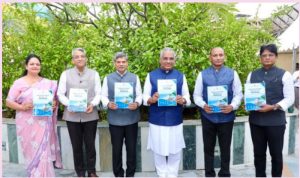
  • Commemorative Releases: The Prime Minister released a UPSC Centenary Commemorative Coin, Commemorative Stamp, and the book 100 Landmark Judgements.

About Union Public Service Commission (UPSC)

  • UPSC is India’s premier constitutional body responsible for conducting examinations and making recruitment-related recommendations for various Union civil services and posts.
  • Origin: The Public Service Commission was established on 1 October 1926 on the recommendations of the Lee Commission (1924).
    • After Independence, it was constituted as the Union Public Service Commission under the Constitution.
  • Constitutional Status
    • Articles 315–323 (Part XIV) provide for Public Service Commissions for the Union and the States.
    • Article 315 provides for a Public Service Commission for the Union and a State Public Service Commission for each State, with provision for Joint State PSCs.
  • Composition & Tenure
    • The President of India appoints the Chairman and other members of UPSC.
    • Under Article 316, a member holds office for six years or until attaining 65 years of age, whichever is earlier.
  • Key Role
    • UPSC conducts examinations such as the Civil Services Examination, Engineering Services Examination and Combined Defence Services Examination.
    • Under Article 320, it performs functions including advising on recruitment methods, appointments, promotions, transfers and disciplinary matters.

Click to Know UPSC Coaching Centres in India

CAG-BHASHINI Anuvaad

Context: Recently, DIBD and CAG launched CAG-BHASHINI Anuvaad to enable secure, AI-powered multilingual translation of official audit documents.

About CAG-BHASHINI Anuvaad

  • CAG-BHASHINI Anuvaad is an AI-enabled document translation solution customised for the Comptroller and Auditor General of India (CAG).
  • Objective: To make official CAG documents and audit-related reports available more efficiently in Indian languages.
  • Developed By: The solution was developed by the Digital India BHASHINI Division (DIBD) in collaboration with the Office of the CAG.
    • DIBD functions under the Digital India Corporation, under the Ministry of Electronics and Information Technology (MeitY).
  • Key Features
    • Contextual Translation: The platform provides consistent and contextual translations suited to the specialised terminology used in financial, legal and audit documents.
    • Multilingual Accessibility: It enables translation of official CAG documents, administrative files and audit-related reports into Indian languages.
    • This can improve citizens’ access to information relating to public expenditure and financial accountability.
    • Data Security and Sovereignty: The platform incorporates controlled access, data-security safeguards and data-sovereignty requirements.
    • These safeguards are important because CAG documents may contain sensitive institutional and audit information.
    • Human Oversight: AI-based translation is intended to support existing institutional workflows, while human review can ensure accuracy and quality in official documents.
  • Significance: The initiative combines language technology with public-sector auditing, potentially reducing language barriers in accessing government accountability information.

Check Out UPSC CSE Books

Visit PW Store

online store 1

News In Shorts 01 October 2026: GEC-III, NCM 2.0, Sengol, UPSC & CAG

Need help preparing for UPSC or State PSCs?

Connect with our experts to get free counselling & start preparing

Free Counselling for UPSC Aspirants

Connect with our experts and take the right next step.

Expert Guidance
Personalized Strategy
100% Free

Book Your Free Session

NEED ASSISTANCE?

Request a Callback

Our counsellor will connect with you and help you choose the right course and centre.

  • Expert Guidance
  • Course & Fee Information
  • Quick Callback Support

Request a Callback

Books
UPSC PYQs
UPSC Notes
Current Affairs
Quick Revise Now !
AVAILABLE FOR DOWNLOAD SOON
UDAAN PRELIMS WALLAH
Comprehensive coverage with a concise format
Integration of PYQ within the booklet
Designed as per recent trends of Prelims questions
हिंदी में भी उपलब्ध
Quick Revise Now !
UDAAN PRELIMS WALLAH
Comprehensive coverage with a concise format
Integration of PYQ within the booklet
Designed as per recent trends of Prelims questions
हिंदी में भी उपलब्ध

<div class="new-fform">


    </div>

    Subscribe our Newsletter
    Sign up now for our exclusive newsletter and be the first to know about our latest Initiatives, Quality Content, and much more.
    *Promise! We won't spam you.
    Yes! I want to Subscribe.